

98
5 Life Cycle Assessment of Chemical Products and Processes
• Gain in social acceptance: Through successfully increasing social acceptance of
a product or process, faster regulatory approval procedures can often be expected,
meaning less time until the product is on the market and until the cash inflow can
become positive.
However, when not properly applied, integrated development can potentially have
direct, negative impacts on the NPV such as:
• Maximization of solely safety, human health, and environmental protection: In
this case, financial trade-offs are not considered carefully and will result in losing
synergies with the business side of the project, higher total costs, and a negative
impact on the NPV.
• Safety and environmental protection addressed after development: If integrated
development is not followed from early stages of the design process, this can lead
to additional costs that reduce the NPV, including (i) loss of valuable resources
resulting from increased waste and emissions, (ii) additional investment costs
for extra disposal facilities that could have been avoided, and (iii) additional
operating and maintenance costs that could have been avoided.
As with LCA and any other type of assessment, it is important to also analyze
and consider the sensitivity of the variables and inputs involved. In the case
of calculating NPV, a sensitivity analysis can be performed to account for the
uncertainty of expected costs and to compare actual costs with theoretical optimum
values. For example, the effect of changing the product price or sales volume (by ±
X%) will lead to a specific change in the NPV (by ± Y %).
5.8.3 Calculating Eco-Efficiency
If a chemical product or process has been evaluated both for its value added (e.g.,
through calculating the NPV) and for the life cycle impacts it has on human health
and the environment (through completion of an LCA), these two quantities can be
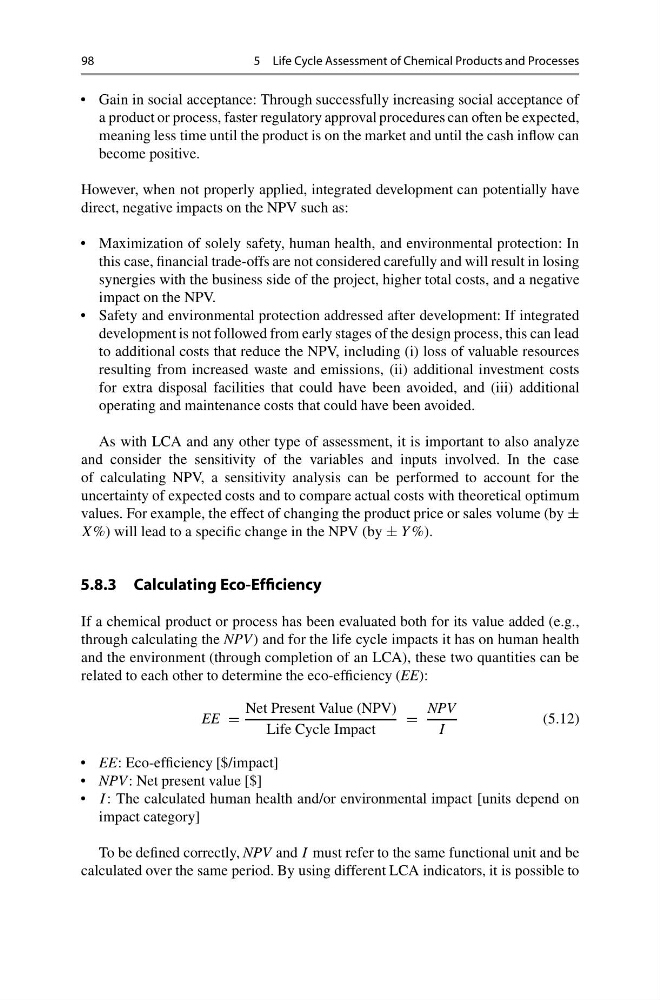
related to each other to determine the eco-efficiency (EE):
EE =
Net Present Value (NPV)
Life Cycle Impact
=
NPV
I
(5.12)
• EE: Eco-efficiency [$/impact]
• NPV: Net present value [$]
• I : The calculated human health and/or environmental impact [units depend on
impact category]
To be defined correctly, NPV and I must refer to the same functional unit and be
calculated over the same period. By using different LCA indicators, it is possible to
5 Life Cycle Assessment of Chemical Products and Processes
• Gain in social acceptance: Through successfully increasing social acceptance of
a product or process, faster regulatory approval procedures can often be expected,
meaning less time until the product is on the market and until the cash inflow can
become positive.
However, when not properly applied, integrated development can potentially have
direct, negative impacts on the NPV such as:
• Maximization of solely safety, human health, and environmental protection: In
this case, financial trade-offs are not considered carefully and will result in losing
synergies with the business side of the project, higher total costs, and a negative
impact on the NPV.
• Safety and environmental protection addressed after development: If integrated
development is not followed from early stages of the design process, this can lead
to additional costs that reduce the NPV, including (i) loss of valuable resources
resulting from increased waste and emissions, (ii) additional investment costs
for extra disposal facilities that could have been avoided, and (iii) additional
operating and maintenance costs that could have been avoided.
As with LCA and any other type of assessment, it is important to also analyze
and consider the sensitivity of the variables and inputs involved. In the case
of calculating NPV, a sensitivity analysis can be performed to account for the
uncertainty of expected costs and to compare actual costs with theoretical optimum
values. For example, the effect of changing the product price or sales volume (by ±
X%) will lead to a specific change in the NPV (by ± Y %).
5.8.3 Calculating Eco-Efficiency
If a chemical product or process has been evaluated both for its value added (e.g.,
through calculating the NPV) and for the life cycle impacts it has on human health
and the environment (through completion of an LCA), these two quantities can be
related to each other to determine the eco-efficiency (EE):
EE =
Net Present Value (NPV)
Life Cycle Impact
=
NPV
I
(5.12)
• EE: Eco-efficiency [$/impact]
• NPV: Net present value [$]
• I : The calculated human health and/or environmental impact [units depend on
impact category]
To be defined correctly, NPV and I must refer to the same functional unit and be
calculated over the same period. By using different LCA indicators, it is possible to