

90
5 Life Cycle Assessment of Chemical Products and Processes
(and least) important. Experts can be consulted to help do this, and setting political
targets or societal priorities can also be used.
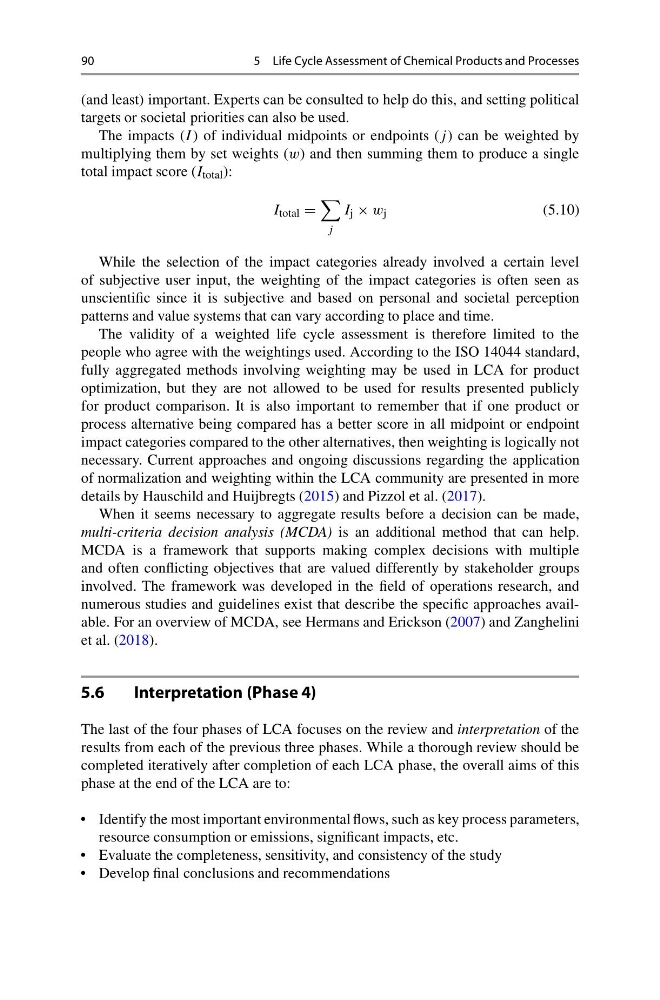
The impacts (I ) of individual midpoints or endpoints (j ) can be weighted by
multiplying them by set weights (w) and then summing them to produce a single
total impact score (I total ):
I total =
j
I j × w j
(5.10)
While the selection of the impact categories already involved a certain level
of subjective user input, the weighting of the impact categories is often seen as
unscientific since it is subjective and based on personal and societal perception
patterns and value systems that can vary according to place and time.
The validity of a weighted life cycle assessment is therefore limited to the
people who agree with the weightings used. According to the ISO 14044 standard,
fully aggregated methods involving weighting may be used in LCA for product
optimization, but they are not allowed to be used for results presented publicly
for product comparison. It is also important to remember that if one product or
process alternative being compared has a better score in all midpoint or endpoint
impact categories compared to the other alternatives, then weighting is logically not
necessary. Current approaches and ongoing discussions regarding the application
of normalization and weighting within the LCA community are presented in more
details by Hauschild and Huijbregts (2015) and Pizzol et al. (2017).
When it seems necessary to aggregate results before a decision can be made,
multi-criteria decision analysis (MCDA) is an additional method that can help.
MCDA is a framework that supports making complex decisions with multiple
and often conflicting objectives that are valued differently by stakeholder groups
involved. The framework was developed in the field of operations research, and
numerous studies and guidelines exist that describe the specific approaches available. For an overview of MCDA, see Hermans and Erickson (2007) and Zanghelini
et al. (2018).
5.6
Interpretation (Phase 4)
The last of the four phases of LCA focuses on the review and interpretation of the
results from each of the previous three phases. While a thorough review should be
completed iteratively after completion of each LCA phase, the overall aims of this
phase at the end of the LCA are to:
• Identify the most important environmental flows, such as key process parameters,
resource consumption or emissions, significant impacts, etc.
• Evaluate the completeness, sensitivity, and consistency of the study
• Develop final conclusions and recommendations
5 Life Cycle Assessment of Chemical Products and Processes
(and least) important. Experts can be consulted to help do this, and setting political
targets or societal priorities can also be used.
The impacts (I ) of individual midpoints or endpoints (j ) can be weighted by
multiplying them by set weights (w) and then summing them to produce a single
total impact score (I total ):
I total =
j
I j × w j
(5.10)
While the selection of the impact categories already involved a certain level
of subjective user input, the weighting of the impact categories is often seen as
unscientific since it is subjective and based on personal and societal perception
patterns and value systems that can vary according to place and time.
The validity of a weighted life cycle assessment is therefore limited to the
people who agree with the weightings used. According to the ISO 14044 standard,
fully aggregated methods involving weighting may be used in LCA for product
optimization, but they are not allowed to be used for results presented publicly
for product comparison. It is also important to remember that if one product or
process alternative being compared has a better score in all midpoint or endpoint
impact categories compared to the other alternatives, then weighting is logically not
necessary. Current approaches and ongoing discussions regarding the application
of normalization and weighting within the LCA community are presented in more
details by Hauschild and Huijbregts (2015) and Pizzol et al. (2017).
When it seems necessary to aggregate results before a decision can be made,
multi-criteria decision analysis (MCDA) is an additional method that can help.
MCDA is a framework that supports making complex decisions with multiple
and often conflicting objectives that are valued differently by stakeholder groups
involved. The framework was developed in the field of operations research, and
numerous studies and guidelines exist that describe the specific approaches available. For an overview of MCDA, see Hermans and Erickson (2007) and Zanghelini
et al. (2018).
5.6
Interpretation (Phase 4)
The last of the four phases of LCA focuses on the review and interpretation of the
results from each of the previous three phases. While a thorough review should be
completed iteratively after completion of each LCA phase, the overall aims of this
phase at the end of the LCA are to:
• Identify the most important environmental flows, such as key process parameters,
resource consumption or emissions, significant impacts, etc.
• Evaluate the completeness, sensitivity, and consistency of the study
• Develop final conclusions and recommendations