

5.5 Impact Assessment (Phase 3)
89
• A reference state, e.g., natural background pollution, current environmental
impact for an area, etc.
• Critical values, e.g., legal limits, scientifically defined acceptable limits, etc.
• A reference product, reference process, etc.
The impact from an individual impact category j (I j ) is therefore set in relation to
the impact of that category for the reference system (I ref ). This yields the normalized
impact (NI j ):
NI j =
I j
I ref
(5.9)
Within the ReCiPe impact assessment method (Huijbregts et al., 2017), the global
annual impacts in the year 2000 are available as reference systems for normalization.
The total calculated impacts that took place globally in that year for each impact
category were calculated and used to define the corresponding normalization factor
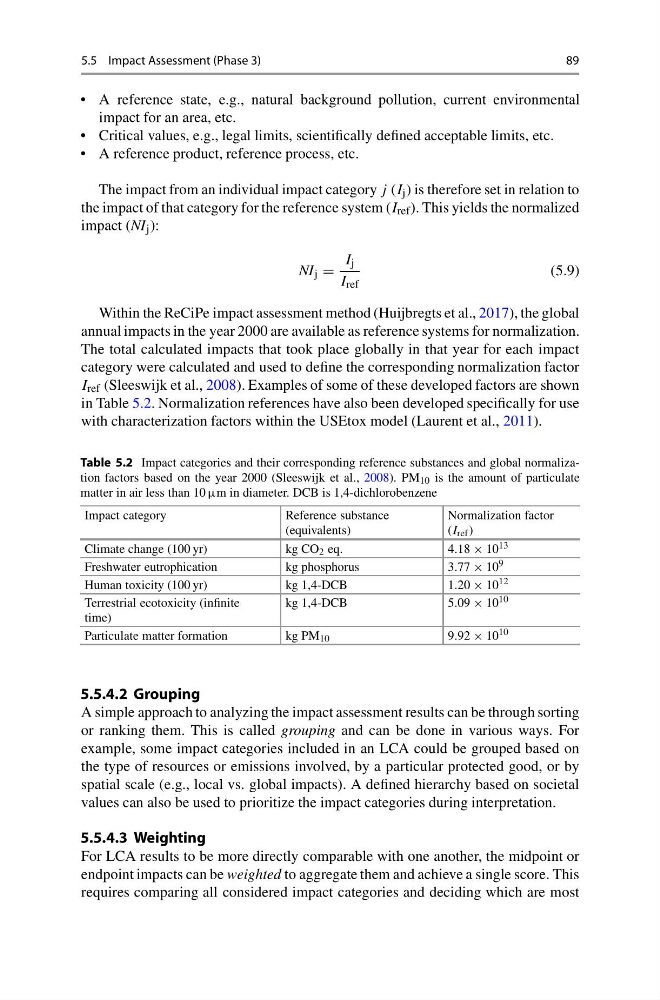
I ref (Sleeswijk et al., 2008). Examples of some of these developed factors are shown
in Table 5.2. Normalization references have also been developed specifically for use
with characterization factors within the USEtox model (Laurent et al., 2011).
Table 5.2 Impact categories and their corresponding reference substances and global normalization factors based on the year 2000 (Sleeswijk et al., 2008). PM 10 is the amount of particulate
matter in air less than 10 µm in diameter. DCB is 1,4-dichlorobenzene
Impact category
Reference substance
(equivalents)
Normalization factor
(I ref )
Climate change (100 yr)
kg CO 2 eq.
4.18 × 10 13
Freshwater eutrophication
kg phosphorus
3.77 × 10 9
Human toxicity (100 yr)
kg 1,4-DCB
1.20 × 10 12
Terrestrial ecotoxicity (infinite
time)
kg 1,4-DCB
5.09 × 10 10
Particulate matter formation
kg PM 10
9.92 × 10 10
5.5.4.2 Grouping
A simple approach to analyzing the impact assessment results can be through sorting
or ranking them. This is called grouping and can be done in various ways. For
example, some impact categories included in an LCA could be grouped based on
the type of resources or emissions involved, by a particular protected good, or by
spatial scale (e.g., local vs. global impacts). A defined hierarchy based on societal
values can also be used to prioritize the impact categories during interpretation.
5.5.4.3 Weighting
For LCA results to be more directly comparable with one another, the midpoint or
endpoint impacts can be weighted to aggregate them and achieve a single score. This
requires comparing all considered impact categories and deciding which are most
89
• A reference state, e.g., natural background pollution, current environmental
impact for an area, etc.
• Critical values, e.g., legal limits, scientifically defined acceptable limits, etc.
• A reference product, reference process, etc.
The impact from an individual impact category j (I j ) is therefore set in relation to
the impact of that category for the reference system (I ref ). This yields the normalized
impact (NI j ):
NI j =
I j
I ref
(5.9)
Within the ReCiPe impact assessment method (Huijbregts et al., 2017), the global
annual impacts in the year 2000 are available as reference systems for normalization.
The total calculated impacts that took place globally in that year for each impact
category were calculated and used to define the corresponding normalization factor
I ref (Sleeswijk et al., 2008). Examples of some of these developed factors are shown
in Table 5.2. Normalization references have also been developed specifically for use
with characterization factors within the USEtox model (Laurent et al., 2011).
Table 5.2 Impact categories and their corresponding reference substances and global normalization factors based on the year 2000 (Sleeswijk et al., 2008). PM 10 is the amount of particulate
matter in air less than 10 µm in diameter. DCB is 1,4-dichlorobenzene
Impact category
Reference substance
(equivalents)
Normalization factor
(I ref )
Climate change (100 yr)
kg CO 2 eq.
4.18 × 10 13
Freshwater eutrophication
kg phosphorus
3.77 × 10 9
Human toxicity (100 yr)
kg 1,4-DCB
1.20 × 10 12
Terrestrial ecotoxicity (infinite
time)
kg 1,4-DCB
5.09 × 10 10
Particulate matter formation
kg PM 10
9.92 × 10 10
5.5.4.2 Grouping
A simple approach to analyzing the impact assessment results can be through sorting
or ranking them. This is called grouping and can be done in various ways. For
example, some impact categories included in an LCA could be grouped based on
the type of resources or emissions involved, by a particular protected good, or by
spatial scale (e.g., local vs. global impacts). A defined hierarchy based on societal
values can also be used to prioritize the impact categories during interpretation.
5.5.4.3 Weighting
For LCA results to be more directly comparable with one another, the midpoint or
endpoint impacts can be weighted to aggregate them and achieve a single score. This
requires comparing all considered impact categories and deciding which are most