

86
5 Life Cycle Assessment of Chemical Products and Processes
(“solv.incin.”):
CED sec.solv. = (CED prim.solv. + CED solv.incin. ) × (1 − r) + CED solv.dist. × r
(5.4)
Generally, recycling through distillation is preferable to incineration when:
CED prim.solv. + CED solv.incin. > CED solv.dist.
(5.5)
This application of solvent recycling is an example of a process that can support a
transition toward a circular economy, which aims to design out waste and pollution,
to keep products and materials in use, and to regenerate natural systems (Ellen
Macarthur Foundation, 2019).
5.5.3.2 Climate Change
The global warming that causes climate change derives from the radiative efficiency
of the greenhouse gases present in the atmosphere. Fundamentally, Earth’s dynamic
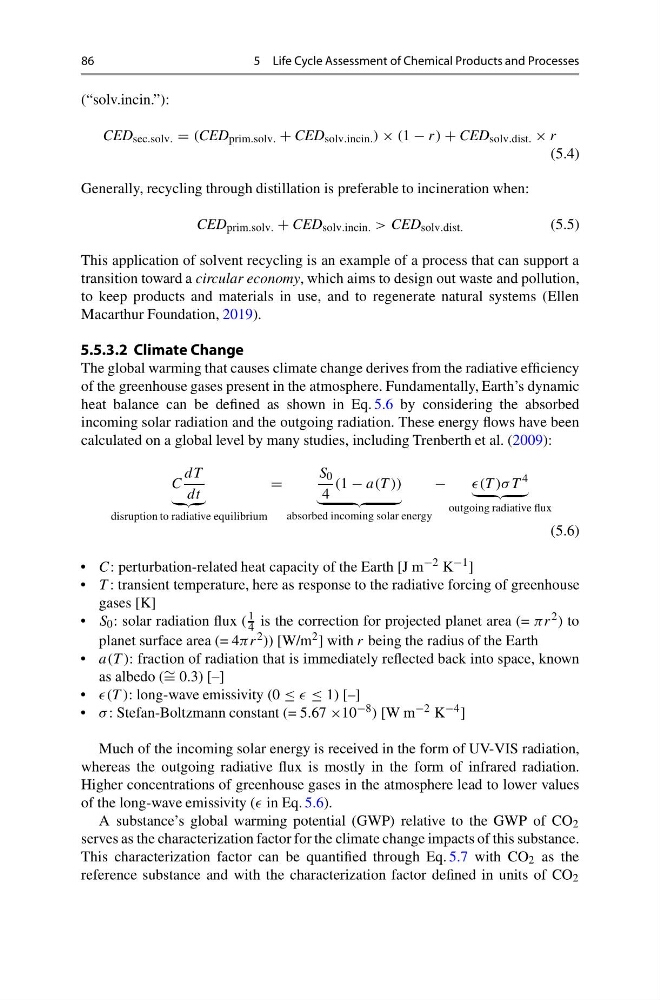
heat balance can be defined as shown in Eq. 5.6 by considering the absorbed
incoming solar radiation and the outgoing radiation. These energy flows have been
calculated on a global level by many studies, including Trenberth et al. (2009):
C
dT
dt
disruption to radiative equilibrium
=
S 0
4
(1 − a(T ))
absorbed incoming solar energy
−
(T )σ T
4
outgoing radiative flux
(5.6)
• C: perturbation-related heat capacity of the Earth [J m −2 K −1 ]
• T : transient temperature, here as response to the radiative forcing of greenhouse
gases [K]
• S 0 : solar radiation flux (
1
4 is the correction for projected planet area (= πr 2 ) to
planet surface area (= 4πr 2 )) [W/m 2 ] with r being the radius of the Earth
• a(T ): fraction of radiation that is immediately reflected back into space, known
as albedo ( ∼ = 0.3) [–]
• (T ): long-wave emissivity (0 ≤ ≤ 1) [–]
• σ : Stefan-Boltzmann constant (= 5.67 ×10 −8 ) [W m −2 K −4 ]
Much of the incoming solar energy is received in the form of UV-VIS radiation,
whereas the outgoing radiative flux is mostly in the form of infrared radiation.
Higher concentrations of greenhouse gases in the atmosphere lead to lower values
of the long-wave emissivity ( in Eq. 5.6).
A substance’s global warming potential (GWP) relative to the GWP of CO 2
serves as the characterization factor for the climate change impacts of this substance.
This characterization factor can be quantified through Eq. 5.7 with CO 2 as the
reference substance and with the characterization factor defined in units of CO 2
5 Life Cycle Assessment of Chemical Products and Processes
(“solv.incin.”):
CED sec.solv. = (CED prim.solv. + CED solv.incin. ) × (1 − r) + CED solv.dist. × r
(5.4)
Generally, recycling through distillation is preferable to incineration when:
CED prim.solv. + CED solv.incin. > CED solv.dist.
(5.5)
This application of solvent recycling is an example of a process that can support a
transition toward a circular economy, which aims to design out waste and pollution,
to keep products and materials in use, and to regenerate natural systems (Ellen
Macarthur Foundation, 2019).
5.5.3.2 Climate Change
The global warming that causes climate change derives from the radiative efficiency
of the greenhouse gases present in the atmosphere. Fundamentally, Earth’s dynamic
heat balance can be defined as shown in Eq. 5.6 by considering the absorbed
incoming solar radiation and the outgoing radiation. These energy flows have been
calculated on a global level by many studies, including Trenberth et al. (2009):
C
dT
dt
disruption to radiative equilibrium
=
S 0
4
(1 − a(T ))
absorbed incoming solar energy
−
(T )σ T
4
outgoing radiative flux
(5.6)
• C: perturbation-related heat capacity of the Earth [J m −2 K −1 ]
• T : transient temperature, here as response to the radiative forcing of greenhouse
gases [K]
• S 0 : solar radiation flux (
1
4 is the correction for projected planet area (= πr 2 ) to
planet surface area (= 4πr 2 )) [W/m 2 ] with r being the radius of the Earth
• a(T ): fraction of radiation that is immediately reflected back into space, known
as albedo ( ∼ = 0.3) [–]
• (T ): long-wave emissivity (0 ≤ ≤ 1) [–]
• σ : Stefan-Boltzmann constant (= 5.67 ×10 −8 ) [W m −2 K −4 ]
Much of the incoming solar energy is received in the form of UV-VIS radiation,
whereas the outgoing radiative flux is mostly in the form of infrared radiation.
Higher concentrations of greenhouse gases in the atmosphere lead to lower values
of the long-wave emissivity ( in Eq. 5.6).
A substance’s global warming potential (GWP) relative to the GWP of CO 2
serves as the characterization factor for the climate change impacts of this substance.
This characterization factor can be quantified through Eq. 5.7 with CO 2 as the
reference substance and with the characterization factor defined in units of CO 2