

RF power applied to the electrodes is pulsed; the pulse length ranges from a few
tenths of a second up to 30 s.
During synthesis there is a steady flow of gas, consisting of the carrier gas and the
evaporated precursor, through the reaction zone (i.e., the space between the two gaspermeable electrodes). When RF power is “on,” the particles stay fixed in the
reaction zone and grow. After switching RF power “off,” the particles are blown out
from the reaction zone and collected outside of the reaction zone. The experimental
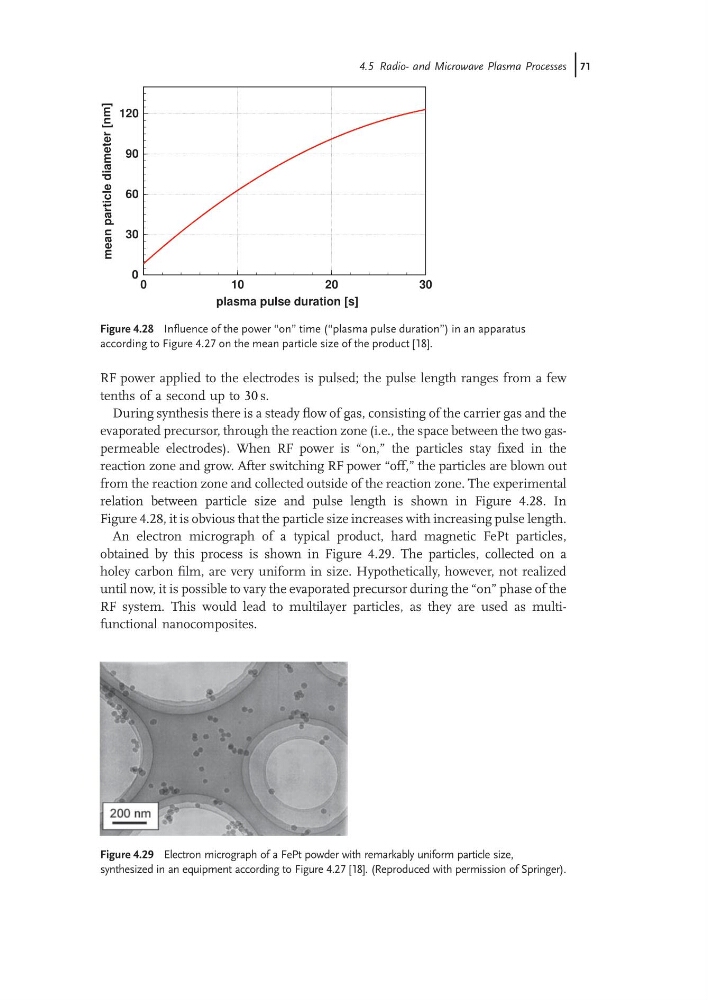
relation between particle size and pulse length is shown in Figure 4.28. In
Figure 4.28, it is obvious that the particle size increases with increasing pulse length.
An electron micrograph of a typical product, hard magnetic FePt particles,
obtained by this process is shown in Figure 4.29. The particles, collected on a
holey carbon film, are very uniform in size. Hypothetically, however, not realized
until now, it is possible to vary the evaporated precursor during the “on” phase of the
RF system. This would lead to multilayer particles, as they are used as multifunctional nanocomposites.
0
10
20
30
plasma pulse duration [s]
0
30
60
90
120
mean
particle
diameter
[nm]
Figure 4.28 Influence of the power “on” time (“plasma pulse duration”) in an apparatus
according to Figure 4.27 on the mean particle size of the product [18].
Figure 4.29 Electron micrograph of a FePt powder with remarkably uniform particle size,
synthesized in an equipment according to Figure 4.27 [18]. (Reproduced with permission of Springer).
4.5 Radio- and Microwave Plasma Processes j71
tenths of a second up to 30 s.
During synthesis there is a steady flow of gas, consisting of the carrier gas and the
evaporated precursor, through the reaction zone (i.e., the space between the two gaspermeable electrodes). When RF power is “on,” the particles stay fixed in the
reaction zone and grow. After switching RF power “off,” the particles are blown out
from the reaction zone and collected outside of the reaction zone. The experimental
relation between particle size and pulse length is shown in Figure 4.28. In
Figure 4.28, it is obvious that the particle size increases with increasing pulse length.
An electron micrograph of a typical product, hard magnetic FePt particles,
obtained by this process is shown in Figure 4.29. The particles, collected on a
holey carbon film, are very uniform in size. Hypothetically, however, not realized
until now, it is possible to vary the evaporated precursor during the “on” phase of the
RF system. This would lead to multilayer particles, as they are used as multifunctional nanocomposites.
0
10
20
30
plasma pulse duration [s]
0
30
60
90
120
mean
particle
diameter
[nm]
Figure 4.28 Influence of the power “on” time (“plasma pulse duration”) in an apparatus
according to Figure 4.27 on the mean particle size of the product [18].
Figure 4.29 Electron micrograph of a FePt powder with remarkably uniform particle size,
synthesized in an equipment according to Figure 4.27 [18]. (Reproduced with permission of Springer).
4.5 Radio- and Microwave Plasma Processes j71