

frequency z in the plasma, depending essentially on the gas pressure. The free path
length l of the electrons now limits the maximum energy U max to be transferred in
an electric field with the field strength E:
U max ¼ QlE
ð4:20Þ
As the strength of the electric field in a resonant microwave cavity (as applied to
microwave plasma synthesis) is significantly above 10
4 V cm
À1 , the energy transferred to an electron, depending on the gas pressure, may be in the range up to kilo
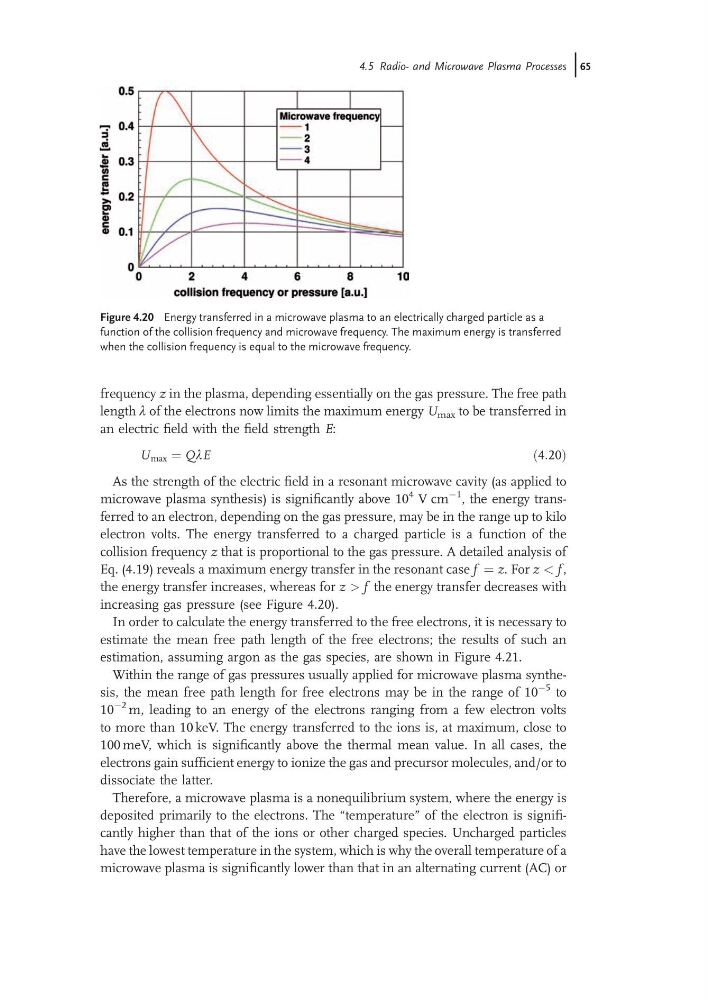
electron volts. The energy transferred to a charged particle is a function of the
collision frequency z that is proportional to the gas pressure. A detailed analysis of
Eq. (4.19) reveals a maximum energy transfer in the resonant case f ¼ z. For z < f ,
the energy transfer increases, whereas for z > f the energy transfer decreases with
increasing gas pressure (see Figure 4.20).
In order to calculate the energy transferred to the free electrons, it is necessary to
estimate the mean free path length of the free electrons; the results of such an
estimation, assuming argon as the gas species, are shown in Figure 4.21.
Within the range of gas pressures usually applied for microwave plasma synthesis, the mean free path length for free electrons may be in the range of 10
À5 to
10
À2 m, leading to an energy of the electrons ranging from a few electron volts
to more than 10 keV. The energy transferred to the ions is, at maximum, close to
100 meV, which is significantly above the thermal mean value. In all cases, the
electrons gain sufficient energy to ionize the gas and precursor molecules, and/or to
dissociate the latter.
Therefore, a microwave plasma is a nonequilibrium system, where the energy is
deposited primarily to the electrons. The “temperature” of the electron is significantly higher than that of the ions or other charged species. Uncharged particles
have the lowest temperature in the system, which is why the overall temperature of a
microwave plasma is significantly lower than that in an alternating current (AC) or
Figure 4.20 Energy transferred in a microwave plasma to an electrically charged particle as a
function of the collision frequency and microwave frequency. The maximum energy is transferred
when the collision frequency is equal to the microwave frequency.
4.5 Radio- and Microwave Plasma Processes j65
length l of the electrons now limits the maximum energy U max to be transferred in
an electric field with the field strength E:
U max ¼ QlE
ð4:20Þ
As the strength of the electric field in a resonant microwave cavity (as applied to
microwave plasma synthesis) is significantly above 10
4 V cm
À1 , the energy transferred to an electron, depending on the gas pressure, may be in the range up to kilo
electron volts. The energy transferred to a charged particle is a function of the
collision frequency z that is proportional to the gas pressure. A detailed analysis of
Eq. (4.19) reveals a maximum energy transfer in the resonant case f ¼ z. For z < f ,
the energy transfer increases, whereas for z > f the energy transfer decreases with
increasing gas pressure (see Figure 4.20).
In order to calculate the energy transferred to the free electrons, it is necessary to
estimate the mean free path length of the free electrons; the results of such an
estimation, assuming argon as the gas species, are shown in Figure 4.21.
Within the range of gas pressures usually applied for microwave plasma synthesis, the mean free path length for free electrons may be in the range of 10
À5 to
10
À2 m, leading to an energy of the electrons ranging from a few electron volts
to more than 10 keV. The energy transferred to the ions is, at maximum, close to
100 meV, which is significantly above the thermal mean value. In all cases, the
electrons gain sufficient energy to ionize the gas and precursor molecules, and/or to
dissociate the latter.
Therefore, a microwave plasma is a nonequilibrium system, where the energy is
deposited primarily to the electrons. The “temperature” of the electron is significantly higher than that of the ions or other charged species. Uncharged particles
have the lowest temperature in the system, which is why the overall temperature of a
microwave plasma is significantly lower than that in an alternating current (AC) or
Figure 4.20 Energy transferred in a microwave plasma to an electrically charged particle as a
function of the collision frequency and microwave frequency. The maximum energy is transferred
when the collision frequency is equal to the microwave frequency.
4.5 Radio- and Microwave Plasma Processes j65