

With regard to laser type, either frequency-converted Nd-YAG or excimer lasers
with pulse durations in the nanosecond range are usually applied. The interaction of
these nanosecond pulses leads, especially at the surface of good thermal conductors
and prior to evaporation, to the formation of a pool of melted material. In the case of
targets with a complex composition, this may lead to a powder composition, which
differs from that intended. This problem may be avoided by applying picosecond
lasers, as such a short, high-power laser pulse does not lead to melting at the surface;
rather, the material evaporates instantaneously.
One general problem of the laser ablation process is that a high concentration of
evaporated material gathers in the plume. In the case of an insufficiently rapid
expansion, this may lead to the formation of agglomerates that, in most cases are
either fractal with a fractal dimension in the range from 1.7 to 1.9 [10] or web-like. A
typical example of such an agglomerated powder is shown in Figure 4.17, where
silicon primary particles of about 10 nm are connected together and form a web-like
structure, although the individual particles are not visible.
10
01
10
02
10
03
10
04
10
05
pressure [ Pa]
0
1
2
3
mean
particle
diameter
[nm]
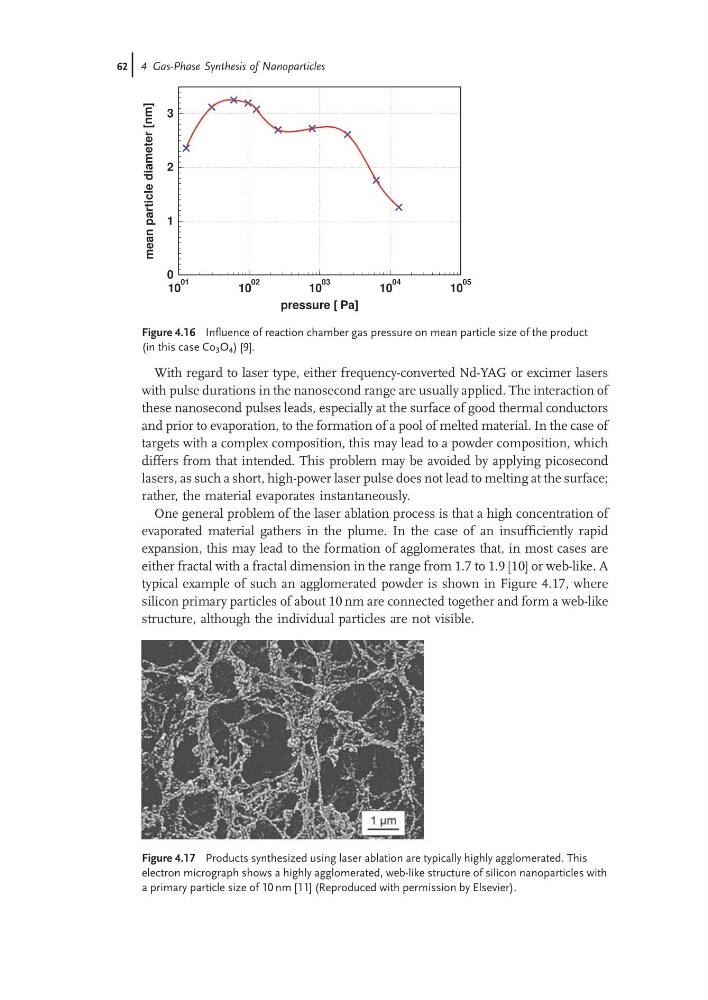
Figure 4.16 Influence of reaction chamber gas pressure on mean particle size of the product
(in this case Co 3 O 4 ) [9].
Figure 4.17 Products synthesized using laser ablation are typically highly agglomerated. This
electron micrograph shows a highly agglomerated, web-like structure of silicon nanoparticles with
a primary particle size of 10 nm [11] (Reproduced with permission by Elsevier).
62j 4 Gas-Phase Synthesis of Nanoparticles
with pulse durations in the nanosecond range are usually applied. The interaction of
these nanosecond pulses leads, especially at the surface of good thermal conductors
and prior to evaporation, to the formation of a pool of melted material. In the case of
targets with a complex composition, this may lead to a powder composition, which
differs from that intended. This problem may be avoided by applying picosecond
lasers, as such a short, high-power laser pulse does not lead to melting at the surface;
rather, the material evaporates instantaneously.
One general problem of the laser ablation process is that a high concentration of
evaporated material gathers in the plume. In the case of an insufficiently rapid
expansion, this may lead to the formation of agglomerates that, in most cases are
either fractal with a fractal dimension in the range from 1.7 to 1.9 [10] or web-like. A
typical example of such an agglomerated powder is shown in Figure 4.17, where
silicon primary particles of about 10 nm are connected together and form a web-like
structure, although the individual particles are not visible.
10
01
10
02
10
03
10
04
10
05
pressure [ Pa]
0
1
2
3
mean
particle
diameter
[nm]
Figure 4.16 Influence of reaction chamber gas pressure on mean particle size of the product
(in this case Co 3 O 4 ) [9].
Figure 4.17 Products synthesized using laser ablation are typically highly agglomerated. This
electron micrograph shows a highly agglomerated, web-like structure of silicon nanoparticles with
a primary particle size of 10 nm [11] (Reproduced with permission by Elsevier).
62j 4 Gas-Phase Synthesis of Nanoparticles