

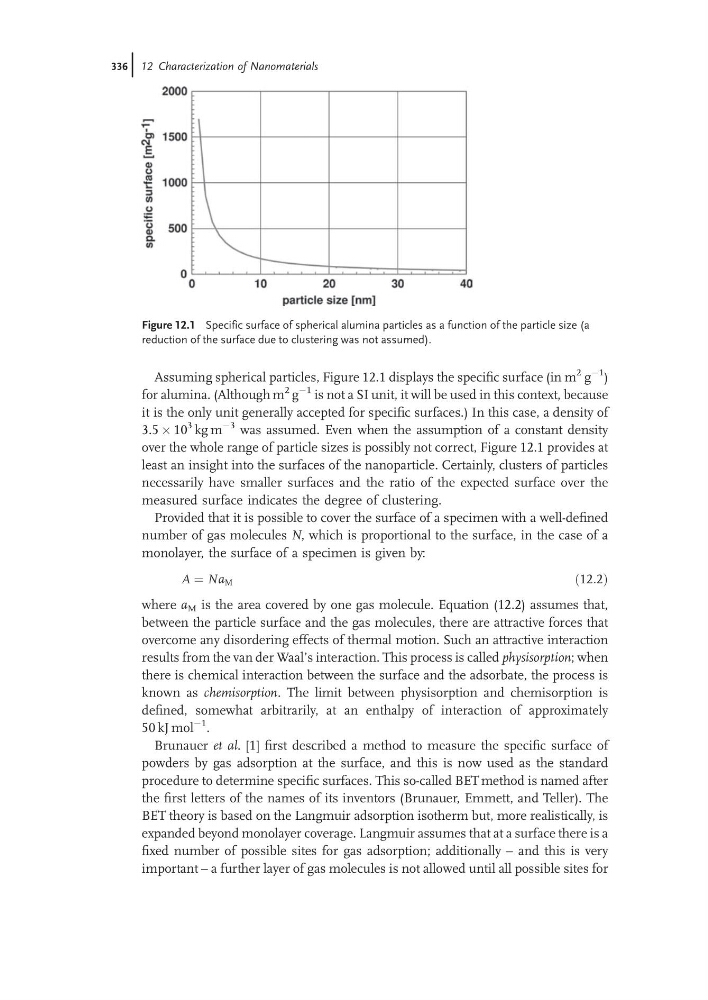
Assuming spherical particles, Figure 12.1 displays the specific surface (in m
2 g
À1 )
for alumina. (Although m
2 g
À1 is not a SI unit, it will be used in this context, because
it is the only unit generally accepted for specific surfaces.) In this case, a density of
3.5 Â 10
3 kg m
À3 was assumed. Even when the assumption of a constant density
over the whole range of particle sizes is possibly not correct, Figure 12.1 provides at
least an insight into the surfaces of the nanoparticle. Certainly, clusters of particles
necessarily have smaller surfaces and the ratio of the expected surface over the
measured surface indicates the degree of clustering.
Provided that it is possible to cover the surface of a specimen with a well-defined
number of gas molecules N, which is proportional to the surface, in the case of a
monolayer, the surface of a specimen is given by:
A ¼ Na M
ð12:2Þ
where a M is the area covered by one gas molecule. Equation (12.2) assumes that,
between the particle surface and the gas molecules, there are attractive forces that
overcome any disordering effects of thermal motion. Such an attractive interaction
results from the van der Waal’s interaction. This process is called physisorption; when
there is chemical interaction between the surface and the adsorbate, the process is
known as chemisorption. The limit between physisorption and chemisorption is
defined, somewhat arbitrarily, at an enthalpy of interaction of approximately
50 kJ mol
À1 .
Brunauer et al. [1] first described a method to measure the specific surface of
powders by gas adsorption at the surface, and this is now used as the standard
procedure to determine specific surfaces. This so-called BET method is named after
the first letters of the names of its inventors (Brunauer, Emmett, and Teller). The
BET theory is based on the Langmuir adsorption isotherm but, more realistically, is
expanded beyond monolayer coverage. Langmuir assumes that at a surface there is a
fixed number of possible sites for gas adsorption; additionally – and this is very
important – a further layer of gas molecules is not allowed until all possible sites for
Figure 12.1 Specific surface of spherical alumina particles as a function of the particle size (a
reduction of the surface due to clustering was not assumed).
336j 12 Characterization of Nanomaterials
2 g
À1 )
for alumina. (Although m
2 g
À1 is not a SI unit, it will be used in this context, because
it is the only unit generally accepted for specific surfaces.) In this case, a density of
3.5 Â 10
3 kg m
À3 was assumed. Even when the assumption of a constant density
over the whole range of particle sizes is possibly not correct, Figure 12.1 provides at
least an insight into the surfaces of the nanoparticle. Certainly, clusters of particles
necessarily have smaller surfaces and the ratio of the expected surface over the
measured surface indicates the degree of clustering.
Provided that it is possible to cover the surface of a specimen with a well-defined
number of gas molecules N, which is proportional to the surface, in the case of a
monolayer, the surface of a specimen is given by:
A ¼ Na M
ð12:2Þ
where a M is the area covered by one gas molecule. Equation (12.2) assumes that,
between the particle surface and the gas molecules, there are attractive forces that
overcome any disordering effects of thermal motion. Such an attractive interaction
results from the van der Waal’s interaction. This process is called physisorption; when
there is chemical interaction between the surface and the adsorbate, the process is
known as chemisorption. The limit between physisorption and chemisorption is
defined, somewhat arbitrarily, at an enthalpy of interaction of approximately
50 kJ mol
À1 .
Brunauer et al. [1] first described a method to measure the specific surface of
powders by gas adsorption at the surface, and this is now used as the standard
procedure to determine specific surfaces. This so-called BET method is named after
the first letters of the names of its inventors (Brunauer, Emmett, and Teller). The
BET theory is based on the Langmuir adsorption isotherm but, more realistically, is
expanded beyond monolayer coverage. Langmuir assumes that at a surface there is a
fixed number of possible sites for gas adsorption; additionally – and this is very
important – a further layer of gas molecules is not allowed until all possible sites for
Figure 12.1 Specific surface of spherical alumina particles as a function of the particle size (a
reduction of the surface due to clustering was not assumed).
336j 12 Characterization of Nanomaterials