

12
Characterization of Nanomaterials
12.1
General Remarks
When considering characterization methods, it is very important to distinguish
between methods that deliver values averaged over a large ensemble of particles and
those that provide information about one or a limited number of particles. The most
important among the latter group of methods are those that are microscopic in
nature. The behavior of nanomaterials is controlled by their global properties, which
provide indications of how an ensemble behaves. However, in order to understand
why an ensemble behaves in a certain way, it is necessary to utilize microscopic
methods.
12.2
Global Methods for Characterization
12.2.1
Specific Surface Area
As each particle is characterized by its surface, and the surface is directly related to
the particle size, then measuring the surface will provide an indication on particle
size and the state of agglomeration. The specific surface A (here, in contrast to the
rule used in previous chapters, capital letters denote quantities per gram) is usually
given per gram and is the number of particles per gram multiplied by the surface
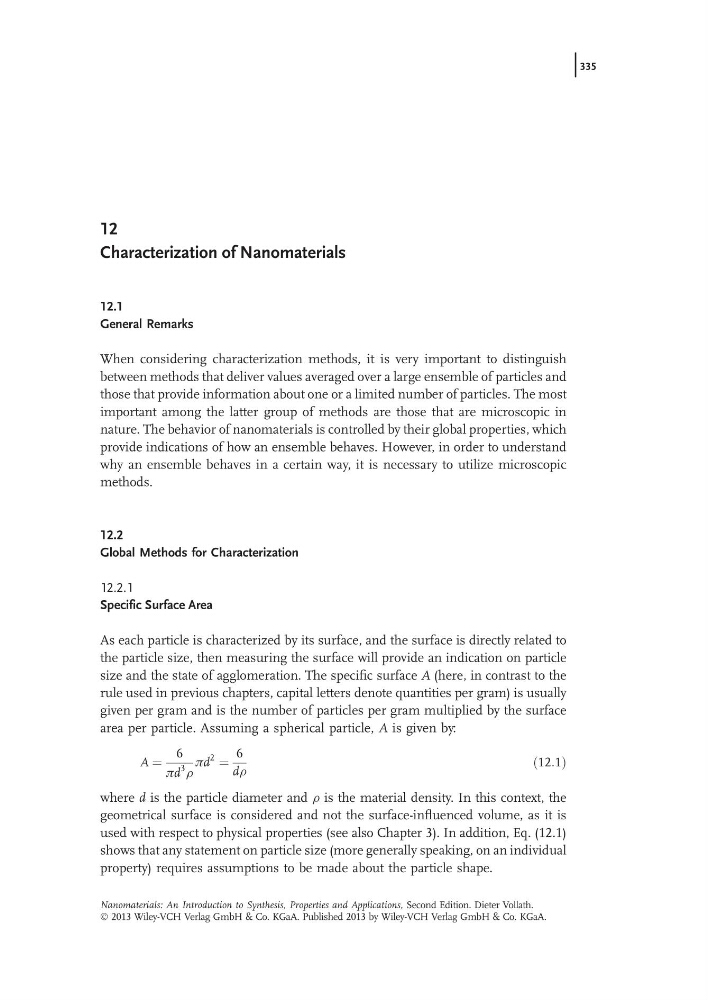
area per particle. Assuming a spherical particle, A is given by:
A ¼
6
pd
3 r
pd
2 ¼
6
dr
ð12:1Þ
where d is the particle diameter and r is the material density. In this context, the
geometrical surface is considered and not the surface-influenced volume, as it is
used with respect to physical properties (see also Chapter 3). In addition, Eq. (12.1)
shows that any statement on particle size (more generally speaking, on an individual
property) requires assumptions to be made about the particle shape.
Nanomaterials: An Introduction to Synthesis, Properties and Applications, Second Edition. Dieter Vollath.
Ó 2013 Wiley-VCH Verlag GmbH & Co. KGaA. Published 2013 by Wiley-VCH Verlag GmbH & Co. KGaA.
j335
Characterization of Nanomaterials
12.1
General Remarks
When considering characterization methods, it is very important to distinguish
between methods that deliver values averaged over a large ensemble of particles and
those that provide information about one or a limited number of particles. The most
important among the latter group of methods are those that are microscopic in
nature. The behavior of nanomaterials is controlled by their global properties, which
provide indications of how an ensemble behaves. However, in order to understand
why an ensemble behaves in a certain way, it is necessary to utilize microscopic
methods.
12.2
Global Methods for Characterization
12.2.1
Specific Surface Area
As each particle is characterized by its surface, and the surface is directly related to
the particle size, then measuring the surface will provide an indication on particle
size and the state of agglomeration. The specific surface A (here, in contrast to the
rule used in previous chapters, capital letters denote quantities per gram) is usually
given per gram and is the number of particles per gram multiplied by the surface
area per particle. Assuming a spherical particle, A is given by:
A ¼
6
pd
3 r
pd
2 ¼
6
dr
ð12:1Þ
where d is the particle diameter and r is the material density. In this context, the
geometrical surface is considered and not the surface-influenced volume, as it is
used with respect to physical properties (see also Chapter 3). In addition, Eq. (12.1)
shows that any statement on particle size (more generally speaking, on an individual
property) requires assumptions to be made about the particle shape.
Nanomaterials: An Introduction to Synthesis, Properties and Applications, Second Edition. Dieter Vollath.
Ó 2013 Wiley-VCH Verlag GmbH & Co. KGaA. Published 2013 by Wiley-VCH Verlag GmbH & Co. KGaA.
j335