

size of the Vickers hardness indentation is plotted versus time. The length of the
impression diagonal was selected as the size of the indentation and, for the
theoretical calculations, the models of Coble and Ashby–Verall were used. Subsequently, the experimental points were described quite well by the Ashby–Verall
mechanism, whereas the assumption of the Coble process led to a time-dependency
far from experimental reality.
Like the Coble mechanism, the mechanism according to Ashby–Verall is proportional to d
À3 . Although this mechanism is the most probable for nanocrystalline
materials, molecular dynamics calculations on the deformation of nanocrystalline
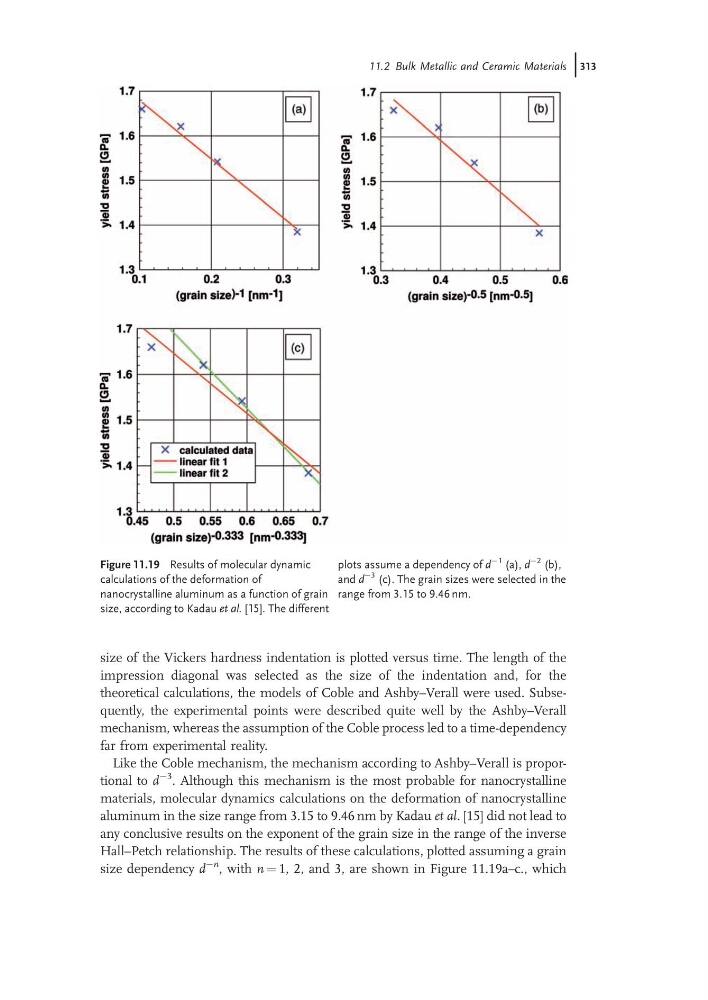
aluminum in the size range from 3.15 to 9.46 nm by Kadau et al. [15] did not lead to
any conclusive results on the exponent of the grain size in the range of the inverse
Hall–Petch relationship. The results of these calculations, plotted assuming a grain
size dependency d
Àn , with n ¼ 1, 2, and 3, are shown in Figure 11.19a–c., which
Figure 11.19 Results of molecular dynamic
calculations of the deformation of
nanocrystalline aluminum as a function of grain
size, according to Kadau et al. [15]. The different
plots assume a dependency of d
À1 (a), d
À2 (b),
and d
À3 (c). The grain sizes were selected in the
range from 3.15 to 9.46 nm.
11.2 Bulk Metallic and Ceramic Materials j313
impression diagonal was selected as the size of the indentation and, for the
theoretical calculations, the models of Coble and Ashby–Verall were used. Subsequently, the experimental points were described quite well by the Ashby–Verall
mechanism, whereas the assumption of the Coble process led to a time-dependency
far from experimental reality.
Like the Coble mechanism, the mechanism according to Ashby–Verall is proportional to d
À3 . Although this mechanism is the most probable for nanocrystalline
materials, molecular dynamics calculations on the deformation of nanocrystalline
aluminum in the size range from 3.15 to 9.46 nm by Kadau et al. [15] did not lead to
any conclusive results on the exponent of the grain size in the range of the inverse
Hall–Petch relationship. The results of these calculations, plotted assuming a grain
size dependency d
Àn , with n ¼ 1, 2, and 3, are shown in Figure 11.19a–c., which
Figure 11.19 Results of molecular dynamic
calculations of the deformation of
nanocrystalline aluminum as a function of grain
size, according to Kadau et al. [15]. The different
plots assume a dependency of d
À1 (a), d
À2 (b),
and d
À3 (c). The grain sizes were selected in the
range from 3.15 to 9.46 nm.
11.2 Bulk Metallic and Ceramic Materials j313