

the range of 10 and 1000 nm was a remarkable achievement by these authors.)
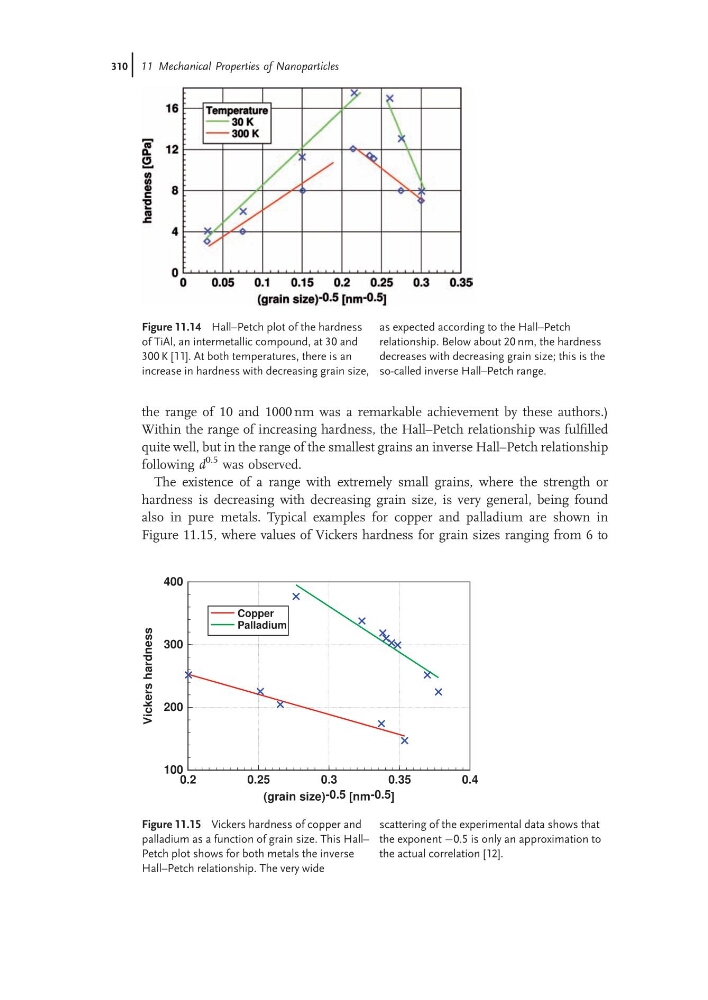
Within the range of increasing hardness, the Hall–Petch relationship was fulfilled
quite well, but in the range of the smallest grains an inverse Hall–Petch relationship
following d
0.5 was observed.
The existence of a range with extremely small grains, where the strength or
hardness is decreasing with decreasing grain size, is very general, being found
also in pure metals. Typical examples for copper and palladium are shown in
Figure 11.15, where values of Vickers hardness for grain sizes ranging from 6 to
Figure 11.14 Hall–Petch plot of the hardness
of TiAl, an intermetallic compound, at 30 and
300 K [11]. At both temperatures, there is an
increase in hardness with decreasing grain size,
as expected according to the Hall–Petch
relationship. Below about 20 nm, the hardness
decreases with decreasing grain size; this is the
so-called inverse Hall–Petch range.
0.2
0.25
0.3
0.35
0.4
(grain size) -0.5 [nm -0.5 ]
100
200
300
400
Copper
Palladium
Vickers hardness
Figure 11.15 Vickers hardness of copper and
palladium as a function of grain size. This Hall–
Petch plot shows for both metals the inverse
Hall–Petch relationship. The very wide
scattering of the experimental data shows that
the exponent À0.5 is only an approximation to
the actual correlation [12].
310j 11 Mechanical Properties of Nanoparticles
Within the range of increasing hardness, the Hall–Petch relationship was fulfilled
quite well, but in the range of the smallest grains an inverse Hall–Petch relationship
following d
0.5 was observed.
The existence of a range with extremely small grains, where the strength or
hardness is decreasing with decreasing grain size, is very general, being found
also in pure metals. Typical examples for copper and palladium are shown in
Figure 11.15, where values of Vickers hardness for grain sizes ranging from 6 to
Figure 11.14 Hall–Petch plot of the hardness
of TiAl, an intermetallic compound, at 30 and
300 K [11]. At both temperatures, there is an
increase in hardness with decreasing grain size,
as expected according to the Hall–Petch
relationship. Below about 20 nm, the hardness
decreases with decreasing grain size; this is the
so-called inverse Hall–Petch range.
0.2
0.25
0.3
0.35
0.4
(grain size) -0.5 [nm -0.5 ]
100
200
300
400
Copper
Palladium
Vickers hardness
Figure 11.15 Vickers hardness of copper and
palladium as a function of grain size. This Hall–
Petch plot shows for both metals the inverse
Hall–Petch relationship. The very wide
scattering of the experimental data shows that
the exponent À0.5 is only an approximation to
the actual correlation [12].
310j 11 Mechanical Properties of Nanoparticles