

root of the inverse grain size. Such a plot visualizes immediately the validity of the
Hall–Petch relationship for the material in question. The minimum grain size of
these experiments was 15 nm. Clearly, there is a deviation of the experimental points
from the yield stress versus (grain size)
À0.5 straight line for grain sizes below
approximately 200 nm.
Obviously, at small grain sizes, the deformation mechanism is changing, and in
order to understand these changes it is necessary to analyze the deformation
mechanisms.
Generally, plastic deformation is related to the generation and movement of
dislocations, and within a grain, there may be both immobile and mobile dislocations. However, for plastic deformation only the latter dislocations are of
importance.
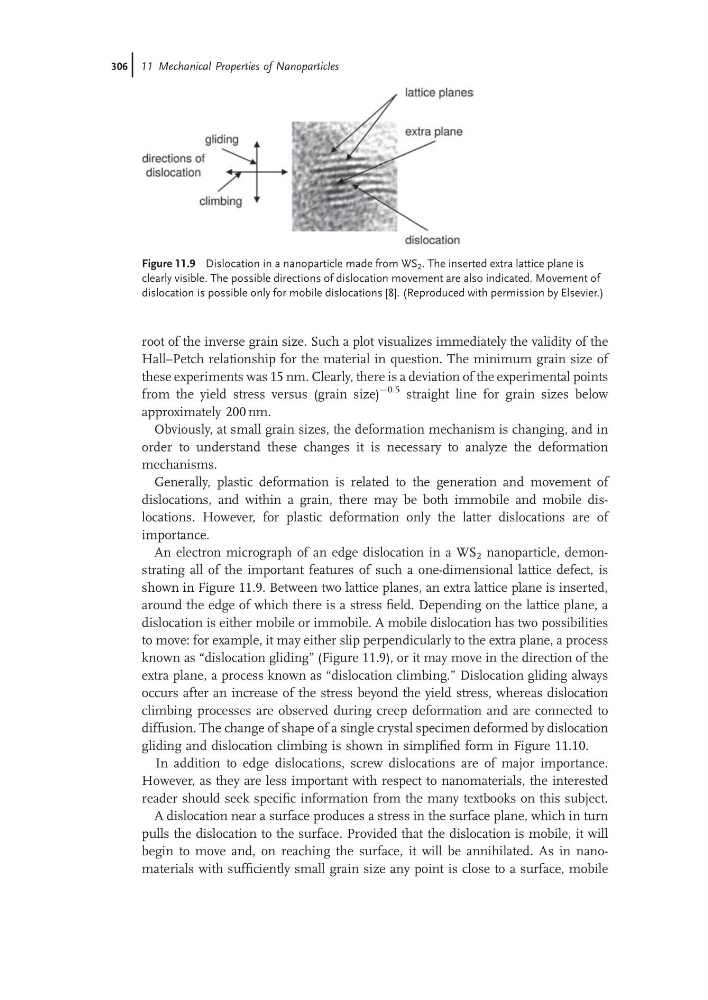
An electron micrograph of an edge dislocation in a WS 2 nanoparticle, demonstrating all of the important features of such a one-dimensional lattice defect, is
shown in Figure 11.9. Between two lattice planes, an extra lattice plane is inserted,
around the edge of which there is a stress field. Depending on the lattice plane, a
dislocation is either mobile or immobile. A mobile dislocation has two possibilities
to move: for example, it may either slip perpendicularly to the extra plane, a process
known as “dislocation gliding” (Figure 11.9), or it may move in the direction of the
extra plane, a process known as “dislocation climbing.” Dislocation gliding always
occurs after an increase of the stress beyond the yield stress, whereas dislocation
climbing processes are observed during creep deformation and are connected to
diffusion. The change of shape of a single crystal specimen deformed by dislocation
gliding and dislocation climbing is shown in simplified form in Figure 11.10.
In addition to edge dislocations, screw dislocations are of major importance.
However, as they are less important with respect to nanomaterials, the interested
reader should seek specific information from the many textbooks on this subject.
A dislocation near a surface produces a stress in the surface plane, which in turn
pulls the dislocation to the surface. Provided that the dislocation is mobile, it will
begin to move and, on reaching the surface, it will be annihilated. As in nanomaterials with sufficiently small grain size any point is close to a surface, mobile
Figure 11.9 Dislocation in a nanoparticle made from WS 2 . The inserted extra lattice plane is
clearly visible. The possible directions of dislocation movement are also indicated. Movement of
dislocation is possible only for mobile dislocations [8]. (Reproduced with permission by Elsevier.)
306j 11 Mechanical Properties of Nanoparticles
Hall–Petch relationship for the material in question. The minimum grain size of
these experiments was 15 nm. Clearly, there is a deviation of the experimental points
from the yield stress versus (grain size)
À0.5 straight line for grain sizes below
approximately 200 nm.
Obviously, at small grain sizes, the deformation mechanism is changing, and in
order to understand these changes it is necessary to analyze the deformation
mechanisms.
Generally, plastic deformation is related to the generation and movement of
dislocations, and within a grain, there may be both immobile and mobile dislocations. However, for plastic deformation only the latter dislocations are of
importance.
An electron micrograph of an edge dislocation in a WS 2 nanoparticle, demonstrating all of the important features of such a one-dimensional lattice defect, is
shown in Figure 11.9. Between two lattice planes, an extra lattice plane is inserted,
around the edge of which there is a stress field. Depending on the lattice plane, a
dislocation is either mobile or immobile. A mobile dislocation has two possibilities
to move: for example, it may either slip perpendicularly to the extra plane, a process
known as “dislocation gliding” (Figure 11.9), or it may move in the direction of the
extra plane, a process known as “dislocation climbing.” Dislocation gliding always
occurs after an increase of the stress beyond the yield stress, whereas dislocation
climbing processes are observed during creep deformation and are connected to
diffusion. The change of shape of a single crystal specimen deformed by dislocation
gliding and dislocation climbing is shown in simplified form in Figure 11.10.
In addition to edge dislocations, screw dislocations are of major importance.
However, as they are less important with respect to nanomaterials, the interested
reader should seek specific information from the many textbooks on this subject.
A dislocation near a surface produces a stress in the surface plane, which in turn
pulls the dislocation to the surface. Provided that the dislocation is mobile, it will
begin to move and, on reaching the surface, it will be annihilated. As in nanomaterials with sufficiently small grain size any point is close to a surface, mobile
Figure 11.9 Dislocation in a nanoparticle made from WS 2 . The inserted extra lattice plane is
clearly visible. The possible directions of dislocation movement are also indicated. Movement of
dislocation is possible only for mobile dislocations [8]. (Reproduced with permission by Elsevier.)
306j 11 Mechanical Properties of Nanoparticles