

At first glance, there is clearly a higher yield stress of 259 MPa for the nanocrystalline
material compared to the significantly lower value of 52 MPa for the coarse-grained
material.
On detailed examination of Figure 11.7, two features are striking:
The elastic modulus (Young’s modulus) of the nanocrystalline specimen is
smaller than that of the coarse-grained material. This is highly probable to
have been caused by residual porosity in the specimen as, according to
Eq. (11.3), Young’s modulus is reduced with increasing porosity. As the nanocrystalline specimen was produced by the compaction and sintering of nanocrystalline palladium powder, a residual porosity is unavoidable.
The increase of the strength cannot be overseen. This is also an effect of the grain
size, although the increase is less distinct than might be expected. Again, this is an
influence of the residual porosity.
The correlation between grain size d and yield stress s y , the Hall–Petch relationship, is described by:
s y ¼ s 0 þ k
À0:5
ð11:5Þ
where s 0 and k are constants. The grain size d is not necessarily defined by wideangle grain boundaries; rather, it is related to the smallest units that may also be
limited by small-angle grain boundaries. The exponent À0.5 is, in theory, well
established; however, when analyzing experimental data in general the exponents
are found in a wide range, perhaps from À0.3 to À0.7. It is important to note that the
Hall–Petch relationship is also valid for the dependency of hardness as function of
grain size.
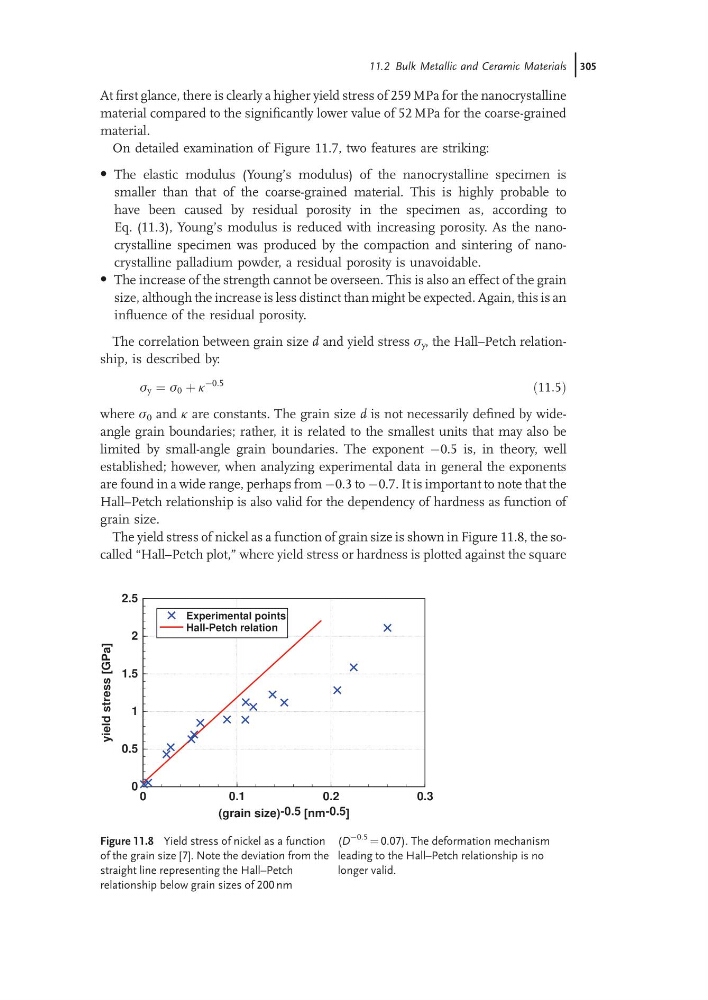
The yield stress of nickel as a function of grain size is shown in Figure 11.8, the socalled “Hall–Petch plot,” where yield stress or hardness is plotted against the square
0
0.1
0.2
0.3
(grain size) -0.5 [nm -0.5 ]
0
0.5
1
1.5
2
2.5
Experimental points
Hall-Petch relation
yield stress [GPa]
Figure 11.8 Yield stress of nickel as a function
of the grain size [7]. Note the deviation from the
straight line representing the Hall–Petch
relationship below grain sizes of 200 nm
(D
À0.5 ¼ 0.07). The deformation mechanism
leading to the Hall–Petch relationship is no
longer valid.
11.2 Bulk Metallic and Ceramic Materials j305
material compared to the significantly lower value of 52 MPa for the coarse-grained
material.
On detailed examination of Figure 11.7, two features are striking:
The elastic modulus (Young’s modulus) of the nanocrystalline specimen is
smaller than that of the coarse-grained material. This is highly probable to
have been caused by residual porosity in the specimen as, according to
Eq. (11.3), Young’s modulus is reduced with increasing porosity. As the nanocrystalline specimen was produced by the compaction and sintering of nanocrystalline palladium powder, a residual porosity is unavoidable.
The increase of the strength cannot be overseen. This is also an effect of the grain
size, although the increase is less distinct than might be expected. Again, this is an
influence of the residual porosity.
The correlation between grain size d and yield stress s y , the Hall–Petch relationship, is described by:
s y ¼ s 0 þ k
À0:5
ð11:5Þ
where s 0 and k are constants. The grain size d is not necessarily defined by wideangle grain boundaries; rather, it is related to the smallest units that may also be
limited by small-angle grain boundaries. The exponent À0.5 is, in theory, well
established; however, when analyzing experimental data in general the exponents
are found in a wide range, perhaps from À0.3 to À0.7. It is important to note that the
Hall–Petch relationship is also valid for the dependency of hardness as function of
grain size.
The yield stress of nickel as a function of grain size is shown in Figure 11.8, the socalled “Hall–Petch plot,” where yield stress or hardness is plotted against the square
0
0.1
0.2
0.3
(grain size) -0.5 [nm -0.5 ]
0
0.5
1
1.5
2
2.5
Experimental points
Hall-Petch relation
yield stress [GPa]
Figure 11.8 Yield stress of nickel as a function
of the grain size [7]. Note the deviation from the
straight line representing the Hall–Petch
relationship below grain sizes of 200 nm
(D
À0.5 ¼ 0.07). The deformation mechanism
leading to the Hall–Petch relationship is no
longer valid.
11.2 Bulk Metallic and Ceramic Materials j305