

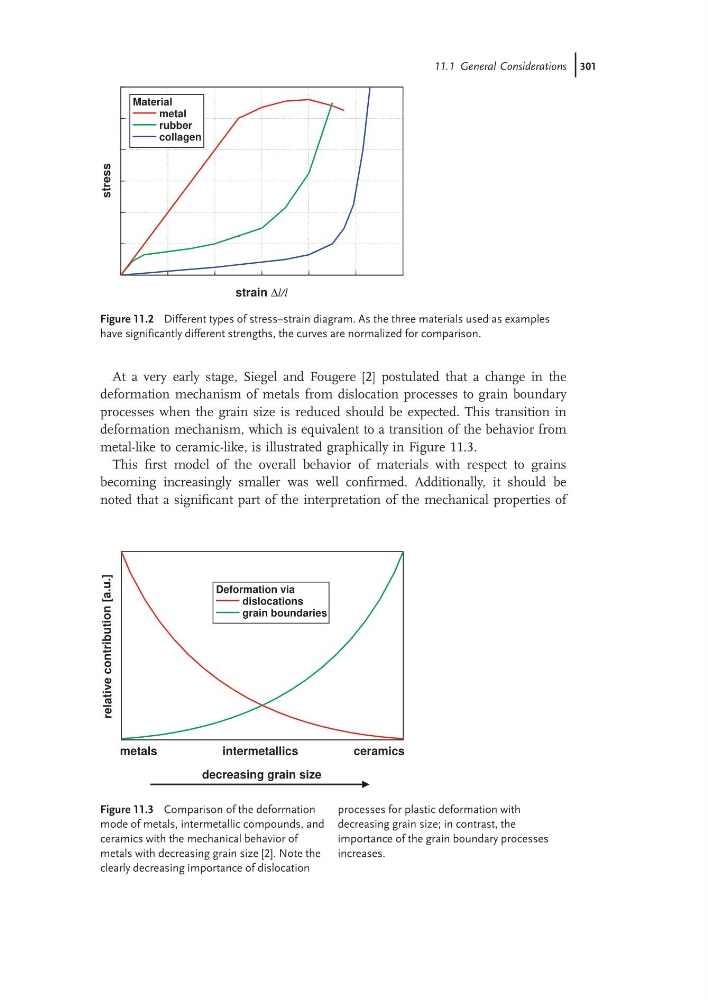
At a very early stage, Siegel and Fougere [2] postulated that a change in the
deformation mechanism of metals from dislocation processes to grain boundary
processes when the grain size is reduced should be expected. This transition in
deformation mechanism, which is equivalent to a transition of the behavior from
metal-like to ceramic-like, is illustrated graphically in Figure 11.3.
This first model of the overall behavior of materials with respect to grains
becoming increasingly smaller was well confirmed. Additionally, it should be
noted that a significant part of the interpretation of the mechanical properties of
0
2
4
6
8
10
12
0
2
4
6
8
10
12
stress
Material
metal
rubber
collagen
strain Δl/l
Figure 11.2 Different types of stress–strain diagram. As the three materials used as examples
have significantly different strengths, the curves are normalized for comparison.
0.1
0
relative
contribution
[a.u.]
Deformation via
dislocations
grain boundaries
intermetallics
ceramics
metals
decreasing grain size
Figure 11.3 Comparison of the deformation
mode of metals, intermetallic compounds, and
ceramics with the mechanical behavior of
metals with decreasing grain size [2]. Note the
clearly decreasing importance of dislocation
processes for plastic deformation with
decreasing grain size; in contrast, the
importance of the grain boundary processes
increases.
11.1 General Considerations j301
deformation mechanism of metals from dislocation processes to grain boundary
processes when the grain size is reduced should be expected. This transition in
deformation mechanism, which is equivalent to a transition of the behavior from
metal-like to ceramic-like, is illustrated graphically in Figure 11.3.
This first model of the overall behavior of materials with respect to grains
becoming increasingly smaller was well confirmed. Additionally, it should be
noted that a significant part of the interpretation of the mechanical properties of
0
2
4
6
8
10
12
0
2
4
6
8
10
12
stress
Material
metal
rubber
collagen
strain Δl/l
Figure 11.2 Different types of stress–strain diagram. As the three materials used as examples
have significantly different strengths, the curves are normalized for comparison.
0.1
0
relative
contribution
[a.u.]
Deformation via
dislocations
grain boundaries
intermetallics
ceramics
metals
decreasing grain size
Figure 11.3 Comparison of the deformation
mode of metals, intermetallic compounds, and
ceramics with the mechanical behavior of
metals with decreasing grain size [2]. Note the
clearly decreasing importance of dislocation
processes for plastic deformation with
decreasing grain size; in contrast, the
importance of the grain boundary processes
increases.
11.1 General Considerations j301