

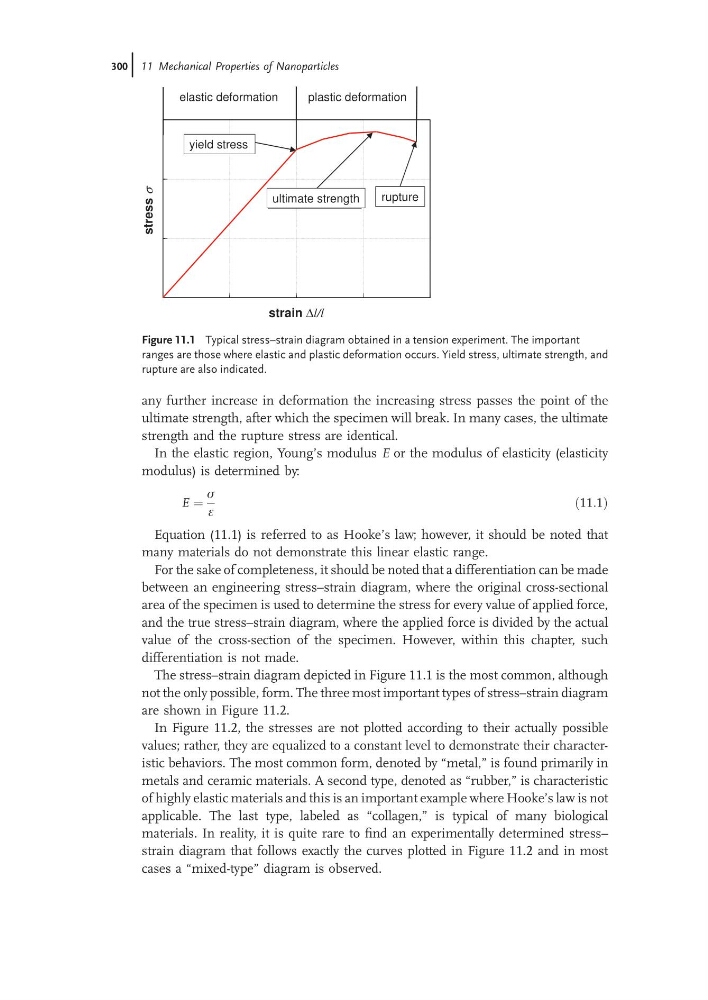
any further increase in deformation the increasing stress passes the point of the
ultimate strength, after which the specimen will break. In many cases, the ultimate
strength and the rupture stress are identical.
In the elastic region, Young’s modulus E or the modulus of elasticity (elasticity
modulus) is determined by:
E ¼
s
e
ð11:1Þ
Equation (11.1) is referred to as Hooke’s law; however, it should be noted that
many materials do not demonstrate this linear elastic range.
For the sake of completeness, it should be noted that a differentiation can be made
between an engineering stress–strain diagram, where the original cross-sectional
area of the specimen is used to determine the stress for every value of applied force,
and the true stress–strain diagram, where the applied force is divided by the actual
value of the cross-section of the specimen. However, within this chapter, such
differentiation is not made.
The stress–strain diagram depicted in Figure 11.1 is the most common, although
not the only possible, form. The three most important types of stress–strain diagram
are shown in Figure 11.2.
In Figure 11.2, the stresses are not plotted according to their actually possible
values; rather, they are equalized to a constant level to demonstrate their characteristic behaviors. The most common form, denoted by “metal,” is found primarily in
metals and ceramic materials. A second type, denoted as “rubber,” is characteristic
of highly elastic materials and this is an important example where Hooke’s law is not
applicable. The last type, labeled as “collagen,” is typical of many biological
materials. In reality, it is quite rare to find an experimentally determined stress–
strain diagram that follows exactly the curves plotted in Figure 11.2 and in most
cases a “mixed-type” diagram is observed.
plastic deformation
elastic deformation
yield stress
ultimate strength
rupture
strain Δl/l
stress
σ
Figure 11.1 Typical stress–strain diagram obtained in a tension experiment. The important
ranges are those where elastic and plastic deformation occurs. Yield stress, ultimate strength, and
rupture are also indicated.
300j 11 Mechanical Properties of Nanoparticles
ultimate strength, after which the specimen will break. In many cases, the ultimate
strength and the rupture stress are identical.
In the elastic region, Young’s modulus E or the modulus of elasticity (elasticity
modulus) is determined by:
E ¼
s
e
ð11:1Þ
Equation (11.1) is referred to as Hooke’s law; however, it should be noted that
many materials do not demonstrate this linear elastic range.
For the sake of completeness, it should be noted that a differentiation can be made
between an engineering stress–strain diagram, where the original cross-sectional
area of the specimen is used to determine the stress for every value of applied force,
and the true stress–strain diagram, where the applied force is divided by the actual
value of the cross-section of the specimen. However, within this chapter, such
differentiation is not made.
The stress–strain diagram depicted in Figure 11.1 is the most common, although
not the only possible, form. The three most important types of stress–strain diagram
are shown in Figure 11.2.
In Figure 11.2, the stresses are not plotted according to their actually possible
values; rather, they are equalized to a constant level to demonstrate their characteristic behaviors. The most common form, denoted by “metal,” is found primarily in
metals and ceramic materials. A second type, denoted as “rubber,” is characteristic
of highly elastic materials and this is an important example where Hooke’s law is not
applicable. The last type, labeled as “collagen,” is typical of many biological
materials. In reality, it is quite rare to find an experimentally determined stress–
strain diagram that follows exactly the curves plotted in Figure 11.2 and in most
cases a “mixed-type” diagram is observed.
plastic deformation
elastic deformation
yield stress
ultimate strength
rupture
strain Δl/l
stress
σ
Figure 11.1 Typical stress–strain diagram obtained in a tension experiment. The important
ranges are those where elastic and plastic deformation occurs. Yield stress, ultimate strength, and
rupture are also indicated.
300j 11 Mechanical Properties of Nanoparticles