

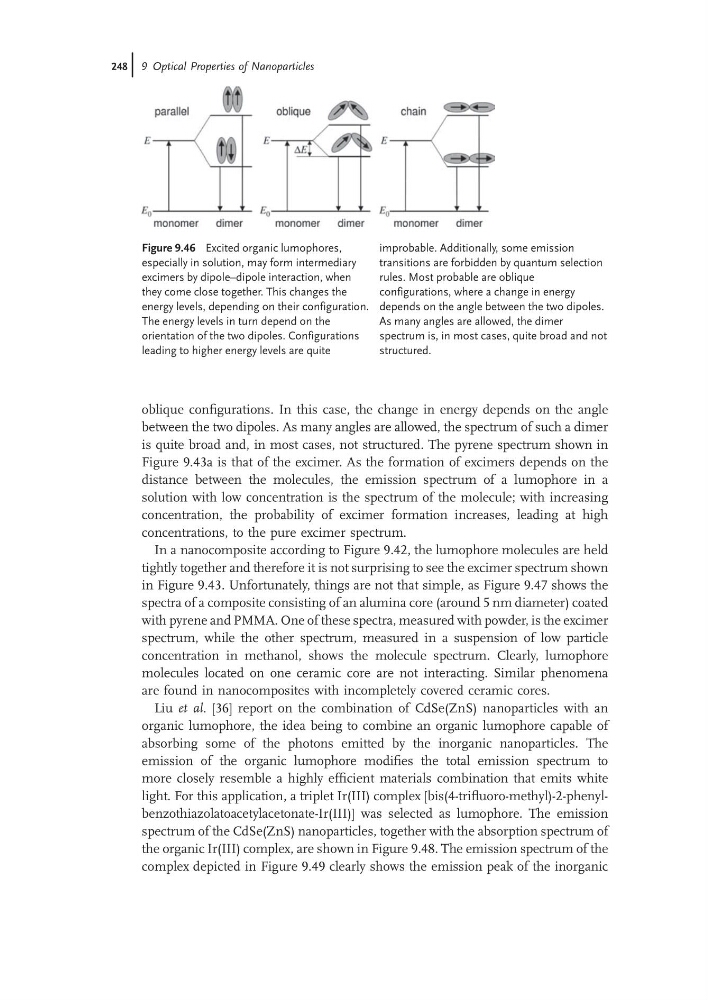
oblique configurations. In this case, the change in energy depends on the angle
between the two dipoles. As many angles are allowed, the spectrum of such a dimer
is quite broad and, in most cases, not structured. The pyrene spectrum shown in
Figure 9.43a is that of the excimer. As the formation of excimers depends on the
distance between the molecules, the emission spectrum of a lumophore in a
solution with low concentration is the spectrum of the molecule; with increasing
concentration, the probability of excimer formation increases, leading at high
concentrations, to the pure excimer spectrum.
In a nanocomposite according to Figure 9.42, the lumophore molecules are held
tightly together and therefore it is not surprising to see the excimer spectrum shown
in Figure 9.43. Unfortunately, things are not that simple, as Figure 9.47 shows the
spectra of a composite consisting of an alumina core (around 5 nm diameter) coated
with pyrene and PMMA. One of these spectra, measured with powder, is the excimer
spectrum, while the other spectrum, measured in a suspension of low particle
concentration in methanol, shows the molecule spectrum. Clearly, lumophore
molecules located on one ceramic core are not interacting. Similar phenomena
are found in nanocomposites with incompletely covered ceramic cores.
Liu et al. [36] report on the combination of CdSe(ZnS) nanoparticles with an
organic lumophore, the idea being to combine an organic lumophore capable of
absorbing some of the photons emitted by the inorganic nanoparticles. The
emission of the organic lumophore modifies the total emission spectrum to
more closely resemble a highly efficient materials combination that emits white
light. For this application, a triplet Ir(III) complex [bis(4-trifluoro-methyl)-2-phenylbenzothiazolatoacetylacetonate-Ir(III)] was selected as lumophore. The emission
spectrum of the CdSe(ZnS) nanoparticles, together with the absorption spectrum of
the organic Ir(III) complex, are shown in Figure 9.48. The emission spectrum of the
complex depicted in Figure 9.49 clearly shows the emission peak of the inorganic
Figure 9.46 Excited organic lumophores,
especially in solution, may form intermediary
excimers by dipole–dipole interaction, when
they come close together. This changes the
energy levels, depending on their configuration.
The energy levels in turn depend on the
orientation of the two dipoles. Configurations
leading to higher energy levels are quite
improbable. Additionally, some emission
transitions are forbidden by quantum selection
rules. Most probable are oblique
configurations, where a change in energy
depends on the angle between the two dipoles.
As many angles are allowed, the dimer
spectrum is, in most cases, quite broad and not
structured.
248j 9 Optical Properties of Nanoparticles
between the two dipoles. As many angles are allowed, the spectrum of such a dimer
is quite broad and, in most cases, not structured. The pyrene spectrum shown in
Figure 9.43a is that of the excimer. As the formation of excimers depends on the
distance between the molecules, the emission spectrum of a lumophore in a
solution with low concentration is the spectrum of the molecule; with increasing
concentration, the probability of excimer formation increases, leading at high
concentrations, to the pure excimer spectrum.
In a nanocomposite according to Figure 9.42, the lumophore molecules are held
tightly together and therefore it is not surprising to see the excimer spectrum shown
in Figure 9.43. Unfortunately, things are not that simple, as Figure 9.47 shows the
spectra of a composite consisting of an alumina core (around 5 nm diameter) coated
with pyrene and PMMA. One of these spectra, measured with powder, is the excimer
spectrum, while the other spectrum, measured in a suspension of low particle
concentration in methanol, shows the molecule spectrum. Clearly, lumophore
molecules located on one ceramic core are not interacting. Similar phenomena
are found in nanocomposites with incompletely covered ceramic cores.
Liu et al. [36] report on the combination of CdSe(ZnS) nanoparticles with an
organic lumophore, the idea being to combine an organic lumophore capable of
absorbing some of the photons emitted by the inorganic nanoparticles. The
emission of the organic lumophore modifies the total emission spectrum to
more closely resemble a highly efficient materials combination that emits white
light. For this application, a triplet Ir(III) complex [bis(4-trifluoro-methyl)-2-phenylbenzothiazolatoacetylacetonate-Ir(III)] was selected as lumophore. The emission
spectrum of the CdSe(ZnS) nanoparticles, together with the absorption spectrum of
the organic Ir(III) complex, are shown in Figure 9.48. The emission spectrum of the
complex depicted in Figure 9.49 clearly shows the emission peak of the inorganic
Figure 9.46 Excited organic lumophores,
especially in solution, may form intermediary
excimers by dipole–dipole interaction, when
they come close together. This changes the
energy levels, depending on their configuration.
The energy levels in turn depend on the
orientation of the two dipoles. Configurations
leading to higher energy levels are quite
improbable. Additionally, some emission
transitions are forbidden by quantum selection
rules. Most probable are oblique
configurations, where a change in energy
depends on the angle between the two dipoles.
As many angles are allowed, the dimer
spectrum is, in most cases, quite broad and not
structured.
248j 9 Optical Properties of Nanoparticles