

then annealed at different temperatures. While the silver-doped coatings deposited
on silica substrates did not exhibit any luminescence, the coatings on soda-lime
substrates excelled with intense emission in the UV, with a maximum at 320 nm. Up
to 648 K, the intensity increased with annealing temperature, but at higher annealing temperatures, the photoluminescence intensity decreased (see Figure 9.40).
This emission is well known and ascribed to the presence of Ag
þ ions in the glass
matrix, and not to the precipitation of silver nanoparticles. The difference between
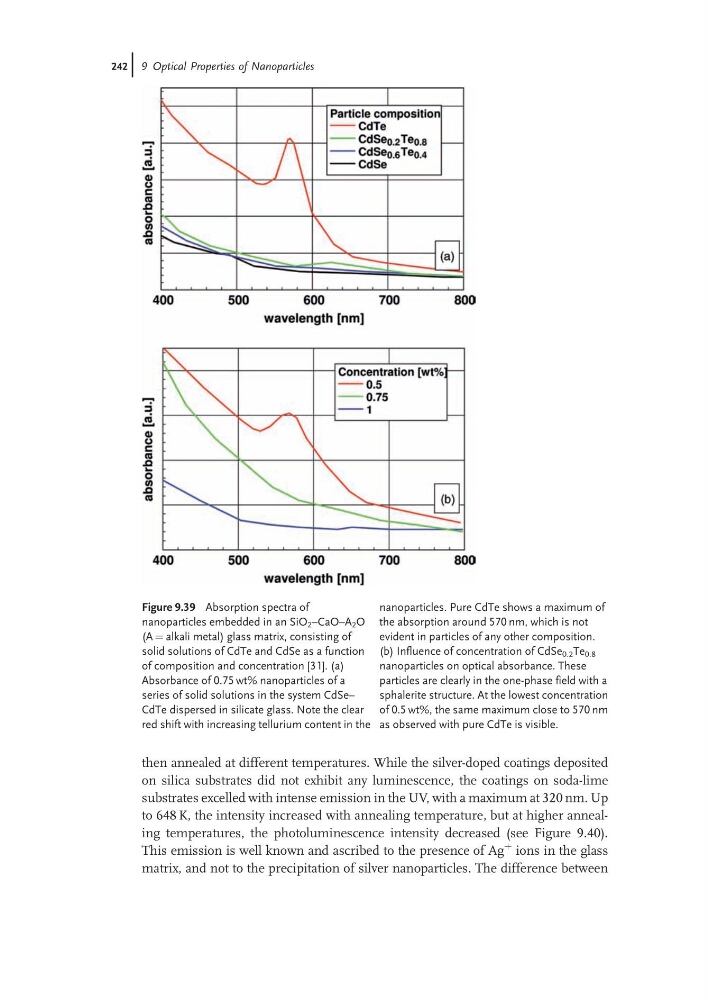
Figure 9.39 Absorption spectra of
nanoparticles embedded in an SiO 2 –CaO–A 2 O
(A ¼ alkali metal) glass matrix, consisting of
solid solutions of CdTe and CdSe as a function
of composition and concentration [31]. (a)
Absorbance of 0.75 wt% nanoparticles of a
series of solid solutions in the system CdSe–
CdTe dispersed in silicate glass. Note the clear
red shift with increasing tellurium content in the
nanoparticles. Pure CdTe shows a maximum of
the absorption around 570 nm, which is not
evident in particles of any other composition.
(b) Influence of concentration of CdSe 0.2 Te 0.8
nanoparticles on optical absorbance. These
particles are clearly in the one-phase field with a
sphalerite structure. At the lowest concentration
of 0.5 wt%, the same maximum close to 570 nm
as observed with pure CdTe is visible.
242j 9 Optical Properties of Nanoparticles
on silica substrates did not exhibit any luminescence, the coatings on soda-lime
substrates excelled with intense emission in the UV, with a maximum at 320 nm. Up
to 648 K, the intensity increased with annealing temperature, but at higher annealing temperatures, the photoluminescence intensity decreased (see Figure 9.40).
This emission is well known and ascribed to the presence of Ag
þ ions in the glass
matrix, and not to the precipitation of silver nanoparticles. The difference between
Figure 9.39 Absorption spectra of
nanoparticles embedded in an SiO 2 –CaO–A 2 O
(A ¼ alkali metal) glass matrix, consisting of
solid solutions of CdTe and CdSe as a function
of composition and concentration [31]. (a)
Absorbance of 0.75 wt% nanoparticles of a
series of solid solutions in the system CdSe–
CdTe dispersed in silicate glass. Note the clear
red shift with increasing tellurium content in the
nanoparticles. Pure CdTe shows a maximum of
the absorption around 570 nm, which is not
evident in particles of any other composition.
(b) Influence of concentration of CdSe 0.2 Te 0.8
nanoparticles on optical absorbance. These
particles are clearly in the one-phase field with a
sphalerite structure. At the lowest concentration
of 0.5 wt%, the same maximum close to 570 nm
as observed with pure CdTe is visible.
242j 9 Optical Properties of Nanoparticles