

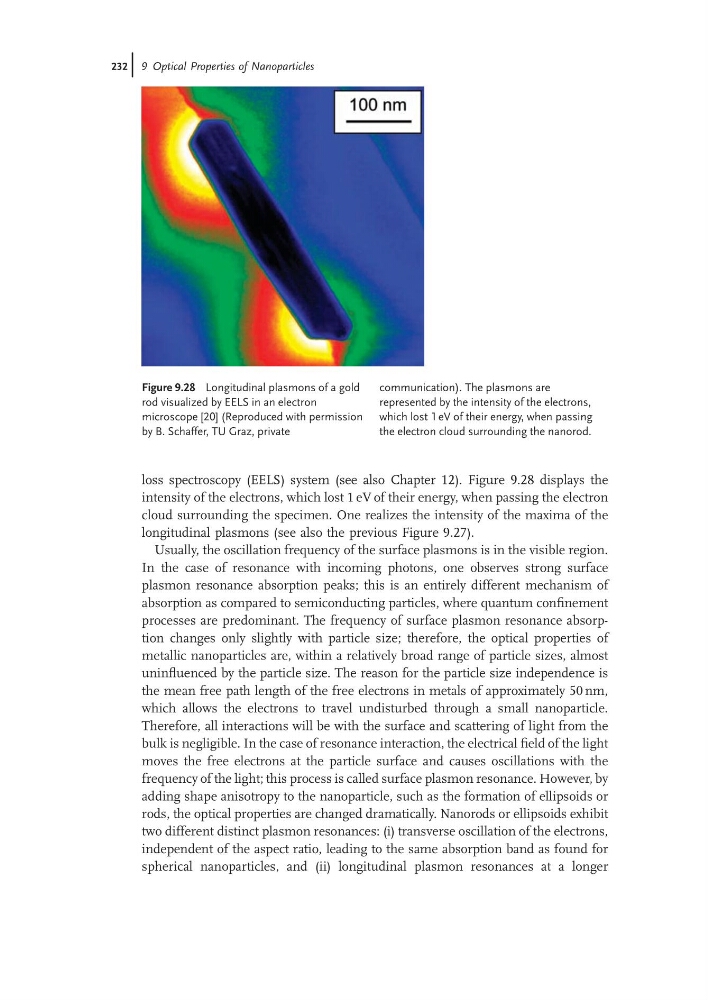
loss spectroscopy (EELS) system (see also Chapter 12). Figure 9.28 displays the
intensity of the electrons, which lost 1 eV of their energy, when passing the electron
cloud surrounding the specimen. One realizes the intensity of the maxima of the
longitudinal plasmons (see also the previous Figure 9.27).
Usually, the oscillation frequency of the surface plasmons is in the visible region.
In the case of resonance with incoming photons, one observes strong surface
plasmon resonance absorption peaks; this is an entirely different mechanism of
absorption as compared to semiconducting particles, where quantum confinement
processes are predominant. The frequency of surface plasmon resonance absorption changes only slightly with particle size; therefore, the optical properties of
metallic nanoparticles are, within a relatively broad range of particle sizes, almost
uninfluenced by the particle size. The reason for the particle size independence is
the mean free path length of the free electrons in metals of approximately 50 nm,
which allows the electrons to travel undisturbed through a small nanoparticle.
Therefore, all interactions will be with the surface and scattering of light from the
bulk is negligible. In the case of resonance interaction, the electrical field of the light
moves the free electrons at the particle surface and causes oscillations with the
frequency of the light; this process is called surface plasmon resonance. However, by
adding shape anisotropy to the nanoparticle, such as the formation of ellipsoids or
rods, the optical properties are changed dramatically. Nanorods or ellipsoids exhibit
two different distinct plasmon resonances: (i) transverse oscillation of the electrons,
independent of the aspect ratio, leading to the same absorption band as found for
spherical nanoparticles, and (ii) longitudinal plasmon resonances at a longer
Figure 9.28 Longitudinal plasmons of a gold
rod visualized by EELS in an electron
microscope [20] (Reproduced with permission
by B. Schaffer, TU Graz, private
communication). The plasmons are
represented by the intensity of the electrons,
which lost 1 eV of their energy, when passing
the electron cloud surrounding the nanorod.
232j 9 Optical Properties of Nanoparticles
intensity of the electrons, which lost 1 eV of their energy, when passing the electron
cloud surrounding the specimen. One realizes the intensity of the maxima of the
longitudinal plasmons (see also the previous Figure 9.27).
Usually, the oscillation frequency of the surface plasmons is in the visible region.
In the case of resonance with incoming photons, one observes strong surface
plasmon resonance absorption peaks; this is an entirely different mechanism of
absorption as compared to semiconducting particles, where quantum confinement
processes are predominant. The frequency of surface plasmon resonance absorption changes only slightly with particle size; therefore, the optical properties of
metallic nanoparticles are, within a relatively broad range of particle sizes, almost
uninfluenced by the particle size. The reason for the particle size independence is
the mean free path length of the free electrons in metals of approximately 50 nm,
which allows the electrons to travel undisturbed through a small nanoparticle.
Therefore, all interactions will be with the surface and scattering of light from the
bulk is negligible. In the case of resonance interaction, the electrical field of the light
moves the free electrons at the particle surface and causes oscillations with the
frequency of the light; this process is called surface plasmon resonance. However, by
adding shape anisotropy to the nanoparticle, such as the formation of ellipsoids or
rods, the optical properties are changed dramatically. Nanorods or ellipsoids exhibit
two different distinct plasmon resonances: (i) transverse oscillation of the electrons,
independent of the aspect ratio, leading to the same absorption band as found for
spherical nanoparticles, and (ii) longitudinal plasmon resonances at a longer
Figure 9.28 Longitudinal plasmons of a gold
rod visualized by EELS in an electron
microscope [20] (Reproduced with permission
by B. Schaffer, TU Graz, private
communication). The plasmons are
represented by the intensity of the electrons,
which lost 1 eV of their energy, when passing
the electron cloud surrounding the nanorod.
232j 9 Optical Properties of Nanoparticles