

Comparable phenomena have been described for many other combinations of
oxides with polymers. Typical examples are the incorporation of oxide nanoparticles
in poly(p-phenylene vinylene (PPV) and poly(2-(6-cyano-6b-methylheptyloxy)-1,4phenylene) [19].
9.5
Metallic and Semiconducting Nanoparticles Isolated and in Transparent Matrices
The free electrons in the incompletely filled conduction band of a metal move
collectively in discrete waves. The metal particle is embedded in a cloud of electrons
(see Figure 9.6). As with a quantized lattice, the vibrations are called phonons and the
quantized waves of the free electrons are plasmons. This cloud oscillates relative to
the lattice consisting of the positive charged atomic cores of the metal in different
quantized modes – the plasmons. At the metallic surfaces, light with frequencies
below the frequency of the surface plasmons is reflected. For most metals the
plasmon frequency is in the UV range and therefore these have a “metallic luster” in
the visible range. Very few metals (e.g., copper, gold, and a few alloys) have plasmon
frequencies in the visible range and this leads to their typical colors. Plasmon
frequencies in the IR region are observed in highly doped semiconductors.
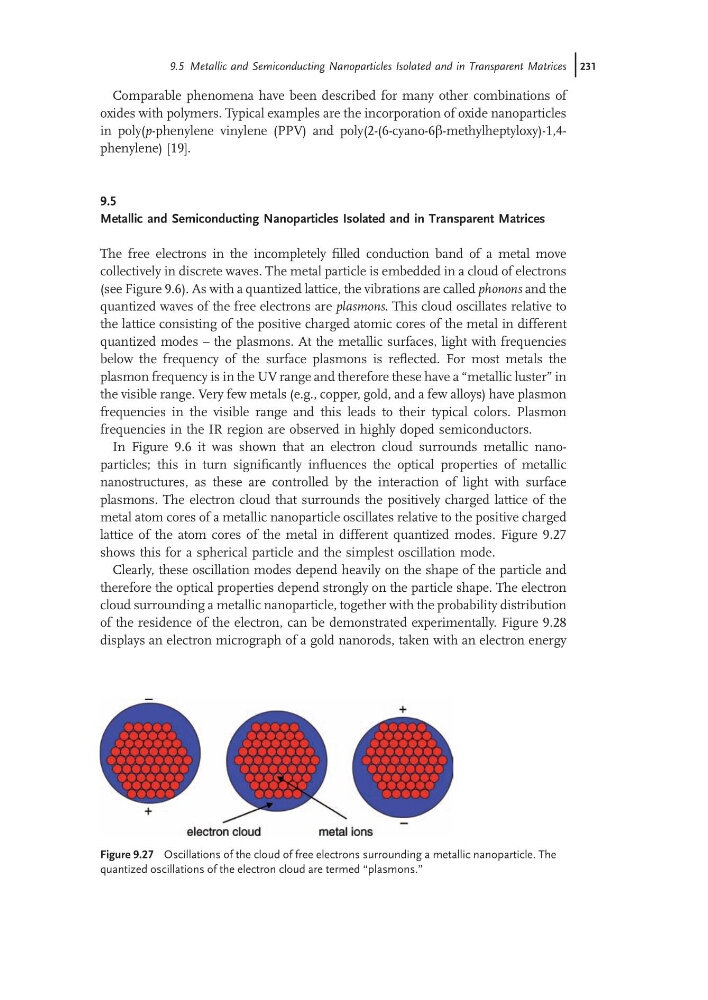
In Figure 9.6 it was shown that an electron cloud surrounds metallic nanoparticles; this in turn significantly influences the optical properties of metallic
nanostructures, as these are controlled by the interaction of light with surface
plasmons. The electron cloud that surrounds the positively charged lattice of the
metal atom cores of a metallic nanoparticle oscillates relative to the positive charged
lattice of the atom cores of the metal in different quantized modes. Figure 9.27
shows this for a spherical particle and the simplest oscillation mode.
Clearly, these oscillation modes depend heavily on the shape of the particle and
therefore the optical properties depend strongly on the particle shape. The electron
cloud surrounding a metallic nanoparticle, together with the probability distribution
of the residence of the electron, can be demonstrated experimentally. Figure 9.28
displays an electron micrograph of a gold nanorods, taken with an electron energy
Figure 9.27 Oscillations of the cloud of free electrons surrounding a metallic nanoparticle. The
quantized oscillations of the electron cloud are termed “plasmons.”
9.5 Metallic and Semiconducting Nanoparticles Isolated and in Transparent Matrices j231
oxides with polymers. Typical examples are the incorporation of oxide nanoparticles
in poly(p-phenylene vinylene (PPV) and poly(2-(6-cyano-6b-methylheptyloxy)-1,4phenylene) [19].
9.5
Metallic and Semiconducting Nanoparticles Isolated and in Transparent Matrices
The free electrons in the incompletely filled conduction band of a metal move
collectively in discrete waves. The metal particle is embedded in a cloud of electrons
(see Figure 9.6). As with a quantized lattice, the vibrations are called phonons and the
quantized waves of the free electrons are plasmons. This cloud oscillates relative to
the lattice consisting of the positive charged atomic cores of the metal in different
quantized modes – the plasmons. At the metallic surfaces, light with frequencies
below the frequency of the surface plasmons is reflected. For most metals the
plasmon frequency is in the UV range and therefore these have a “metallic luster” in
the visible range. Very few metals (e.g., copper, gold, and a few alloys) have plasmon
frequencies in the visible range and this leads to their typical colors. Plasmon
frequencies in the IR region are observed in highly doped semiconductors.
In Figure 9.6 it was shown that an electron cloud surrounds metallic nanoparticles; this in turn significantly influences the optical properties of metallic
nanostructures, as these are controlled by the interaction of light with surface
plasmons. The electron cloud that surrounds the positively charged lattice of the
metal atom cores of a metallic nanoparticle oscillates relative to the positive charged
lattice of the atom cores of the metal in different quantized modes. Figure 9.27
shows this for a spherical particle and the simplest oscillation mode.
Clearly, these oscillation modes depend heavily on the shape of the particle and
therefore the optical properties depend strongly on the particle shape. The electron
cloud surrounding a metallic nanoparticle, together with the probability distribution
of the residence of the electron, can be demonstrated experimentally. Figure 9.28
displays an electron micrograph of a gold nanorods, taken with an electron energy
Figure 9.27 Oscillations of the cloud of free electrons surrounding a metallic nanoparticle. The
quantized oscillations of the electron cloud are termed “plasmons.”
9.5 Metallic and Semiconducting Nanoparticles Isolated and in Transparent Matrices j231