

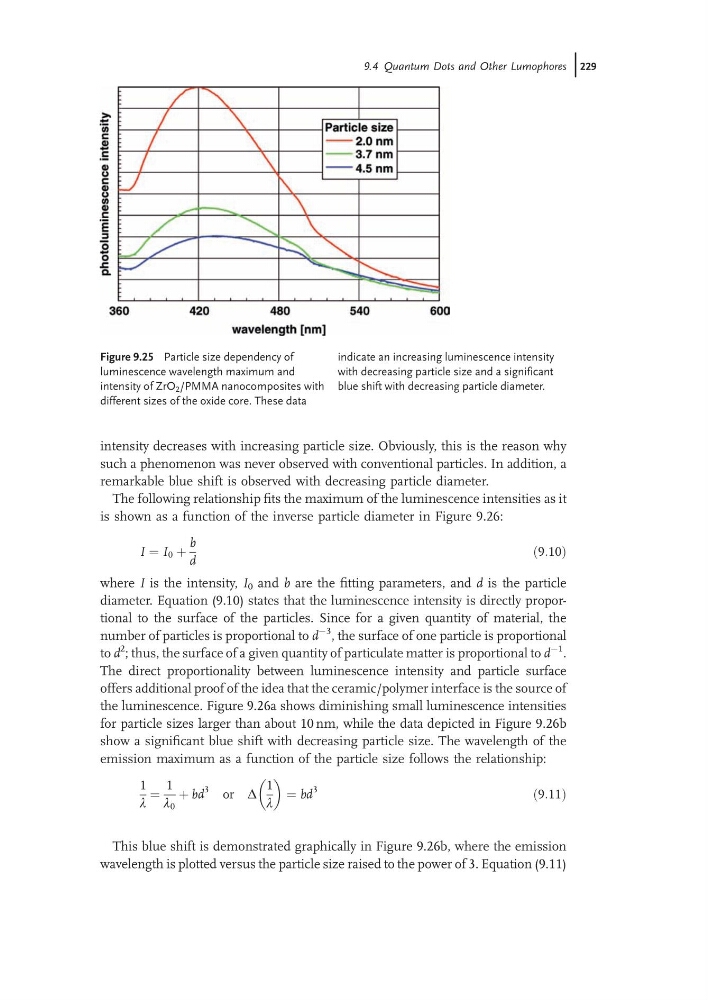
intensity decreases with increasing particle size. Obviously, this is the reason why
such a phenomenon was never observed with conventional particles. In addition, a
remarkable blue shift is observed with decreasing particle diameter.
The following relationship fits the maximum of the luminescence intensities as it
is shown as a function of the inverse particle diameter in Figure 9.26:
I ¼ I 0 þ
b
d
ð9:10Þ
where I is the intensity, I 0 and b are the fitting parameters, and d is the particle
diameter. Equation (9.10) states that the luminescence intensity is directly proportional to the surface of the particles. Since for a given quantity of material, the
number of particles is proportional to d
À3 , the surface of one particle is proportional
to d
2
; thus, the surface of a given quantity of particulate matter is proportional to d
À1
.
The direct proportionality between luminescence intensity and particle surface
offers additional proof of the idea that the ceramic/polymer interface is the source of
the luminescence. Figure 9.26a shows diminishing small luminescence intensities
for particle sizes larger than about 10 nm, while the data depicted in Figure 9.26b
show a significant blue shift with decreasing particle size. The wavelength of the
emission maximum as a function of the particle size follows the relationship:
1
l
¼
1
l 0
þ bd
3
or D
1
l
¼ bd
3
ð9:11Þ
This blue shift is demonstrated graphically in Figure 9.26b, where the emission
wavelength is plotted versus the particle size raised to the power of 3. Equation (9.11)
Figure 9.25 Particle size dependency of
luminescence wavelength maximum and
intensity of ZrO 2 /PMMA nanocomposites with
different sizes of the oxide core. These data
indicate an increasing luminescence intensity
with decreasing particle size and a significant
blue shift with decreasing particle diameter.
9.4 Quantum Dots and Other Lumophores j229
such a phenomenon was never observed with conventional particles. In addition, a
remarkable blue shift is observed with decreasing particle diameter.
The following relationship fits the maximum of the luminescence intensities as it
is shown as a function of the inverse particle diameter in Figure 9.26:
I ¼ I 0 þ
b
d
ð9:10Þ
where I is the intensity, I 0 and b are the fitting parameters, and d is the particle
diameter. Equation (9.10) states that the luminescence intensity is directly proportional to the surface of the particles. Since for a given quantity of material, the
number of particles is proportional to d
À3 , the surface of one particle is proportional
to d
2
; thus, the surface of a given quantity of particulate matter is proportional to d
À1
.
The direct proportionality between luminescence intensity and particle surface
offers additional proof of the idea that the ceramic/polymer interface is the source of
the luminescence. Figure 9.26a shows diminishing small luminescence intensities
for particle sizes larger than about 10 nm, while the data depicted in Figure 9.26b
show a significant blue shift with decreasing particle size. The wavelength of the
emission maximum as a function of the particle size follows the relationship:
1
l
¼
1
l 0
þ bd
3
or D
1
l
¼ bd
3
ð9:11Þ
This blue shift is demonstrated graphically in Figure 9.26b, where the emission
wavelength is plotted versus the particle size raised to the power of 3. Equation (9.11)
Figure 9.25 Particle size dependency of
luminescence wavelength maximum and
intensity of ZrO 2 /PMMA nanocomposites with
different sizes of the oxide core. These data
indicate an increasing luminescence intensity
with decreasing particle size and a significant
blue shift with decreasing particle diameter.
9.4 Quantum Dots and Other Lumophores j229