

The most important feature in Figure 9.23 is the carbonyl group located directly at
the surface of the nanoparticle. As with biacetyl, CH 3 À À(CÀ À
À ÀO)À À(CÀ À
À ÀO)À ÀCH 3 , this
carbonyl group is responsible for luminescence [17]. In the m-PMMA system, where
a carbonyl group is close to the ceramic surface, the same mechanism is in
operation, this having been proven by using the smallest molecule with a carboxylate
group binding similarly to the ceramic surface. Here, formic acid methylester
(FAME), HÀ À(CÀ À
À ÀO)À ÀOÀ ÀCH 3 , was selected for particle coating instead of MMA.
The FAME molecules bind, in a similar manner as m-PMMA, to the surface,
thus forming HÀ À(CÀ À
À ÀO)À ÀOÀ À (oxide particle). As oxide particles coated with
poly(hydroxypropyl methacrylate) (PHPMA) show only very weak luminescence, the
particles were coated additionally with this compound. The difference from PMMA
occurs because, in the case of PHPMA, the OH
À group binds with greater
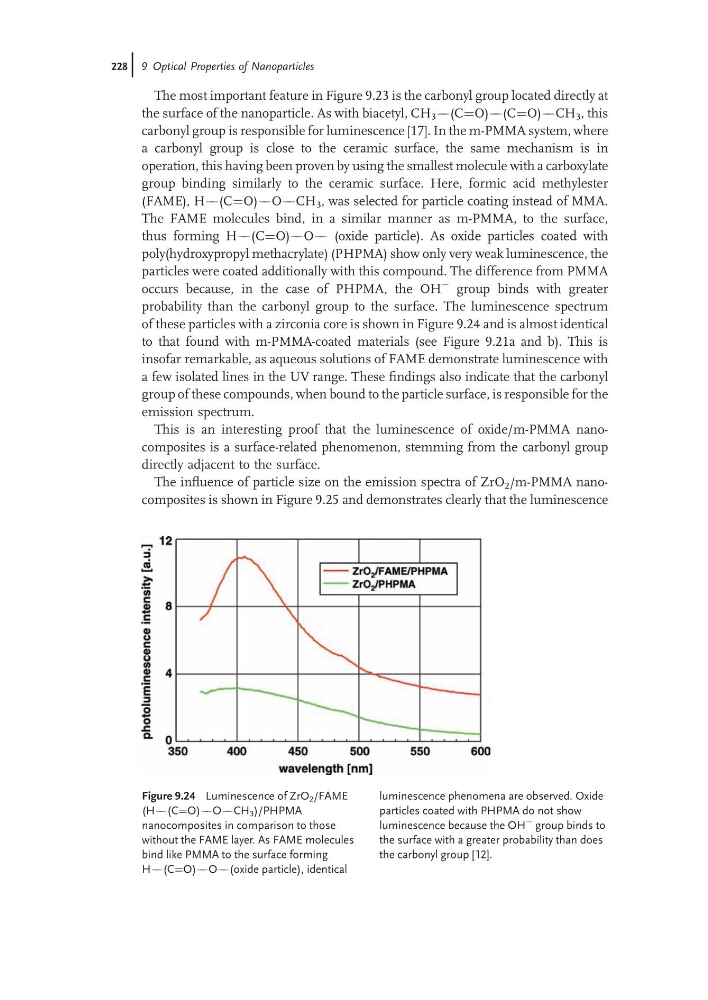
probability than the carbonyl group to the surface. The luminescence spectrum
of these particles with a zirconia core is shown in Figure 9.24 and is almost identical
to that found with m-PMMA-coated materials (see Figure 9.21a and b). This is
insofar remarkable, as aqueous solutions of FAME demonstrate luminescence with
a few isolated lines in the UV range. These findings also indicate that the carbonyl
group of these compounds, when bound to the particle surface, is responsible for the
emission spectrum.
This is an interesting proof that the luminescence of oxide/m-PMMA nanocomposites is a surface-related phenomenon, stemming from the carbonyl group
directly adjacent to the surface.
The influence of particle size on the emission spectra of ZrO 2 /m-PMMA nanocomposites is shown in Figure 9.25 and demonstrates clearly that the luminescence
Figure 9.24 Luminescence of ZrO 2 /FAME
(HÀ À(CÀ À
À ÀO)À ÀOÀ ÀCH 3 )/PHPMA
nanocomposites in comparison to those
without the FAME layer. As FAME molecules
bind like PMMA to the surface forming
HÀ À(CÀ À
À ÀO)À ÀOÀ À(oxide particle), identical
luminescence phenomena are observed. Oxide
particles coated with PHPMA do not show
luminescence because the OH
À group binds to
the surface with a greater probability than does
the carbonyl group [12].
228j 9 Optical Properties of Nanoparticles
the surface of the nanoparticle. As with biacetyl, CH 3 À À(CÀ À
À ÀO)À À(CÀ À
À ÀO)À ÀCH 3 , this
carbonyl group is responsible for luminescence [17]. In the m-PMMA system, where
a carbonyl group is close to the ceramic surface, the same mechanism is in
operation, this having been proven by using the smallest molecule with a carboxylate
group binding similarly to the ceramic surface. Here, formic acid methylester
(FAME), HÀ À(CÀ À
À ÀO)À ÀOÀ ÀCH 3 , was selected for particle coating instead of MMA.
The FAME molecules bind, in a similar manner as m-PMMA, to the surface,
thus forming HÀ À(CÀ À
À ÀO)À ÀOÀ À (oxide particle). As oxide particles coated with
poly(hydroxypropyl methacrylate) (PHPMA) show only very weak luminescence, the
particles were coated additionally with this compound. The difference from PMMA
occurs because, in the case of PHPMA, the OH
À group binds with greater
probability than the carbonyl group to the surface. The luminescence spectrum
of these particles with a zirconia core is shown in Figure 9.24 and is almost identical
to that found with m-PMMA-coated materials (see Figure 9.21a and b). This is
insofar remarkable, as aqueous solutions of FAME demonstrate luminescence with
a few isolated lines in the UV range. These findings also indicate that the carbonyl
group of these compounds, when bound to the particle surface, is responsible for the
emission spectrum.
This is an interesting proof that the luminescence of oxide/m-PMMA nanocomposites is a surface-related phenomenon, stemming from the carbonyl group
directly adjacent to the surface.
The influence of particle size on the emission spectra of ZrO 2 /m-PMMA nanocomposites is shown in Figure 9.25 and demonstrates clearly that the luminescence
Figure 9.24 Luminescence of ZrO 2 /FAME
(HÀ À(CÀ À
À ÀO)À ÀOÀ ÀCH 3 )/PHPMA
nanocomposites in comparison to those
without the FAME layer. As FAME molecules
bind like PMMA to the surface forming
HÀ À(CÀ À
À ÀO)À ÀOÀ À(oxide particle), identical
luminescence phenomena are observed. Oxide
particles coated with PHPMA do not show
luminescence because the OH
À group binds to
the surface with a greater probability than does
the carbonyl group [12].
228j 9 Optical Properties of Nanoparticles