

Again, this example clearly demonstrates the possibility of adjusting the optical
properties – in this case “color” – by the particle size that, in this example, is adjusted
by annealing at different temperatures.
These elementary considerations are valid for isolated particles and composites
with low concentrations of particles. Otherwise, the properties are defined rather by
the distance between the particles than by their number. Often, the excited nanoparticles form a dipole and, as in the case of organic lumophores, these dipoles may
interact. Although the distance of interaction is, at maximum, 10 or 15 nm, the
interacting dipoles give rise to excimer (see Section 9.6) formation and this may lead
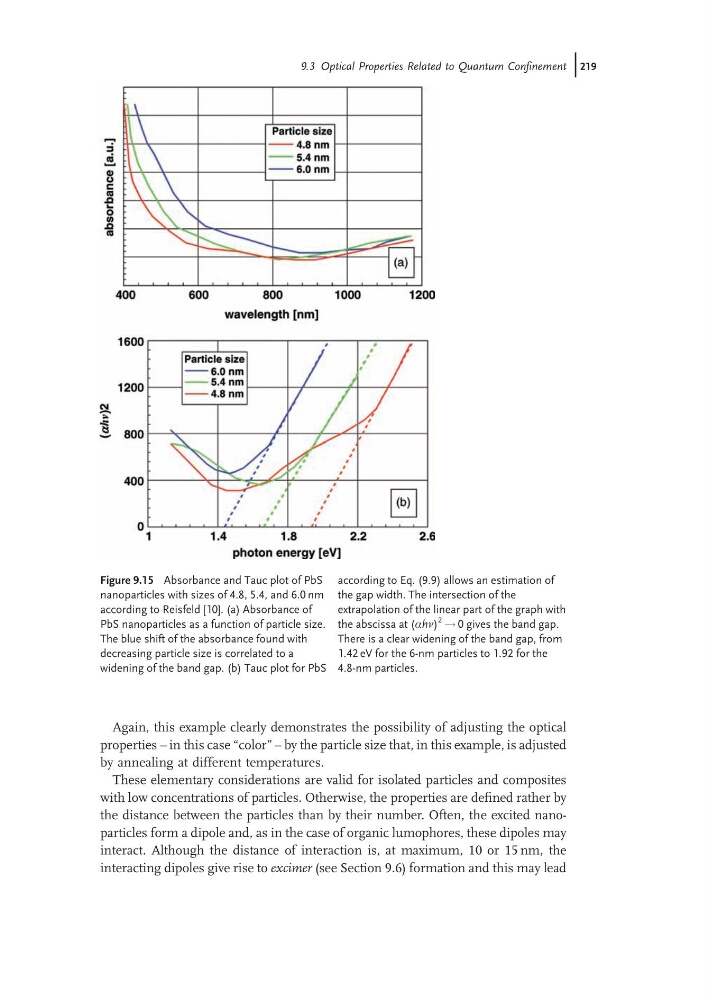
Figure 9.15 Absorbance and Tauc plot of PbS
nanoparticles with sizes of 4.8, 5.4, and 6.0 nm
according to Reisfeld [10]. (a) Absorbance of
PbS nanoparticles as a function of particle size.
The blue shift of the absorbance found with
decreasing particle size is correlated to a
widening of the band gap. (b) Tauc plot for PbS
according to Eq. (9.9) allows an estimation of
the gap width. The intersection of the
extrapolation of the linear part of the graph with
the abscissa at (ahn)
2 ! 0 gives the band gap.
There is a clear widening of the band gap, from
1.42 eV for the 6-nm particles to 1.92 for the
4.8-nm particles.
9.3 Optical Properties Related to Quantum Confinement j219
properties – in this case “color” – by the particle size that, in this example, is adjusted
by annealing at different temperatures.
These elementary considerations are valid for isolated particles and composites
with low concentrations of particles. Otherwise, the properties are defined rather by
the distance between the particles than by their number. Often, the excited nanoparticles form a dipole and, as in the case of organic lumophores, these dipoles may
interact. Although the distance of interaction is, at maximum, 10 or 15 nm, the
interacting dipoles give rise to excimer (see Section 9.6) formation and this may lead
Figure 9.15 Absorbance and Tauc plot of PbS
nanoparticles with sizes of 4.8, 5.4, and 6.0 nm
according to Reisfeld [10]. (a) Absorbance of
PbS nanoparticles as a function of particle size.
The blue shift of the absorbance found with
decreasing particle size is correlated to a
widening of the band gap. (b) Tauc plot for PbS
according to Eq. (9.9) allows an estimation of
the gap width. The intersection of the
extrapolation of the linear part of the graph with
the abscissa at (ahn)
2 ! 0 gives the band gap.
There is a clear widening of the band gap, from
1.42 eV for the 6-nm particles to 1.92 for the
4.8-nm particles.
9.3 Optical Properties Related to Quantum Confinement j219