

The properties of a densified solid may also be adjusted gradually with the thickness
of the coating. Depending on the requirements of the system in question, the
coating material may be either ceramic or polymer. In addition, by coating nanoparticles with second and third layers, the following improvements are obtained:
The distribution of the two phases is homogeneous on a nanometer scale.
The kernels are arranged at a well-defined distance; therefore, the interaction of
the particles is controlled.
The kernel and one or more different coatings may have different properties (e.g.,
ferromagnetism and luminescence); this allows a combination of properties in
one particle that would never exist together in nature (bifunctional materials [2])
In addition, by selecting a proper polymer for the outermost coating it is possible
to adjust the interaction with the surrounding medium (e.g., hydrophilic or
hydrophobic coatings may be selected).
During densification (i.e., sintering) the growth of the kernels is thwarted,
provided that the core and coating show no mutual solubility. An example of
this is shown in Figure 2.6.
These arguments confirm that coated nanoparticles, first described by Vollath and
Szab o [3,6], represent the most advanced type of nanocomposite because they allow:
Different properties to be combined in one particle.
Exactly adjusted distances to be inserted between directly adjacent particles in the
case of densified bodies.
Today, coated particles are widely used in biology and medicine [2], although for
this it may be necessary to add proteins or other biological molecules at the surface
of the particles. Such molecules are attached via specific linking molecules and
accommodated in the outermost coupling layer. A biologically functionalized
particle is shown schematically in Figure 2.10, where the ceramic core is usually
either magnetic or luminescent. Recent developments in the combination of these
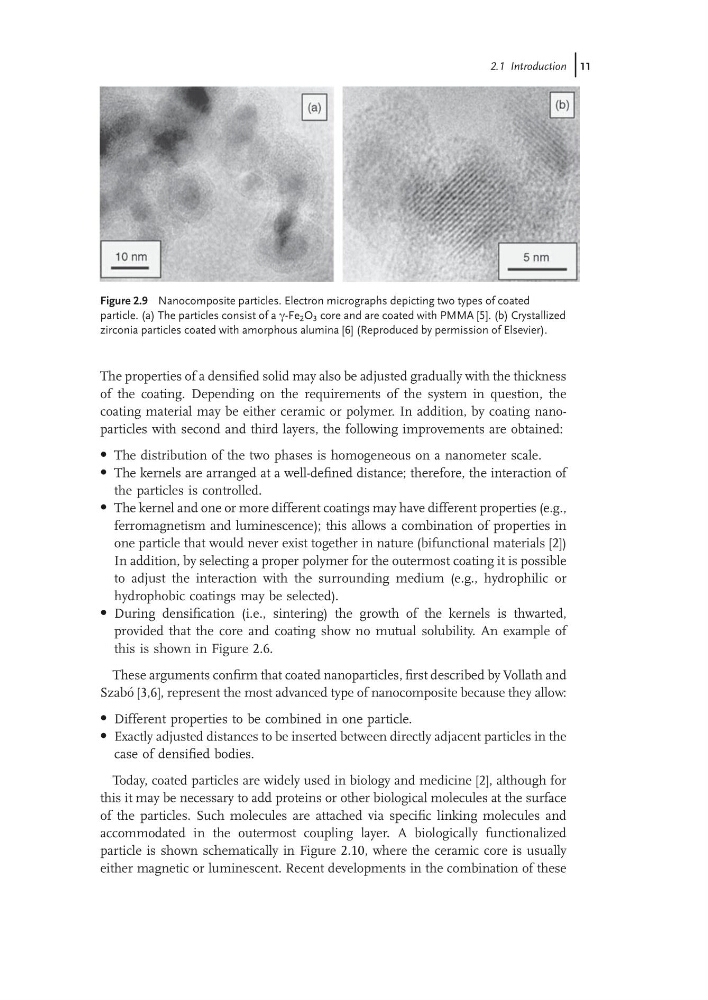
Figure 2.9 Nanocomposite particles. Electron micrographs depicting two types of coated
particle. (a) The particles consist of a c-Fe 2 O 3 core and are coated with PMMA [5]. (b) Crystallized
zirconia particles coated with amorphous alumina [6] (Reproduced by permission of Elsevier).
2.1 Introduction j11
of the coating. Depending on the requirements of the system in question, the
coating material may be either ceramic or polymer. In addition, by coating nanoparticles with second and third layers, the following improvements are obtained:
The distribution of the two phases is homogeneous on a nanometer scale.
The kernels are arranged at a well-defined distance; therefore, the interaction of
the particles is controlled.
The kernel and one or more different coatings may have different properties (e.g.,
ferromagnetism and luminescence); this allows a combination of properties in
one particle that would never exist together in nature (bifunctional materials [2])
In addition, by selecting a proper polymer for the outermost coating it is possible
to adjust the interaction with the surrounding medium (e.g., hydrophilic or
hydrophobic coatings may be selected).
During densification (i.e., sintering) the growth of the kernels is thwarted,
provided that the core and coating show no mutual solubility. An example of
this is shown in Figure 2.6.
These arguments confirm that coated nanoparticles, first described by Vollath and
Szab o [3,6], represent the most advanced type of nanocomposite because they allow:
Different properties to be combined in one particle.
Exactly adjusted distances to be inserted between directly adjacent particles in the
case of densified bodies.
Today, coated particles are widely used in biology and medicine [2], although for
this it may be necessary to add proteins or other biological molecules at the surface
of the particles. Such molecules are attached via specific linking molecules and
accommodated in the outermost coupling layer. A biologically functionalized
particle is shown schematically in Figure 2.10, where the ceramic core is usually
either magnetic or luminescent. Recent developments in the combination of these
Figure 2.9 Nanocomposite particles. Electron micrographs depicting two types of coated
particle. (a) The particles consist of a c-Fe 2 O 3 core and are coated with PMMA [5]. (b) Crystallized
zirconia particles coated with amorphous alumina [6] (Reproduced by permission of Elsevier).
2.1 Introduction j11