

where E 0 and K are constant values, and a is, in most cases, a noninteger number.
One reason for the noninteger exponents is simply that, in most cases, there is not a
single well-defined particle size, but rather a particle size distribution.
When considering materials in the “real world,” a distinction must be made
between metals, semiconductors, and insulators. In metals, the highest occupied
band is not completely filled and therefore the movement of electrons (which is
equivalent to electric conduction) is possible. These are termed “free” electrons. In
contrast, in semiconductors and insulators the last occupied band is filled completely and, as free electrons are not available, then electric conduction is impossible.
In semiconductors, however, the energy gap is so narrow that some of the electrons
have sufficient energy to jump, when thermally activated, into the next band. This
creates electron “holes” in the originally filled band and free electrons in the next
(initially empty) band; as a consequence, the conduction of electricity becomes
possible (see Figure 9.8). (In doped semiconductors, additional, isolated energy
levels are created in this gap and this also leads to electrical conductivity.)
In Figure 9.8, the level of the Fermi energy is also indicated. At absolute zero
temperature, the Fermi energy E F is the energy level of the least tightly bond electron
within a solid. Together with the energy of the gap E g , the Fermi energy level is an
important parameter when characterizing a solid. With nanoparticulate semiconductors it is clear that, in the case of decreasing particle size, the band gap widens,
and this may have the consequence that semiconductors will increasingly acquire
the properties of insulators.
The electrons in the incompletely filled conduction band of a metal are called “free
electrons;” in crude terms, such electrons behave like water in a pot, in that they
move collectively in discrete waves called “plasmons” (this point is discussed in
detail in Section 9.5).
An increase of E g with decreasing particle size leads necessarily to a blue shift of
any absorption, or to the emission of photons. A typical example of the particle sizedependent band gap energy E g is shown in Figure 9.9 for silicon and germanium
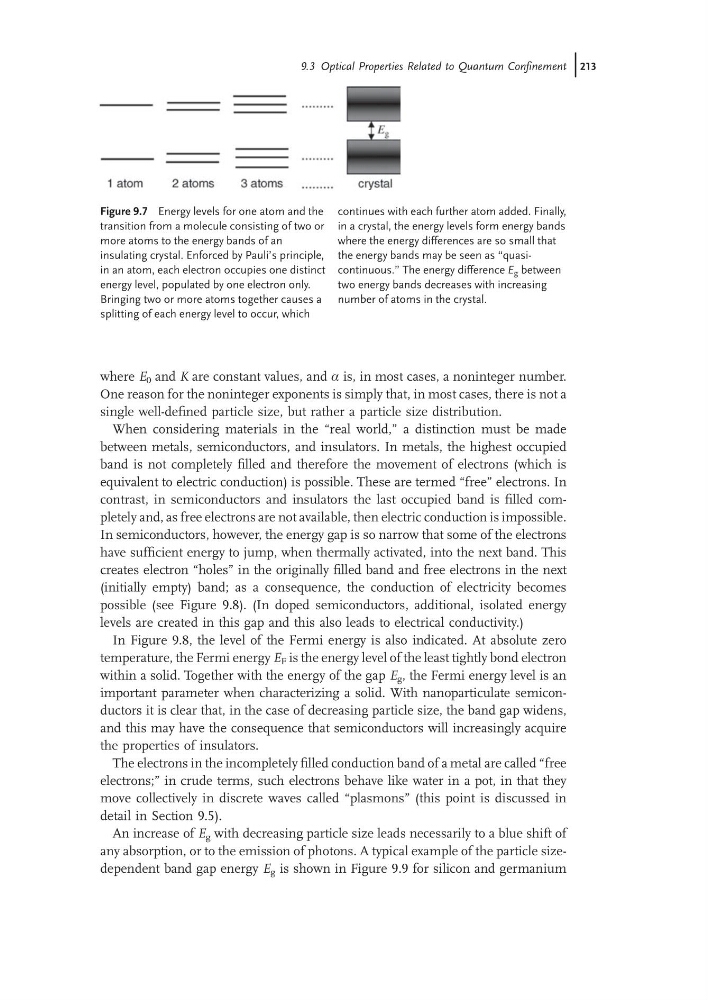
Figure 9.7 Energy levels for one atom and the
transition from a molecule consisting of two or
more atoms to the energy bands of an
insulating crystal. Enforced by Pauli’s principle,
in an atom, each electron occupies one distinct
energy level, populated by one electron only.
Bringing two or more atoms together causes a
splitting of each energy level to occur, which
continues with each further atom added. Finally,
in a crystal, the energy levels form energy bands
where the energy differences are so small that
the energy bands may be seen as “quasicontinuous.” The energy difference E g between
two energy bands decreases with increasing
number of atoms in the crystal.
9.3 Optical Properties Related to Quantum Confinement j213
One reason for the noninteger exponents is simply that, in most cases, there is not a
single well-defined particle size, but rather a particle size distribution.
When considering materials in the “real world,” a distinction must be made
between metals, semiconductors, and insulators. In metals, the highest occupied
band is not completely filled and therefore the movement of electrons (which is
equivalent to electric conduction) is possible. These are termed “free” electrons. In
contrast, in semiconductors and insulators the last occupied band is filled completely and, as free electrons are not available, then electric conduction is impossible.
In semiconductors, however, the energy gap is so narrow that some of the electrons
have sufficient energy to jump, when thermally activated, into the next band. This
creates electron “holes” in the originally filled band and free electrons in the next
(initially empty) band; as a consequence, the conduction of electricity becomes
possible (see Figure 9.8). (In doped semiconductors, additional, isolated energy
levels are created in this gap and this also leads to electrical conductivity.)
In Figure 9.8, the level of the Fermi energy is also indicated. At absolute zero
temperature, the Fermi energy E F is the energy level of the least tightly bond electron
within a solid. Together with the energy of the gap E g , the Fermi energy level is an
important parameter when characterizing a solid. With nanoparticulate semiconductors it is clear that, in the case of decreasing particle size, the band gap widens,
and this may have the consequence that semiconductors will increasingly acquire
the properties of insulators.
The electrons in the incompletely filled conduction band of a metal are called “free
electrons;” in crude terms, such electrons behave like water in a pot, in that they
move collectively in discrete waves called “plasmons” (this point is discussed in
detail in Section 9.5).
An increase of E g with decreasing particle size leads necessarily to a blue shift of
any absorption, or to the emission of photons. A typical example of the particle sizedependent band gap energy E g is shown in Figure 9.9 for silicon and germanium
Figure 9.7 Energy levels for one atom and the
transition from a molecule consisting of two or
more atoms to the energy bands of an
insulating crystal. Enforced by Pauli’s principle,
in an atom, each electron occupies one distinct
energy level, populated by one electron only.
Bringing two or more atoms together causes a
splitting of each energy level to occur, which
continues with each further atom added. Finally,
in a crystal, the energy levels form energy bands
where the energy differences are so small that
the energy bands may be seen as “quasicontinuous.” The energy difference E g between
two energy bands decreases with increasing
number of atoms in the crystal.
9.3 Optical Properties Related to Quantum Confinement j213