

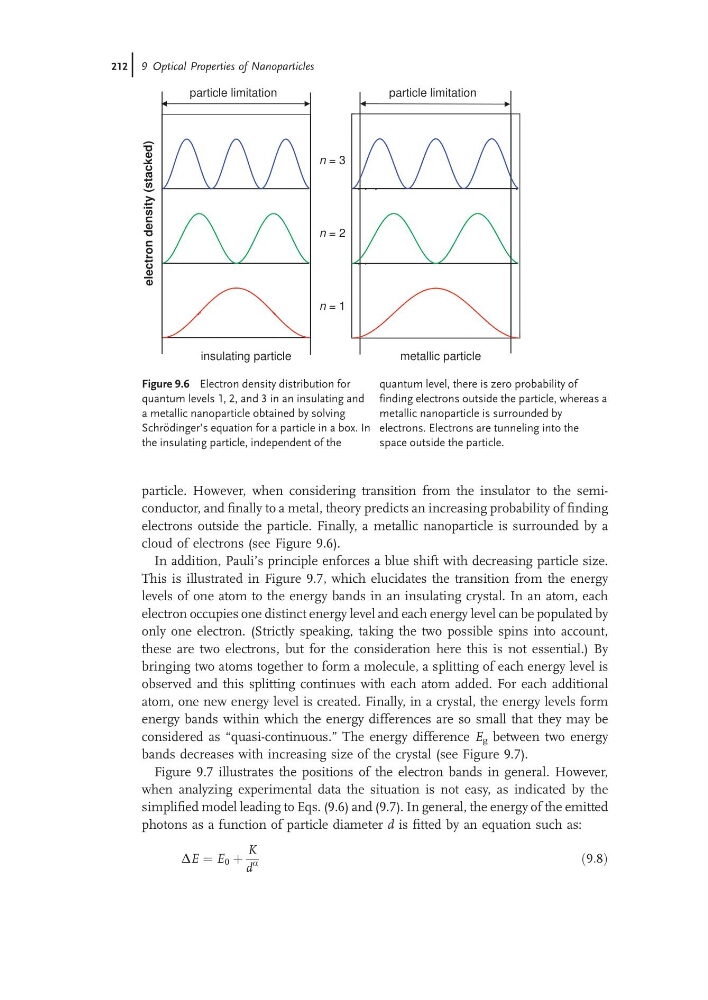
particle. However, when considering transition from the insulator to the semiconductor, and finally to a metal, theory predicts an increasing probability of finding
electrons outside the particle. Finally, a metallic nanoparticle is surrounded by a
cloud of electrons (see Figure 9.6).
In addition, Pauli’s principle enforces a blue shift with decreasing particle size.
This is illustrated in Figure 9.7, which elucidates the transition from the energy
levels of one atom to the energy bands in an insulating crystal. In an atom, each
electron occupies one distinct energy level and each energy level can be populated by
only one electron. (Strictly speaking, taking the two possible spins into account,
these are two electrons, but for the consideration here this is not essential.) By
bringing two atoms together to form a molecule, a splitting of each energy level is
observed and this splitting continues with each atom added. For each additional
atom, one new energy level is created. Finally, in a crystal, the energy levels form
energy bands within which the energy differences are so small that they may be
considered as “quasi-continuous.” The energy difference E g between two energy
bands decreases with increasing size of the crystal (see Figure 9.7).
Figure 9.7 illustrates the positions of the electron bands in general. However,
when analyzing experimental data the situation is not easy, as indicated by the
simplified model leading to Eqs. (9.6) and (9.7). In general, the energy of the emitted
photons as a function of particle diameter d is fitted by an equation such as:
DE ¼ E 0 þ
K
d
a
ð9:8Þ
0
1
electron
density
(stacked)
1
n = 3
n = 2
n = 1
particle limitation
particle limitation
metallic particle
insulating particle
Figure 9.6 Electron density distribution for
quantum levels 1, 2, and 3 in an insulating and
a metallic nanoparticle obtained by solving
Schr€ odinger’s equation for a particle in a box. In
the insulating particle, independent of the
quantum level, there is zero probability of
finding electrons outside the particle, whereas a
metallic nanoparticle is surrounded by
electrons. Electrons are tunneling into the
space outside the particle.
212j 9 Optical Properties of Nanoparticles
electrons outside the particle. Finally, a metallic nanoparticle is surrounded by a
cloud of electrons (see Figure 9.6).
In addition, Pauli’s principle enforces a blue shift with decreasing particle size.
This is illustrated in Figure 9.7, which elucidates the transition from the energy
levels of one atom to the energy bands in an insulating crystal. In an atom, each
electron occupies one distinct energy level and each energy level can be populated by
only one electron. (Strictly speaking, taking the two possible spins into account,
these are two electrons, but for the consideration here this is not essential.) By
bringing two atoms together to form a molecule, a splitting of each energy level is
observed and this splitting continues with each atom added. For each additional
atom, one new energy level is created. Finally, in a crystal, the energy levels form
energy bands within which the energy differences are so small that they may be
considered as “quasi-continuous.” The energy difference E g between two energy
bands decreases with increasing size of the crystal (see Figure 9.7).
Figure 9.7 illustrates the positions of the electron bands in general. However,
when analyzing experimental data the situation is not easy, as indicated by the
simplified model leading to Eqs. (9.6) and (9.7). In general, the energy of the emitted
photons as a function of particle diameter d is fitted by an equation such as:
DE ¼ E 0 þ
K
d
a
ð9:8Þ
0
1
electron
density
(stacked)
1
n = 3
n = 2
n = 1
particle limitation
particle limitation
metallic particle
insulating particle
Figure 9.6 Electron density distribution for
quantum levels 1, 2, and 3 in an insulating and
a metallic nanoparticle obtained by solving
Schr€ odinger’s equation for a particle in a box. In
the insulating particle, independent of the
quantum level, there is zero probability of
finding electrons outside the particle, whereas a
metallic nanoparticle is surrounded by
electrons. Electrons are tunneling into the
space outside the particle.
212j 9 Optical Properties of Nanoparticles