

material was sintered and the starting material alumina-coated zirconia powder; the
particles remained clearly separated.
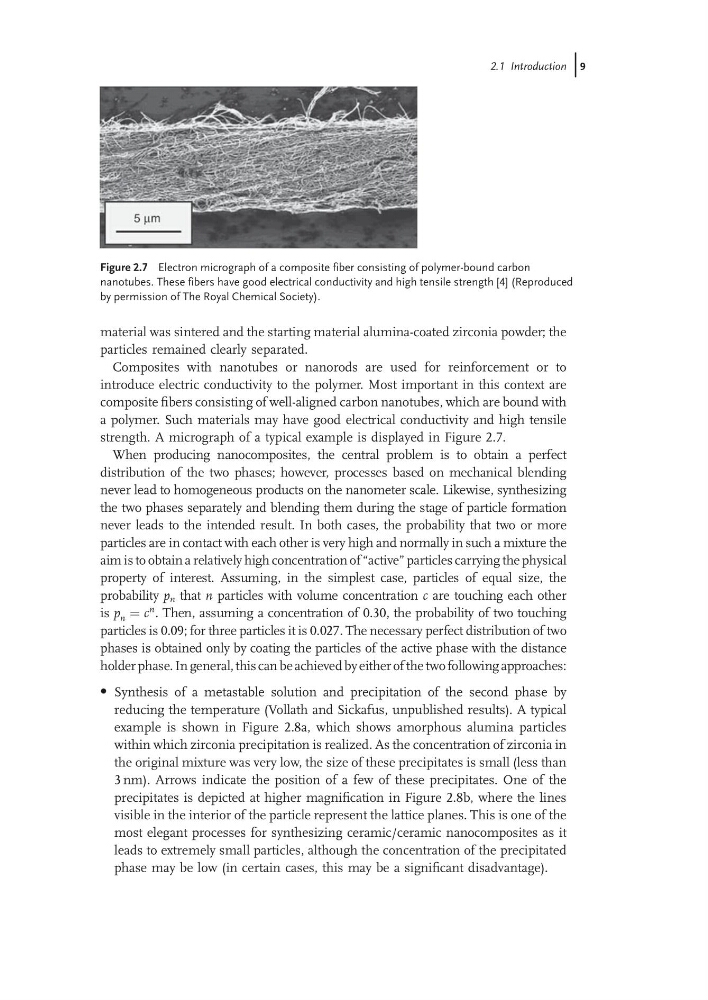
Composites with nanotubes or nanorods are used for reinforcement or to
introduce electric conductivity to the polymer. Most important in this context are
composite fibers consisting of well-aligned carbon nanotubes, which are bound with
a polymer. Such materials may have good electrical conductivity and high tensile
strength. A micrograph of a typical example is displayed in Figure 2.7.
When producing nanocomposites, the central problem is to obtain a perfect
distribution of the two phases; however, processes based on mechanical blending
never lead to homogeneous products on the nanometer scale. Likewise, synthesizing
the two phases separately and blending them during the stage of particle formation
never leads to the intended result. In both cases, the probability that two or more
particles are in contact with each other is very high and normally in such a mixture the
aim is to obtain a relatively high concentration of “active” particles carrying the physical
property of interest. Assuming, in the simplest case, particles of equal size, the
probability p n that n particles with volume concentration c are touching each other
is p n ¼ c
n . Then, assuming a concentration of 0.30, the probability of two touching
particles is 0.09; for three particles it is 0.027. The necessary perfect distribution of two
phases is obtained only by coating the particles of the active phase with the distance
holder phase. In general, this can be achieved by either of the two following approaches:
Synthesis of a metastable solution and precipitation of the second phase by
reducing the temperature (Vollath and Sickafus, unpublished results). A typical
example is shown in Figure 2.8a, which shows amorphous alumina particles
within which zirconia precipitation is realized. As the concentration of zirconia in
the original mixture was very low, the size of these precipitates is small (less than
3 nm). Arrows indicate the position of a few of these precipitates. One of the
precipitates is depicted at higher magnification in Figure 2.8b, where the lines
visible in the interior of the particle represent the lattice planes. This is one of the
most elegant processes for synthesizing ceramic/ceramic nanocomposites as it
leads to extremely small particles, although the concentration of the precipitated
phase may be low (in certain cases, this may be a significant disadvantage).
Figure 2.7 Electron micrograph of a composite fiber consisting of polymer-bound carbon
nanotubes. These fibers have good electrical conductivity and high tensile strength [4] (Reproduced
by permission of The Royal Chemical Society).
2.1 Introduction j9
particles remained clearly separated.
Composites with nanotubes or nanorods are used for reinforcement or to
introduce electric conductivity to the polymer. Most important in this context are
composite fibers consisting of well-aligned carbon nanotubes, which are bound with
a polymer. Such materials may have good electrical conductivity and high tensile
strength. A micrograph of a typical example is displayed in Figure 2.7.
When producing nanocomposites, the central problem is to obtain a perfect
distribution of the two phases; however, processes based on mechanical blending
never lead to homogeneous products on the nanometer scale. Likewise, synthesizing
the two phases separately and blending them during the stage of particle formation
never leads to the intended result. In both cases, the probability that two or more
particles are in contact with each other is very high and normally in such a mixture the
aim is to obtain a relatively high concentration of “active” particles carrying the physical
property of interest. Assuming, in the simplest case, particles of equal size, the
probability p n that n particles with volume concentration c are touching each other
is p n ¼ c
n . Then, assuming a concentration of 0.30, the probability of two touching
particles is 0.09; for three particles it is 0.027. The necessary perfect distribution of two
phases is obtained only by coating the particles of the active phase with the distance
holder phase. In general, this can be achieved by either of the two following approaches:
Synthesis of a metastable solution and precipitation of the second phase by
reducing the temperature (Vollath and Sickafus, unpublished results). A typical
example is shown in Figure 2.8a, which shows amorphous alumina particles
within which zirconia precipitation is realized. As the concentration of zirconia in
the original mixture was very low, the size of these precipitates is small (less than
3 nm). Arrows indicate the position of a few of these precipitates. One of the
precipitates is depicted at higher magnification in Figure 2.8b, where the lines
visible in the interior of the particle represent the lattice planes. This is one of the
most elegant processes for synthesizing ceramic/ceramic nanocomposites as it
leads to extremely small particles, although the concentration of the precipitated
phase may be low (in certain cases, this may be a significant disadvantage).
Figure 2.7 Electron micrograph of a composite fiber consisting of polymer-bound carbon
nanotubes. These fibers have good electrical conductivity and high tensile strength [4] (Reproduced
by permission of The Royal Chemical Society).
2.1 Introduction j9