

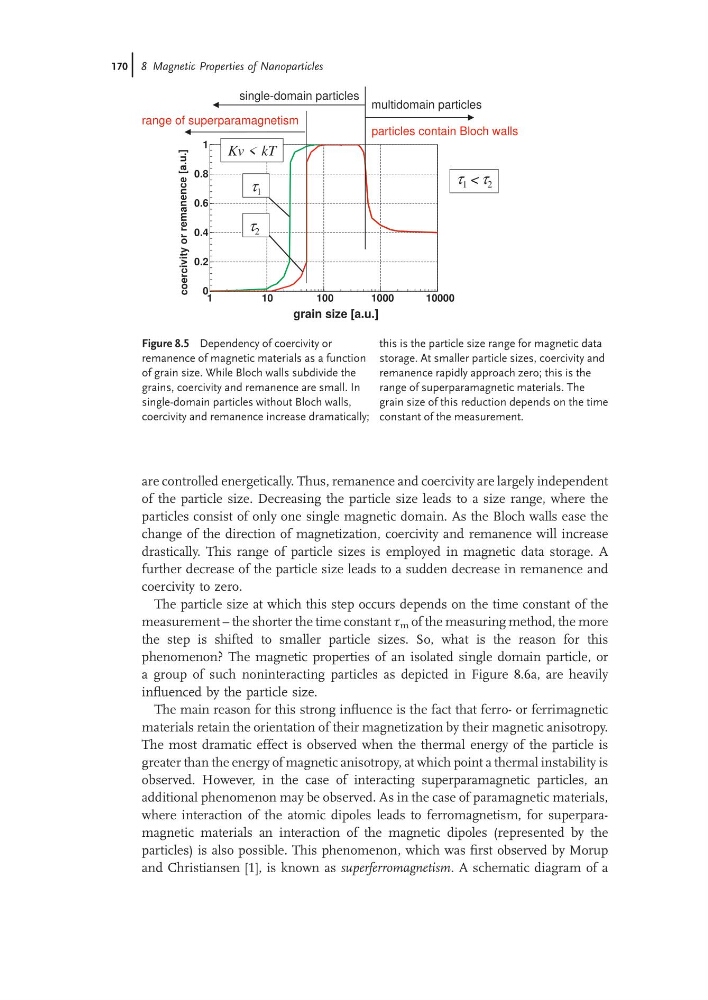
are controlled energetically. Thus, remanence and coercivity are largely independent
of the particle size. Decreasing the particle size leads to a size range, where the
particles consist of only one single magnetic domain. As the Bloch walls ease the
change of the direction of magnetization, coercivity and remanence will increase
drastically. This range of particle sizes is employed in magnetic data storage. A
further decrease of the particle size leads to a sudden decrease in remanence and
coercivity to zero.
The particle size at which this step occurs depends on the time constant of the
measurement – the shorter the time constant t m of the measuring method, the more
the step is shifted to smaller particle sizes. So, what is the reason for this
phenomenon? The magnetic properties of an isolated single domain particle, or
a group of such noninteracting particles as depicted in Figure 8.6a, are heavily
influenced by the particle size.
The main reason for this strong influence is the fact that ferro- or ferrimagnetic
materials retain the orientation of their magnetization by their magnetic anisotropy.
The most dramatic effect is observed when the thermal energy of the particle is
greater than the energy of magnetic anisotropy, at which point a thermal instability is
observed. However, in the case of interacting superparamagnetic particles, an
additional phenomenon may be observed. As in the case of paramagnetic materials,
where interaction of the atomic dipoles leads to ferromagnetism, for superparamagnetic materials an interaction of the magnetic dipoles (represented by the
particles) is also possible. This phenomenon, which was first observed by Morup
and Christiansen [1], is known as superferromagnetism. A schematic diagram of a
1
10
100
1000
10000
grain size [a.u.]
0
0.2
0.4
0.6
0.8
1
coercivity
or
remanence
[a.u.]
Kv < kT
particles contain Bloch walls
multidomain particles
range of superparamagnetism
single-domain particles
τ 1 < τ 2
τ 1
τ 2
Figure 8.5 Dependency of coercivity or
remanence of magnetic materials as a function
of grain size. While Bloch walls subdivide the
grains, coercivity and remanence are small. In
single-domain particles without Bloch walls,
coercivity and remanence increase dramatically;
this is the particle size range for magnetic data
storage. At smaller particle sizes, coercivity and
remanence rapidly approach zero; this is the
range of superparamagnetic materials. The
grain size of this reduction depends on the time
constant of the measurement.
170j 8 Magnetic Properties of Nanoparticles
of the particle size. Decreasing the particle size leads to a size range, where the
particles consist of only one single magnetic domain. As the Bloch walls ease the
change of the direction of magnetization, coercivity and remanence will increase
drastically. This range of particle sizes is employed in magnetic data storage. A
further decrease of the particle size leads to a sudden decrease in remanence and
coercivity to zero.
The particle size at which this step occurs depends on the time constant of the
measurement – the shorter the time constant t m of the measuring method, the more
the step is shifted to smaller particle sizes. So, what is the reason for this
phenomenon? The magnetic properties of an isolated single domain particle, or
a group of such noninteracting particles as depicted in Figure 8.6a, are heavily
influenced by the particle size.
The main reason for this strong influence is the fact that ferro- or ferrimagnetic
materials retain the orientation of their magnetization by their magnetic anisotropy.
The most dramatic effect is observed when the thermal energy of the particle is
greater than the energy of magnetic anisotropy, at which point a thermal instability is
observed. However, in the case of interacting superparamagnetic particles, an
additional phenomenon may be observed. As in the case of paramagnetic materials,
where interaction of the atomic dipoles leads to ferromagnetism, for superparamagnetic materials an interaction of the magnetic dipoles (represented by the
particles) is also possible. This phenomenon, which was first observed by Morup
and Christiansen [1], is known as superferromagnetism. A schematic diagram of a
1
10
100
1000
10000
grain size [a.u.]
0
0.2
0.4
0.6
0.8
1
coercivity
or
remanence
[a.u.]
Kv < kT
particles contain Bloch walls
multidomain particles
range of superparamagnetism
single-domain particles
τ 1 < τ 2
τ 1
τ 2
Figure 8.5 Dependency of coercivity or
remanence of magnetic materials as a function
of grain size. While Bloch walls subdivide the
grains, coercivity and remanence are small. In
single-domain particles without Bloch walls,
coercivity and remanence increase dramatically;
this is the particle size range for magnetic data
storage. At smaller particle sizes, coercivity and
remanence rapidly approach zero; this is the
range of superparamagnetic materials. The
grain size of this reduction depends on the time
constant of the measurement.
170j 8 Magnetic Properties of Nanoparticles