

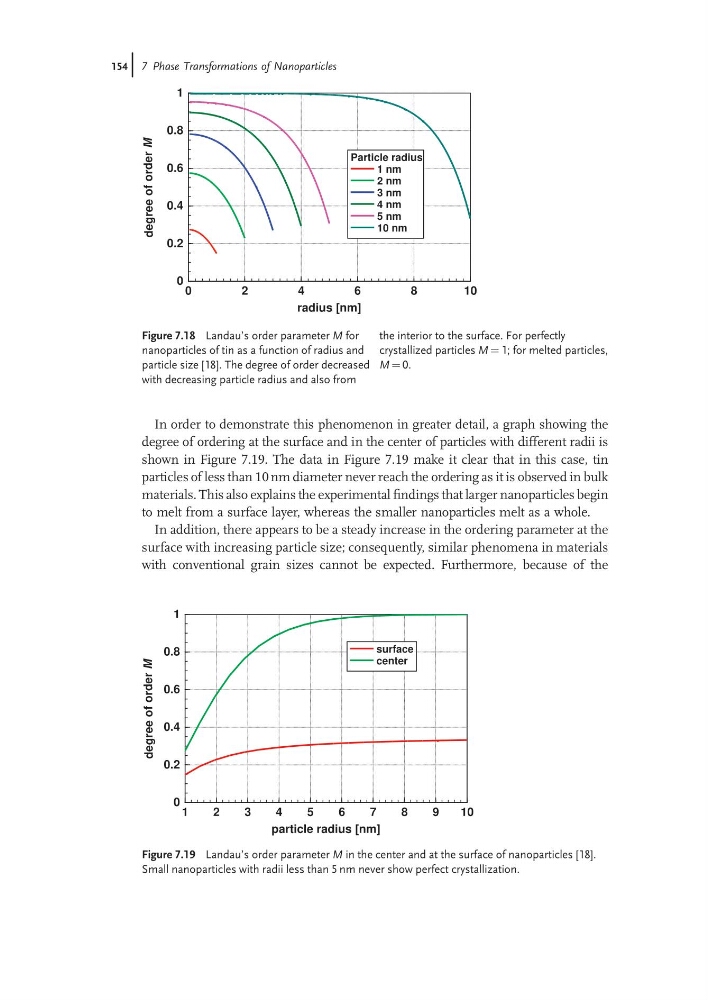
In order to demonstrate this phenomenon in greater detail, a graph showing the
degree of ordering at the surface and in the center of particles with different radii is
shown in Figure 7.19. The data in Figure 7.19 make it clear that in this case, tin
particles of less than 10 nm diameter never reach the ordering as it is observed in bulk
materials. This also explains the experimental findings that larger nanoparticles begin
to melt from a surface layer, whereas the smaller nanoparticles melt as a whole.
In addition, there appears to be a steady increase in the ordering parameter at the
surface with increasing particle size; consequently, similar phenomena in materials
with conventional grain sizes cannot be expected. Furthermore, because of the
0
2
4
6
8
10
radius [nm]
0
0.2
0.4
0.6
0.8
1
degree
of
order
M
Particle radius
1 nm
2 nm
3 nm
4 nm
5 nm
10 nm
Figure 7.18 Landau’s order parameter M for
nanoparticles of tin as a function of radius and
particle size [18]. The degree of order decreased
with decreasing particle radius and also from
the interior to the surface. For perfectly
crystallized particles M ¼ 1; for melted particles,
M ¼ 0.
1
2
3
4
5
6
7
8
9
10
particle radius [nm]
0
0.2
0.4
0.6
0.8
1
degree
of
order
M
surface
center
Figure 7.19 Landau’s order parameter M in the center and at the surface of nanoparticles [18].
Small nanoparticles with radii less than 5 nm never show perfect crystallization.
154j 7 Phase Transformations of Nanoparticles
degree of ordering at the surface and in the center of particles with different radii is
shown in Figure 7.19. The data in Figure 7.19 make it clear that in this case, tin
particles of less than 10 nm diameter never reach the ordering as it is observed in bulk
materials. This also explains the experimental findings that larger nanoparticles begin
to melt from a surface layer, whereas the smaller nanoparticles melt as a whole.
In addition, there appears to be a steady increase in the ordering parameter at the
surface with increasing particle size; consequently, similar phenomena in materials
with conventional grain sizes cannot be expected. Furthermore, because of the
0
2
4
6
8
10
radius [nm]
0
0.2
0.4
0.6
0.8
1
degree
of
order
M
Particle radius
1 nm
2 nm
3 nm
4 nm
5 nm
10 nm
Figure 7.18 Landau’s order parameter M for
nanoparticles of tin as a function of radius and
particle size [18]. The degree of order decreased
with decreasing particle radius and also from
the interior to the surface. For perfectly
crystallized particles M ¼ 1; for melted particles,
M ¼ 0.
1
2
3
4
5
6
7
8
9
10
particle radius [nm]
0
0.2
0.4
0.6
0.8
1
degree
of
order
M
surface
center
Figure 7.19 Landau’s order parameter M in the center and at the surface of nanoparticles [18].
Small nanoparticles with radii less than 5 nm never show perfect crystallization.
154j 7 Phase Transformations of Nanoparticles