

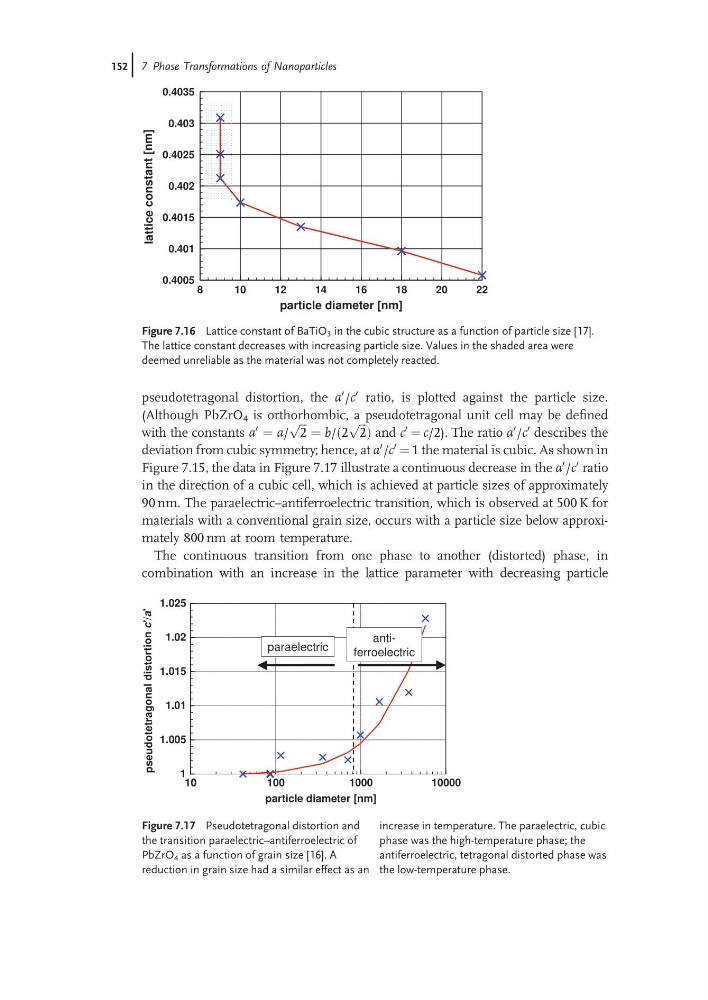
pseudotetragonal distortion, the a
0 /c
0 ratio, is plotted against the particle size.
(Although PbZrO 4 is orthorhombic, a pseudotetragonal unit cell may be defined
with the constants a
0
¼ a/
ffiffi ffi
2
p ¼ b/ð2
ffiffi ffi
2
p Þ and c
0
¼ c/2). The ratio a
0 /c
0 describes the
deviation from cubic symmetry; hence, at a
0 /c
0
¼ 1 the material is cubic. As shown in
Figure 7.15, the data in Figure 7.17 illustrate a continuous decrease in the a
0 /c
0 ratio
in the direction of a cubic cell, which is achieved at particle sizes of approximately
90 nm. The paraelectric–antiferroelectric transition, which is observed at 500 K for
materials with a conventional grain size, occurs with a particle size below approximately 800 nm at room temperature.
The continuous transition from one phase to another (distorted) phase, in
combination with an increase in the lattice parameter with decreasing particle
8
10
12
14
16
18
20
22
particle diameter [nm]
0.4005
0.401
0.4015
0.402
0.4025
0.403
0.4035
lattice
constant
[nm]
Figure 7.16 Lattice constant of BaTiO 3 in the cubic structure as a function of particle size [17].
The lattice constant decreases with increasing particle size. Values in the shaded area were
deemed unreliable as the material was not completely reacted.
10
100
1000
10000
particle diameter [nm]
1
1.005
1.01
1.015
1.02
1.025
pseudotetragonal
distortion
c'/a'
paraelectric
antiferroelectric
Figure 7.17 Pseudotetragonal distortion and
the transition paraelectric–antiferroelectric of
PbZrO 4 as a function of grain size [16]. A
reduction in grain size had a similar effect as an
increase in temperature. The paraelectric, cubic
phase was the high-temperature phase; the
antiferroelectric, tetragonal distorted phase was
the low-temperature phase.
152j 7 Phase Transformations of Nanoparticles
0 /c
0 ratio, is plotted against the particle size.
(Although PbZrO 4 is orthorhombic, a pseudotetragonal unit cell may be defined
with the constants a
0
¼ a/
ffiffi ffi
2
p ¼ b/ð2
ffiffi ffi
2
p Þ and c
0
¼ c/2). The ratio a
0 /c
0 describes the
deviation from cubic symmetry; hence, at a
0 /c
0
¼ 1 the material is cubic. As shown in
Figure 7.15, the data in Figure 7.17 illustrate a continuous decrease in the a
0 /c
0 ratio
in the direction of a cubic cell, which is achieved at particle sizes of approximately
90 nm. The paraelectric–antiferroelectric transition, which is observed at 500 K for
materials with a conventional grain size, occurs with a particle size below approximately 800 nm at room temperature.
The continuous transition from one phase to another (distorted) phase, in
combination with an increase in the lattice parameter with decreasing particle
8
10
12
14
16
18
20
22
particle diameter [nm]
0.4005
0.401
0.4015
0.402
0.4025
0.403
0.4035
lattice
constant
[nm]
Figure 7.16 Lattice constant of BaTiO 3 in the cubic structure as a function of particle size [17].
The lattice constant decreases with increasing particle size. Values in the shaded area were
deemed unreliable as the material was not completely reacted.
10
100
1000
10000
particle diameter [nm]
1
1.005
1.01
1.015
1.02
1.025
pseudotetragonal
distortion
c'/a'
paraelectric
antiferroelectric
Figure 7.17 Pseudotetragonal distortion and
the transition paraelectric–antiferroelectric of
PbZrO 4 as a function of grain size [16]. A
reduction in grain size had a similar effect as an
increase in temperature. The paraelectric, cubic
phase was the high-temperature phase; the
antiferroelectric, tetragonal distorted phase was
the low-temperature phase.
152j 7 Phase Transformations of Nanoparticles