

Within the context of phase transformations of small particles, the majority of
extensive studies have been conducted with respect to the melting of metal particles.
Previously, a number of extensive, theoretical studies of the melting of nanoparticles
have been conducted by Reiss and Wilson [7], Pawlow [8], Hanszen [9], and Zhao
et al. [10], with each presenting a unique theory tailored to interpret the experimental
results obtained.
A first example – the decrease of the melting point of aluminum, a low-melting
metal – is demonstrated in Figure 7.7, where experimental data on the melting point of
aluminum as a function of particle size are displayed. In Figure 7.7a the melting point
is plotted against particle size, whereas in Figure 7.7b, in association with Eq. (7.7), the
inverse particle size is selected as abscissa. Within the precision of the measured
values, it is clear that the melting point of aluminum nanoparticles follows, at least in
the size range from 10 to 40 nm, exactly this simplified theory. For comparison, the
melting temperature of coarse-grained material is indicated in both graphs.
The simplified theory for the change in transformation temperature as a function
of particle size explained above can be extended. Rearranging Eqs. (7.5) and (7.6)
allows an estimation to be made of the enthalpy of transformation as a function of
particle size:
DU transÀnano ¼ DU trans þ c new A new À c old A old
¼ DU trans À
6Mc new
r new d new
1 À
c old
c new
r new
r old
2=3
"
#
ð7:12Þ
This formula can also be simplified as the experimentally well-proven relationship:
DU transÀnano ¼ DU trans À const
1
d
ð7:13Þ
1
10
100
particle diameter [nm]
10
01
10
02
10
03
reduction
of
melting
temperature
[K]
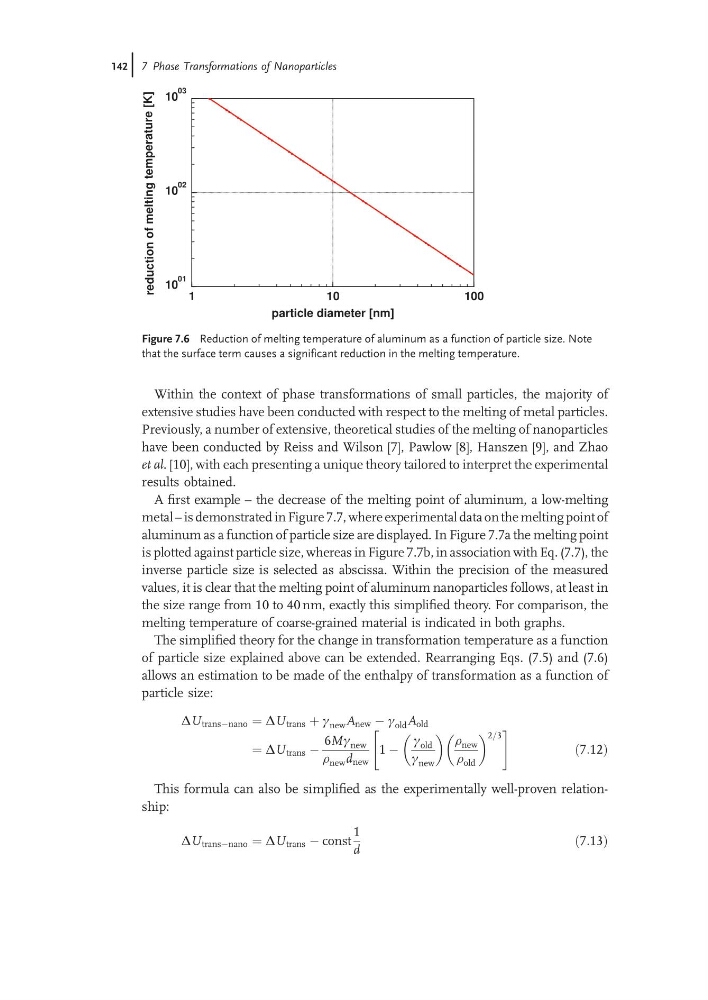
Figure 7.6 Reduction of melting temperature of aluminum as a function of particle size. Note
that the surface term causes a significant reduction in the melting temperature.
142j 7 Phase Transformations of Nanoparticles
extensive studies have been conducted with respect to the melting of metal particles.
Previously, a number of extensive, theoretical studies of the melting of nanoparticles
have been conducted by Reiss and Wilson [7], Pawlow [8], Hanszen [9], and Zhao
et al. [10], with each presenting a unique theory tailored to interpret the experimental
results obtained.
A first example – the decrease of the melting point of aluminum, a low-melting
metal – is demonstrated in Figure 7.7, where experimental data on the melting point of
aluminum as a function of particle size are displayed. In Figure 7.7a the melting point
is plotted against particle size, whereas in Figure 7.7b, in association with Eq. (7.7), the
inverse particle size is selected as abscissa. Within the precision of the measured
values, it is clear that the melting point of aluminum nanoparticles follows, at least in
the size range from 10 to 40 nm, exactly this simplified theory. For comparison, the
melting temperature of coarse-grained material is indicated in both graphs.
The simplified theory for the change in transformation temperature as a function
of particle size explained above can be extended. Rearranging Eqs. (7.5) and (7.6)
allows an estimation to be made of the enthalpy of transformation as a function of
particle size:
DU transÀnano ¼ DU trans þ c new A new À c old A old
¼ DU trans À
6Mc new
r new d new
1 À
c old
c new
r new
r old
2=3
"
#
ð7:12Þ
This formula can also be simplified as the experimentally well-proven relationship:
DU transÀnano ¼ DU trans À const
1
d
ð7:13Þ
1
10
100
particle diameter [nm]
10
01
10
02
10
03
reduction
of
melting
temperature
[K]
Figure 7.6 Reduction of melting temperature of aluminum as a function of particle size. Note
that the surface term causes a significant reduction in the melting temperature.
142j 7 Phase Transformations of Nanoparticles