

7.3
Phase Transformations of Nanoparticles
In general, phase transformations are connected with changes in physical properties, and in most cases, the density of the material that is changing. In relation to
particles, a changing density means a change in the surface; hence, if the energy
connected to the surface of nanoparticles is large then these changes may have a
significant influence on phase transformations. At the temperature where a phase
transformation occurs, T trans , the following equilibrium condition is valid:
U old À T trans S old þ c old A old ¼ U new À T trans S new þ c new A new
ð7:4Þ
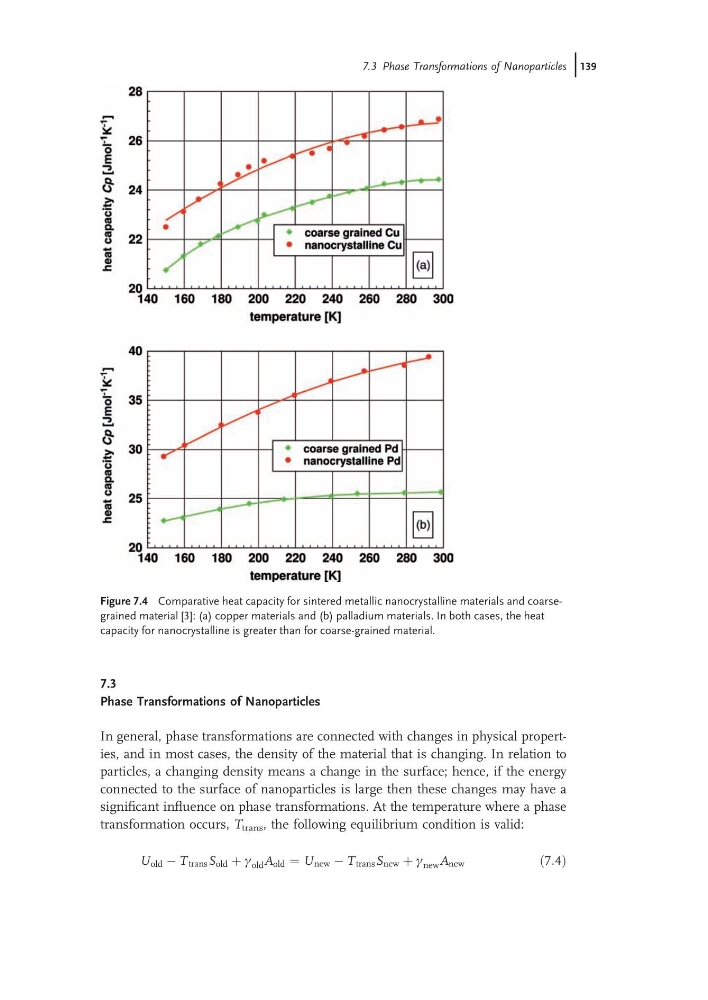
Figure 7.4 Comparative heat capacity for sintered metallic nanocrystalline materials and coarsegrained material [3]: (a) copper materials and (b) palladium materials. In both cases, the heat
capacity for nanocrystalline is greater than for coarse-grained material.
7.3 Phase Transformations of Nanoparticles j139
Phase Transformations of Nanoparticles
In general, phase transformations are connected with changes in physical properties, and in most cases, the density of the material that is changing. In relation to
particles, a changing density means a change in the surface; hence, if the energy
connected to the surface of nanoparticles is large then these changes may have a
significant influence on phase transformations. At the temperature where a phase
transformation occurs, T trans , the following equilibrium condition is valid:
U old À T trans S old þ c old A old ¼ U new À T trans S new þ c new A new
ð7:4Þ
Figure 7.4 Comparative heat capacity for sintered metallic nanocrystalline materials and coarsegrained material [3]: (a) copper materials and (b) palladium materials. In both cases, the heat
capacity for nanocrystalline is greater than for coarse-grained material.
7.3 Phase Transformations of Nanoparticles j139