

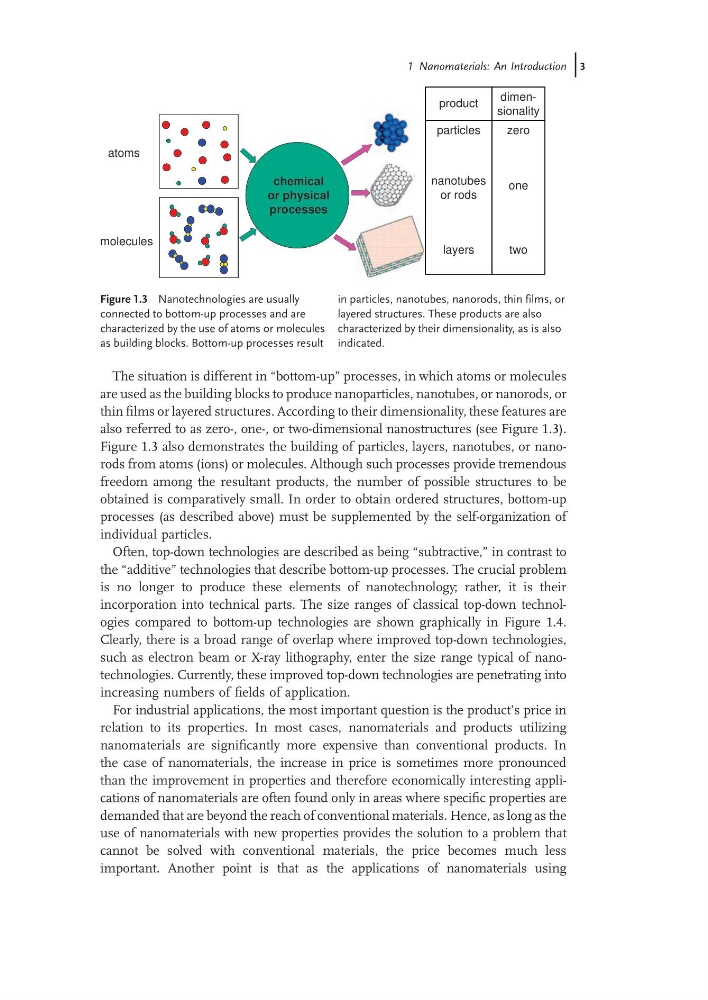
The situation is different in “bottom-up” processes, in which atoms or molecules
are used as the building blocks to produce nanoparticles, nanotubes, or nanorods, or
thin films or layered structures. According to their dimensionality, these features are
also referred to as zero-, one-, or two-dimensional nanostructures (see Figure 1.3).
Figure 1.3 also demonstrates the building of particles, layers, nanotubes, or nanorods from atoms (ions) or molecules. Although such processes provide tremendous
freedom among the resultant products, the number of possible structures to be
obtained is comparatively small. In order to obtain ordered structures, bottom-up
processes (as described above) must be supplemented by the self-organization of
individual particles.
Often, top-down technologies are described as being “subtractive,” in contrast to
the “additive” technologies that describe bottom-up processes. The crucial problem
is no longer to produce these elements of nanotechnology; rather, it is their
incorporation into technical parts. The size ranges of classical top-down technologies compared to bottom-up technologies are shown graphically in Figure 1.4.
Clearly, there is a broad range of overlap where improved top-down technologies,
such as electron beam or X-ray lithography, enter the size range typical of nanotechnologies. Currently, these improved top-down technologies are penetrating into
increasing numbers of fields of application.
For industrial applications, the most important question is the product’s price in
relation to its properties. In most cases, nanomaterials and products utilizing
nanomaterials are significantly more expensive than conventional products. In
the case of nanomaterials, the increase in price is sometimes more pronounced
than the improvement in properties and therefore economically interesting applications of nanomaterials are often found only in areas where specific properties are
demanded that are beyond the reach of conventional materials. Hence, as long as the
use of nanomaterials with new properties provides the solution to a problem that
cannot be solved with conventional materials, the price becomes much less
important. Another point is that as the applications of nanomaterials using
atoms
molecules
chemical
or physical
processes
particles
nanotubes
or rods
layers
zero
one
two
product
dimensionality
Figure 1.3 Nanotechnologies are usually
connected to bottom-up processes and are
characterized by the use of atoms or molecules
as building blocks. Bottom-up processes result
in particles, nanotubes, nanorods, thin films, or
layered structures. These products are also
characterized by their dimensionality, as is also
indicated.
1 Nanomaterials: An Introduction j3
are used as the building blocks to produce nanoparticles, nanotubes, or nanorods, or
thin films or layered structures. According to their dimensionality, these features are
also referred to as zero-, one-, or two-dimensional nanostructures (see Figure 1.3).
Figure 1.3 also demonstrates the building of particles, layers, nanotubes, or nanorods from atoms (ions) or molecules. Although such processes provide tremendous
freedom among the resultant products, the number of possible structures to be
obtained is comparatively small. In order to obtain ordered structures, bottom-up
processes (as described above) must be supplemented by the self-organization of
individual particles.
Often, top-down technologies are described as being “subtractive,” in contrast to
the “additive” technologies that describe bottom-up processes. The crucial problem
is no longer to produce these elements of nanotechnology; rather, it is their
incorporation into technical parts. The size ranges of classical top-down technologies compared to bottom-up technologies are shown graphically in Figure 1.4.
Clearly, there is a broad range of overlap where improved top-down technologies,
such as electron beam or X-ray lithography, enter the size range typical of nanotechnologies. Currently, these improved top-down technologies are penetrating into
increasing numbers of fields of application.
For industrial applications, the most important question is the product’s price in
relation to its properties. In most cases, nanomaterials and products utilizing
nanomaterials are significantly more expensive than conventional products. In
the case of nanomaterials, the increase in price is sometimes more pronounced
than the improvement in properties and therefore economically interesting applications of nanomaterials are often found only in areas where specific properties are
demanded that are beyond the reach of conventional materials. Hence, as long as the
use of nanomaterials with new properties provides the solution to a problem that
cannot be solved with conventional materials, the price becomes much less
important. Another point is that as the applications of nanomaterials using
atoms
molecules
chemical
or physical
processes
particles
nanotubes
or rods
layers
zero
one
two
product
dimensionality
Figure 1.3 Nanotechnologies are usually
connected to bottom-up processes and are
characterized by the use of atoms or molecules
as building blocks. Bottom-up processes result
in particles, nanotubes, nanorods, thin films, or
layered structures. These products are also
characterized by their dimensionality, as is also
indicated.
1 Nanomaterials: An Introduction j3