

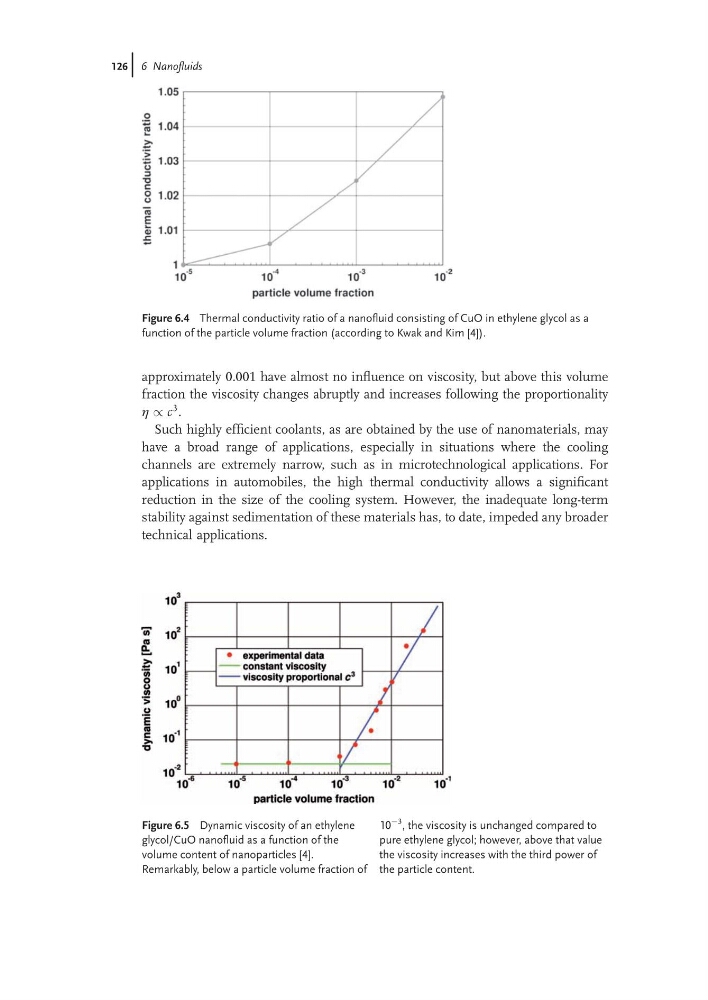
approximately 0.001 have almost no influence on viscosity, but above this volume
fraction the viscosity changes abruptly and increases following the proportionality
g / c
3 .
Such highly efficient coolants, as are obtained by the use of nanomaterials, may
have a broad range of applications, especially in situations where the cooling
channels are extremely narrow, such as in microtechnological applications. For
applications in automobiles, the high thermal conductivity allows a significant
reduction in the size of the cooling system. However, the inadequate long-term
stability against sedimentation of these materials has, to date, impeded any broader
technical applications.
Figure 6.5 Dynamic viscosity of an ethylene
glycol/CuO nanofluid as a function of the
volume content of nanoparticles [4].
Remarkably, below a particle volume fraction of
10
À3 , the viscosity is unchanged compared to
pure ethylene glycol; however, above that value
the viscosity increases with the third power of
the particle content.
Figure 6.4 Thermal conductivity ratio of a nanofluid consisting of CuO in ethylene glycol as a
function of the particle volume fraction (according to Kwak and Kim [4]).
126j 6 Nanofluids
fraction the viscosity changes abruptly and increases following the proportionality
g / c
3 .
Such highly efficient coolants, as are obtained by the use of nanomaterials, may
have a broad range of applications, especially in situations where the cooling
channels are extremely narrow, such as in microtechnological applications. For
applications in automobiles, the high thermal conductivity allows a significant
reduction in the size of the cooling system. However, the inadequate long-term
stability against sedimentation of these materials has, to date, impeded any broader
technical applications.
Figure 6.5 Dynamic viscosity of an ethylene
glycol/CuO nanofluid as a function of the
volume content of nanoparticles [4].
Remarkably, below a particle volume fraction of
10
À3 , the viscosity is unchanged compared to
pure ethylene glycol; however, above that value
the viscosity increases with the third power of
the particle content.
Figure 6.4 Thermal conductivity ratio of a nanofluid consisting of CuO in ethylene glycol as a
function of the particle volume fraction (according to Kwak and Kim [4]).
126j 6 Nanofluids