

In an electric direct current (DC) arc at the surface of the electrodes, carbon is
known to melt. Subsequently, as the temperature drops, the liquid carbon becomes
supercooled and begins to crystallize. The crystallizing nanotube grows through the
liquid layer at the cathode, dragging along small droplets of supercooled carbon.
These droplets, as well as the carbon nanotubes, are visible in Figure 5.32. These
explanations are backed up by the fact that the droplets remain amorphous and the
nanotubes are unintentionally coated with a thin amorphous layer. As mentioned
above, these procedures result in the production of carbon nanotubes, fullerenes,
and often large amounts of soot. As soot is more susceptible to oxidation compared
to carbon nanotubes and fullerenes, it is removed by careful oxidation at elevated
temperatures, ranging from 1000 to 1100 K.
The yield of carbon nanotubes is significantly improved by adding metal catalysts
to the carbon electrodes. However, in order to obtain larger amounts of nanotubes,
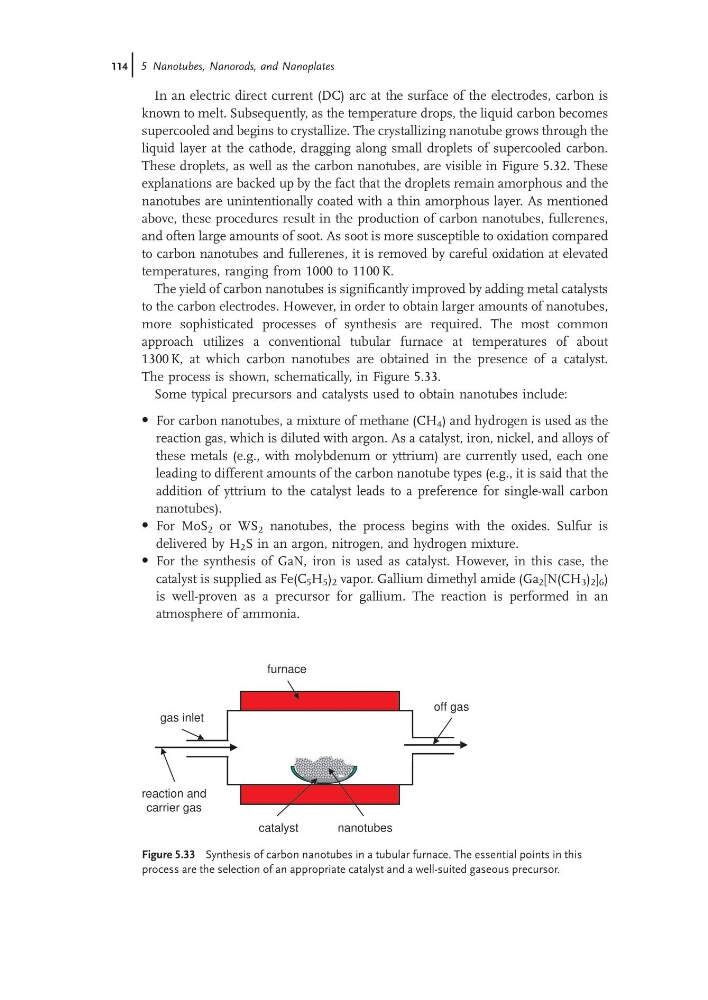
more sophisticated processes of synthesis are required. The most common
approach utilizes a conventional tubular furnace at temperatures of about
1300 K, at which carbon nanotubes are obtained in the presence of a catalyst.
The process is shown, schematically, in Figure 5.33.
Some typical precursors and catalysts used to obtain nanotubes include:
For carbon nanotubes, a mixture of methane (CH 4 ) and hydrogen is used as the
reaction gas, which is diluted with argon. As a catalyst, iron, nickel, and alloys of
these metals (e.g., with molybdenum or yttrium) are currently used, each one
leading to different amounts of the carbon nanotube types (e.g., it is said that the
addition of yttrium to the catalyst leads to a preference for single-wall carbon
nanotubes).
For MoS 2 or WS 2 nanotubes, the process begins with the oxides. Sulfur is
delivered by H 2 S in an argon, nitrogen, and hydrogen mixture.
For the synthesis of GaN, iron is used as catalyst. However, in this case, the
catalyst is supplied as Fe(C 5 H 5 ) 2 vapor. Gallium dimethyl amide (Ga 2 [N(CH 3 ) 2 ] 6 )
is well-proven as a precursor for gallium. The reaction is performed in an
atmosphere of ammonia.
furnace
gas inlet
off gas
reaction and
carrier gas
catalyst
nanotubes
Figure 5.33 Synthesis of carbon nanotubes in a tubular furnace. The essential points in this
process are the selection of an appropriate catalyst and a well-suited gaseous precursor.
114j 5 Nanotubes, Nanorods, and Nanoplates
known to melt. Subsequently, as the temperature drops, the liquid carbon becomes
supercooled and begins to crystallize. The crystallizing nanotube grows through the
liquid layer at the cathode, dragging along small droplets of supercooled carbon.
These droplets, as well as the carbon nanotubes, are visible in Figure 5.32. These
explanations are backed up by the fact that the droplets remain amorphous and the
nanotubes are unintentionally coated with a thin amorphous layer. As mentioned
above, these procedures result in the production of carbon nanotubes, fullerenes,
and often large amounts of soot. As soot is more susceptible to oxidation compared
to carbon nanotubes and fullerenes, it is removed by careful oxidation at elevated
temperatures, ranging from 1000 to 1100 K.
The yield of carbon nanotubes is significantly improved by adding metal catalysts
to the carbon electrodes. However, in order to obtain larger amounts of nanotubes,
more sophisticated processes of synthesis are required. The most common
approach utilizes a conventional tubular furnace at temperatures of about
1300 K, at which carbon nanotubes are obtained in the presence of a catalyst.
The process is shown, schematically, in Figure 5.33.
Some typical precursors and catalysts used to obtain nanotubes include:
For carbon nanotubes, a mixture of methane (CH 4 ) and hydrogen is used as the
reaction gas, which is diluted with argon. As a catalyst, iron, nickel, and alloys of
these metals (e.g., with molybdenum or yttrium) are currently used, each one
leading to different amounts of the carbon nanotube types (e.g., it is said that the
addition of yttrium to the catalyst leads to a preference for single-wall carbon
nanotubes).
For MoS 2 or WS 2 nanotubes, the process begins with the oxides. Sulfur is
delivered by H 2 S in an argon, nitrogen, and hydrogen mixture.
For the synthesis of GaN, iron is used as catalyst. However, in this case, the
catalyst is supplied as Fe(C 5 H 5 ) 2 vapor. Gallium dimethyl amide (Ga 2 [N(CH 3 ) 2 ] 6 )
is well-proven as a precursor for gallium. The reaction is performed in an
atmosphere of ammonia.
furnace
gas inlet
off gas
reaction and
carrier gas
catalyst
nanotubes
Figure 5.33 Synthesis of carbon nanotubes in a tubular furnace. The essential points in this
process are the selection of an appropriate catalyst and a well-suited gaseous precursor.
114j 5 Nanotubes, Nanorods, and Nanoplates