

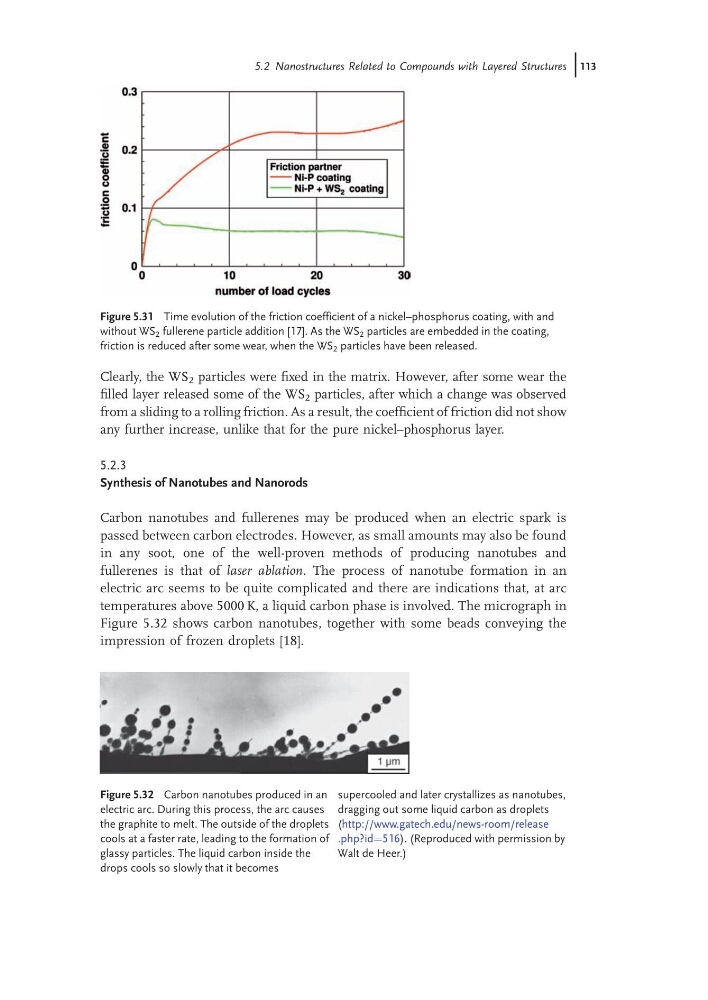
Clearly, the WS 2 particles were fixed in the matrix. However, after some wear the
filled layer released some of the WS 2 particles, after which a change was observed
from a sliding to a rolling friction. As a result, the coef ficient of friction did not show
any further increase, unlike that for the pure nickel–phosphorus layer.
5.2.3
Synthesis of Nanotubes and Nanorods
Car bon n anotub es and f ullerenes may b e p roduc ed when an electric s park is
pass ed be tween carbon ele ctrodes. However, as small amounts may als o be found
in any soot, one of the well-proven methods of producing nanotubes a nd
ful lerenes is that of laser ablation. T he proce ss of n anotube f ormation in an
ele ctric arc s eems to be q uite c omplicated a nd there are indications that , at arc
tempe ratures above 5000 K, a liqu id carbon p hase is involved. The micrograph in
Figure 5.32 s hows c arbon nano t ubes, t ogether with some be ads conveying th e
imp ression of frozen d rople ts [18].
Figure 5.31 Time evolution of the friction coefficient of a nickel–phosphorus coating, with and
without WS 2 fullerene particle addition [17]. As the WS 2 particles are embedded in the coating,
friction is reduced after some wear, when the WS 2 particles have been released.
Figure 5.32 Carbon nanotubes produced in an
electric arc. During this process, the arc causes
the graphite to melt. The outside of the droplets
cools at a faster rate, leading to the formation of
glassy particles. The liquid carbon inside the
drops cools so slowly that it becomes
supercooled and later crystallizes as nanotubes,
dragging out some liquid carbon as droplets
(http://www.gatech.edu/news-room/release
.php?id¼516). (Reproduced with permission by
Walt de Heer.)
5.2 Nanostructures Related to Compounds with Layered Structures j113
filled layer released some of the WS 2 particles, after which a change was observed
from a sliding to a rolling friction. As a result, the coef ficient of friction did not show
any further increase, unlike that for the pure nickel–phosphorus layer.
5.2.3
Synthesis of Nanotubes and Nanorods
Car bon n anotub es and f ullerenes may b e p roduc ed when an electric s park is
pass ed be tween carbon ele ctrodes. However, as small amounts may als o be found
in any soot, one of the well-proven methods of producing nanotubes a nd
ful lerenes is that of laser ablation. T he proce ss of n anotube f ormation in an
ele ctric arc s eems to be q uite c omplicated a nd there are indications that , at arc
tempe ratures above 5000 K, a liqu id carbon p hase is involved. The micrograph in
Figure 5.32 s hows c arbon nano t ubes, t ogether with some be ads conveying th e
imp ression of frozen d rople ts [18].
Figure 5.31 Time evolution of the friction coefficient of a nickel–phosphorus coating, with and
without WS 2 fullerene particle addition [17]. As the WS 2 particles are embedded in the coating,
friction is reduced after some wear, when the WS 2 particles have been released.
Figure 5.32 Carbon nanotubes produced in an
electric arc. During this process, the arc causes
the graphite to melt. The outside of the droplets
cools at a faster rate, leading to the formation of
glassy particles. The liquid carbon inside the
drops cools so slowly that it becomes
supercooled and later crystallizes as nanotubes,
dragging out some liquid carbon as droplets
(http://www.gatech.edu/news-room/release
.php?id¼516). (Reproduced with permission by
Walt de Heer.)
5.2 Nanostructures Related to Compounds with Layered Structures j113