

the S7 point to the side of the route is longer, and it is also affected by the omnidirectional wind, so the probability of collision at the S7 point is high.
For the same circling starting point, when circling to the nearest position of the
route, the collision probability of the military flight with the civil aviation aircraft in the
same direction is lower than the collision probability of the reverse flight. The total
collision probability of other circling starting points is larger than 5 Â 10
−9 except for
all start points. Therefore, if the boundary of the circling path is regarded as the
boundary of the airspace, there is a certain risk of collision. Therefore, we calculate the
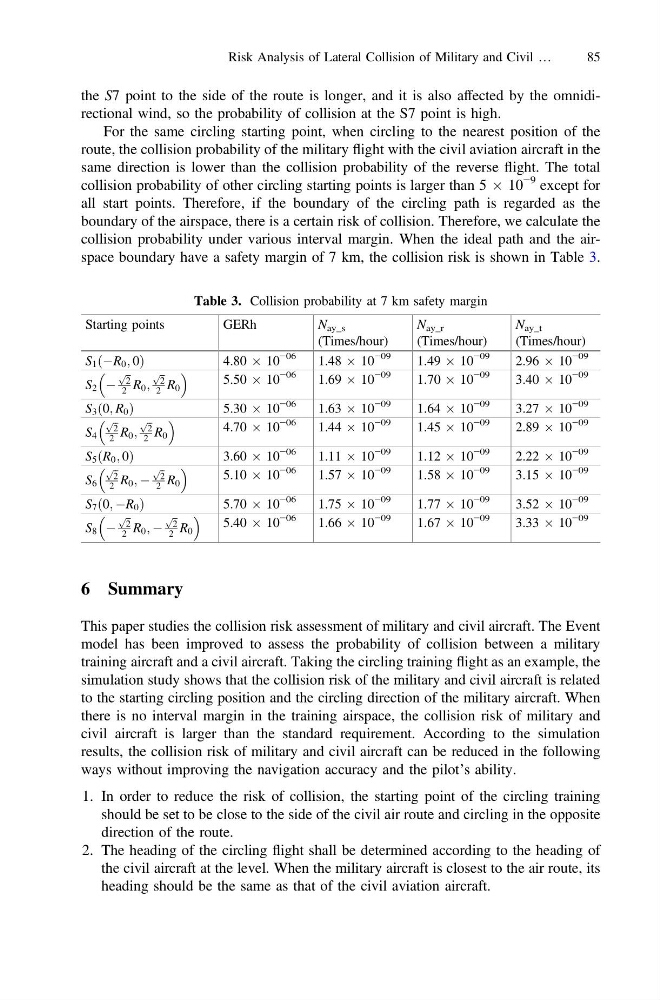
collision probability under various interval margin. When the ideal path and the airspace boundary have a safety margin of 7 km, the collision risk is shown in Table 3.
6 Summary
This paper studies the collision risk assessment of military and civil aircraft. The Event
model has been improved to assess the probability of collision between a military
training aircraft and a civil aircraft. Taking the circling training flight as an example, the
simulation study shows that the collision risk of the military and civil aircraft is related
to the starting circling position and the circling direction of the military aircraft. When
there is no interval margin in the training airspace, the collision risk of military and
civil aircraft is larger than the standard requirement. According to the simulation
results, the collision risk of military and civil aircraft can be reduced in the following
ways without improving the navigation accuracy and the pilot’s ability.
1. In order to reduce the risk of collision, the starting point of the circling training
should be set to be close to the side of the civil air route and circling in the opposite
direction of the route.
2. The heading of the circling flight shall be determined according to the heading of
the civil aircraft at the level. When the military aircraft is closest to the air route, its
heading should be the same as that of the civil aviation aircraft.
Table 3. Collision probability at 7 km safety margin
Starting points
GERh
N ay_s
(Times/hour)
N ay_r
(Times/hour)
N ay_t
(Times/hour)
S 1 ðÀR 0 ; 0Þ
4.80 Â 10
−06
1.48 Â 10
−09
1.49 Â 10
−09
2.96 Â 10
−09
S 2 À
ffiffi
2
p
2 R 0 ;
ffiffi
2
p
2 R 0
5.50 Â 10
−06
1.69 Â 10
−09
1.70 Â 10
−09
3.40 Â 10
−09
S 3 ð0; R 0 Þ
5.30 Â 10
−06
1.63 Â 10
−09
1.64 Â 10
−09
3.27 Â 10
−09
S 4
ffiffi
2
p
2 R 0 ;
ffiffi
2
p
2 R 0
4.70 Â 10
−06
1.44 Â 10
−09
1.45 Â 10
−09
2.89 Â 10
−09
S 5 ðR 0 ; 0Þ
3.60 Â 10
−06
1.11 Â 10
−09
1.12 Â 10
−09
2.22 Â 10
−09
S 6
ffiffi
2
p
2 R 0 ; À
ffiffi
2
p
2 R 0
5.10 Â 10
−06
1.57 Â 10
−09
1.58 Â 10
−09
3.15 Â 10
−09
S 7 ð0; ÀR 0 Þ
5.70 Â 10
−06
1.75 Â 10
−09
1.77 Â 10
−09
3.52 Â 10
−09
S 8 À
ffiffi
2
p
2 R 0 ; À
ffiffi
2
p
2 R 0
5.40 Â 10
−06
1.66 Â 10
−09
1.67 Â 10
−09
3.33 Â 10
−09
Risk Analysis of Lateral Collision of Military and Civil …
85
For the same circling starting point, when circling to the nearest position of the
route, the collision probability of the military flight with the civil aviation aircraft in the
same direction is lower than the collision probability of the reverse flight. The total
collision probability of other circling starting points is larger than 5 Â 10
−9 except for
all start points. Therefore, if the boundary of the circling path is regarded as the
boundary of the airspace, there is a certain risk of collision. Therefore, we calculate the
collision probability under various interval margin. When the ideal path and the airspace boundary have a safety margin of 7 km, the collision risk is shown in Table 3.
6 Summary
This paper studies the collision risk assessment of military and civil aircraft. The Event
model has been improved to assess the probability of collision between a military
training aircraft and a civil aircraft. Taking the circling training flight as an example, the
simulation study shows that the collision risk of the military and civil aircraft is related
to the starting circling position and the circling direction of the military aircraft. When
there is no interval margin in the training airspace, the collision risk of military and
civil aircraft is larger than the standard requirement. According to the simulation
results, the collision risk of military and civil aircraft can be reduced in the following
ways without improving the navigation accuracy and the pilot’s ability.
1. In order to reduce the risk of collision, the starting point of the circling training
should be set to be close to the side of the civil air route and circling in the opposite
direction of the route.
2. The heading of the circling flight shall be determined according to the heading of
the civil aircraft at the level. When the military aircraft is closest to the air route, its
heading should be the same as that of the civil aviation aircraft.
Table 3. Collision probability at 7 km safety margin
Starting points
GERh
N ay_s
(Times/hour)
N ay_r
(Times/hour)
N ay_t
(Times/hour)
S 1 ðÀR 0 ; 0Þ
4.80 Â 10
−06
1.48 Â 10
−09
1.49 Â 10
−09
2.96 Â 10
−09
S 2 À
ffiffi
2
p
2 R 0 ;
ffiffi
2
p
2 R 0
5.50 Â 10
−06
1.69 Â 10
−09
1.70 Â 10
−09
3.40 Â 10
−09
S 3 ð0; R 0 Þ
5.30 Â 10
−06
1.63 Â 10
−09
1.64 Â 10
−09
3.27 Â 10
−09
S 4
ffiffi
2
p
2 R 0 ;
ffiffi
2
p
2 R 0
4.70 Â 10
−06
1.44 Â 10
−09
1.45 Â 10
−09
2.89 Â 10
−09
S 5 ðR 0 ; 0Þ
3.60 Â 10
−06
1.11 Â 10
−09
1.12 Â 10
−09
2.22 Â 10
−09
S 6
ffiffi
2
p
2 R 0 ; À
ffiffi
2
p
2 R 0
5.10 Â 10
−06
1.57 Â 10
−09
1.58 Â 10
−09
3.15 Â 10
−09
S 7 ð0; ÀR 0 Þ
5.70 Â 10
−06
1.75 Â 10
−09
1.77 Â 10
−09
3.52 Â 10
−09
S 8 À
ffiffi
2
p
2 R 0 ; À
ffiffi
2
p
2 R 0
5.40 Â 10
−06
1.66 Â 10
−09
1.67 Â 10
−09
3.33 Â 10
−09
Risk Analysis of Lateral Collision of Military and Civil …
85