

Recurrent Neural Detection of Time–Frequency Overlapped . . .
69
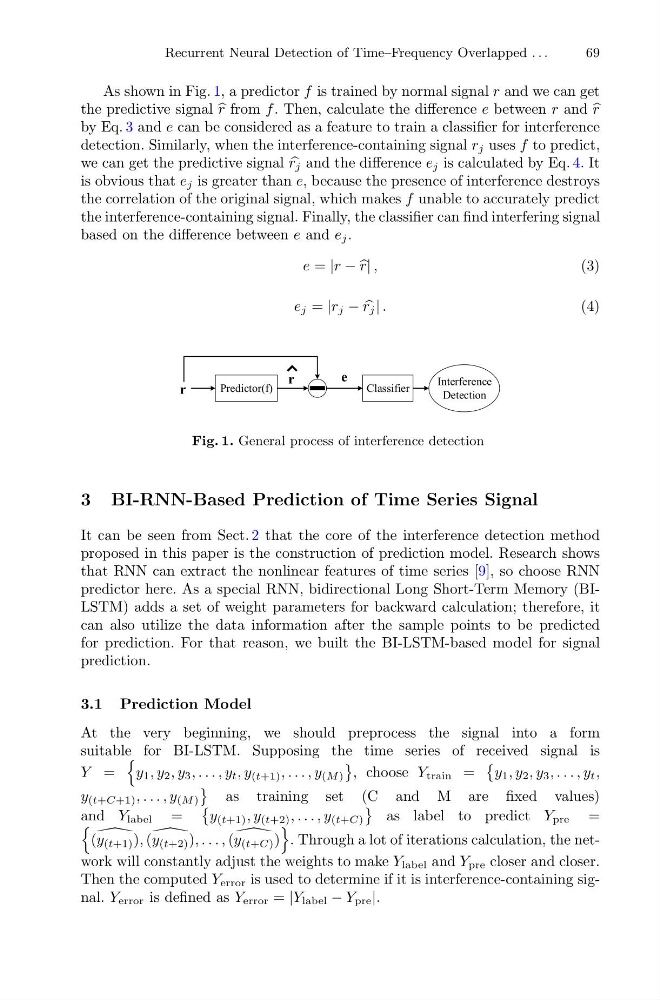
As shown in Fig. 1, a predictor f is trained by normal signal r and we can get
the predictive signal
r from f . Then, calculate the difference e between r and
r
by Eq. 3 and e can be considered as a feature to train a classifier for interference
detection. Similarly, when the interference-containing signal r j uses f to predict,
we can get the predictive signal
r j and the difference e j is calculated by Eq. 4. It
is obvious that e j is greater than e, because the presence of interference destroys
the correlation of the original signal, which makes f unable to accurately predict
the interference-containing signal. Finally, the classifier can find interfering signal
based on the difference between e and e j .
e = |r −
r| ,
(3)
e j = |r j −
r j | .
(4)
Fig. 1. General process of interference detection
3 BI-RNN-Based Prediction of Time Series Signal
It can be seen from Sect. 2 that the core of the interference detection method
proposed in this paper is the construction of prediction model. Research shows
that RNN can extract the nonlinear features of time series [9], so choose RNN
predictor here. As a special RNN, bidirectional Long Short-Term Memory (BILSTM) adds a set of weight parameters for backward calculation; therefore, it
can also utilize the data information after the sample points to be predicted
for prediction. For that reason, we built the BI-LSTM-based model for signal
prediction.
3.1 Prediction Model
At the very beginning, we should preprocess the signal into a form
suitable for BI-LSTM. Supposing the time series of received signal is
Y =
y 1 , y 2 , y 3 , . . . , y t , y (t+1) , . . . , y (M )
, choose Y train =
y 1 , y 2 , y 3 , . . . , y t ,
y (t+C+1) , . . . , y (M )
as training set (C and M are fixed values)
and Y label =
y (t+1) , y (t+2) , . . . , y (t+C)
as label to predict Y pre =
(y (t+1) ),
(y (t+2) ), . . . ,
(y (t+C) )
. Through a lot of iterations calculation, the network will constantly adjust the weights to make Y label and Y pre closer and closer.
Then the computed Y error is used to determine if it is interference-containing signal. Y error is defined as Y error = |Y label − Y pre |.
69
As shown in Fig. 1, a predictor f is trained by normal signal r and we can get
the predictive signal
r from f . Then, calculate the difference e between r and
r
by Eq. 3 and e can be considered as a feature to train a classifier for interference
detection. Similarly, when the interference-containing signal r j uses f to predict,
we can get the predictive signal
r j and the difference e j is calculated by Eq. 4. It
is obvious that e j is greater than e, because the presence of interference destroys
the correlation of the original signal, which makes f unable to accurately predict
the interference-containing signal. Finally, the classifier can find interfering signal
based on the difference between e and e j .
e = |r −
r| ,
(3)
e j = |r j −
r j | .
(4)
Fig. 1. General process of interference detection
3 BI-RNN-Based Prediction of Time Series Signal
It can be seen from Sect. 2 that the core of the interference detection method
proposed in this paper is the construction of prediction model. Research shows
that RNN can extract the nonlinear features of time series [9], so choose RNN
predictor here. As a special RNN, bidirectional Long Short-Term Memory (BILSTM) adds a set of weight parameters for backward calculation; therefore, it
can also utilize the data information after the sample points to be predicted
for prediction. For that reason, we built the BI-LSTM-based model for signal
prediction.
3.1 Prediction Model
At the very beginning, we should preprocess the signal into a form
suitable for BI-LSTM. Supposing the time series of received signal is
Y =
y 1 , y 2 , y 3 , . . . , y t , y (t+1) , . . . , y (M )
, choose Y train =
y 1 , y 2 , y 3 , . . . , y t ,
y (t+C+1) , . . . , y (M )
as training set (C and M are fixed values)
and Y label =
y (t+1) , y (t+2) , . . . , y (t+C)
as label to predict Y pre =
(y (t+1) ),
(y (t+2) ), . . . ,
(y (t+C) )
. Through a lot of iterations calculation, the network will constantly adjust the weights to make Y label and Y pre closer and closer.
Then the computed Y error is used to determine if it is interference-containing signal. Y error is defined as Y error = |Y label − Y pre |.