

meet agz t
½ ¼
X t
tÀ300
int agz t
½ \AN
ð
Þ
ð 15Þ
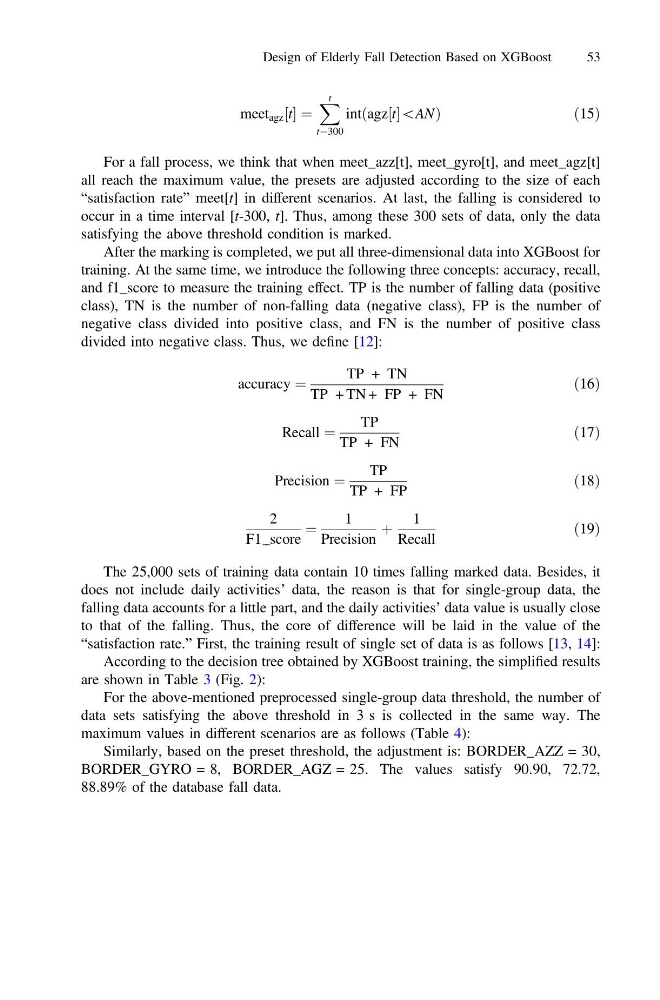
For a fall process, we think that when meet_azz[t], meet_gyro[t], and meet_agz[t]
all reach the maximum value, the presets are adjusted according to the size of each
“satisfaction rate” meet[t] in different scenarios. At last, the falling is considered to
occur in a time interval [t-300, t]. Thus, among these 300 sets of data, only the data
satisfying the above threshold condition is marked.
After the marking is completed, we put all three-dimensional data into XGBoost for
training. At the same time, we introduce the following three concepts: accuracy, recall,
and f1_score to measure the training effect. TP is the number of falling data (positive
class), TN is the number of non-falling data (negative class), FP is the number of
negative class divided into positive class, and FN is the number of positive class
divided into negative class. Thus, we define [12]:
accuracy ¼
TP + TN
TP + TN + FP + FN
ð16Þ
Recall ¼
TP
TP + FN
ð17Þ
Precision ¼
TP
TP + FP
ð18Þ
2
F1 score
¼
1
Precision
þ
1
Recall
ð19Þ
The 25,000 sets of training data contain 10 times falling marked data. Besides, it
does not include daily activities’ data, the reason is that for single-group data, the
falling data accounts for a little part, and the daily activities’ data value is usually close
to that of the falling. Thus, the core of difference will be laid in the value of the
“satisfaction rate.” First, the training result of single set of data is as follows [13, 14]:
According to the decision tree obtained by XGBoost training, the simplified results
are shown in Table 3 (Fig. 2):
For the above-mentioned preprocessed single-group data threshold, the number of
data sets satisfying the above threshold in 3 s is collected in the same way. The
maximum values in different scenarios are as follows (Table 4):
Similarly, based on the preset threshold, the adjustment is: BORDER_AZZ = 30,
BORDER_GYRO = 8, BORDER_AGZ = 25. The values satisfy 90.90, 72.72,
88.89% of the database fall data.
Design of Elderly Fall Detection Based on XGBoost
53
½ ¼
X t
tÀ300
int agz t
½ \AN
ð
Þ
ð 15Þ
For a fall process, we think that when meet_azz[t], meet_gyro[t], and meet_agz[t]
all reach the maximum value, the presets are adjusted according to the size of each
“satisfaction rate” meet[t] in different scenarios. At last, the falling is considered to
occur in a time interval [t-300, t]. Thus, among these 300 sets of data, only the data
satisfying the above threshold condition is marked.
After the marking is completed, we put all three-dimensional data into XGBoost for
training. At the same time, we introduce the following three concepts: accuracy, recall,
and f1_score to measure the training effect. TP is the number of falling data (positive
class), TN is the number of non-falling data (negative class), FP is the number of
negative class divided into positive class, and FN is the number of positive class
divided into negative class. Thus, we define [12]:
accuracy ¼
TP + TN
TP + TN + FP + FN
ð16Þ
Recall ¼
TP
TP + FN
ð17Þ
Precision ¼
TP
TP + FP
ð18Þ
2
F1 score
¼
1
Precision
þ
1
Recall
ð19Þ
The 25,000 sets of training data contain 10 times falling marked data. Besides, it
does not include daily activities’ data, the reason is that for single-group data, the
falling data accounts for a little part, and the daily activities’ data value is usually close
to that of the falling. Thus, the core of difference will be laid in the value of the
“satisfaction rate.” First, the training result of single set of data is as follows [13, 14]:
According to the decision tree obtained by XGBoost training, the simplified results
are shown in Table 3 (Fig. 2):
For the above-mentioned preprocessed single-group data threshold, the number of
data sets satisfying the above threshold in 3 s is collected in the same way. The
maximum values in different scenarios are as follows (Table 4):
Similarly, based on the preset threshold, the adjustment is: BORDER_AZZ = 30,
BORDER_GYRO = 8, BORDER_AGZ = 25. The values satisfy 90.90, 72.72,
88.89% of the database fall data.
Design of Elderly Fall Detection Based on XGBoost
53