

In this experiment, t = 4, k = 15 are selected to compare the SAD values between
the real spectrum and the estimated spectrum obtained by the three algorithms as shown
in Table 2. It can be shown in Table 2 that the optimal ESAD is obtained by the
proposed algorithm, as shown in bold.
5 Conclusion
Aiming at the nonlinear characteristics of hyperspectral data, a novel endmember
extraction method of hyperspectral image based on nonlinear dimensionality reduction
of Euclidean distance is proposed. This method considers the physical characteristics of
hyperspectral data and introduces Euclidean distance into the nonlinear dimensionality
reduction algorithm of local tangent space arrangement to better remove redundant
spatial information and spectral dimensional information in hyperspectral data sets.
Experiments on real hyperspectral data show that the proposed method has a good
effect on hyperspectral image endmember extraction, and its performance is better than
that of linear dimensionality reduction PCA and original LTSA algorithm. Due to the
Euclidean distance of the image, the complexity of the algorithm increases. How to
improve the efficiency of the algorithm needs further study.
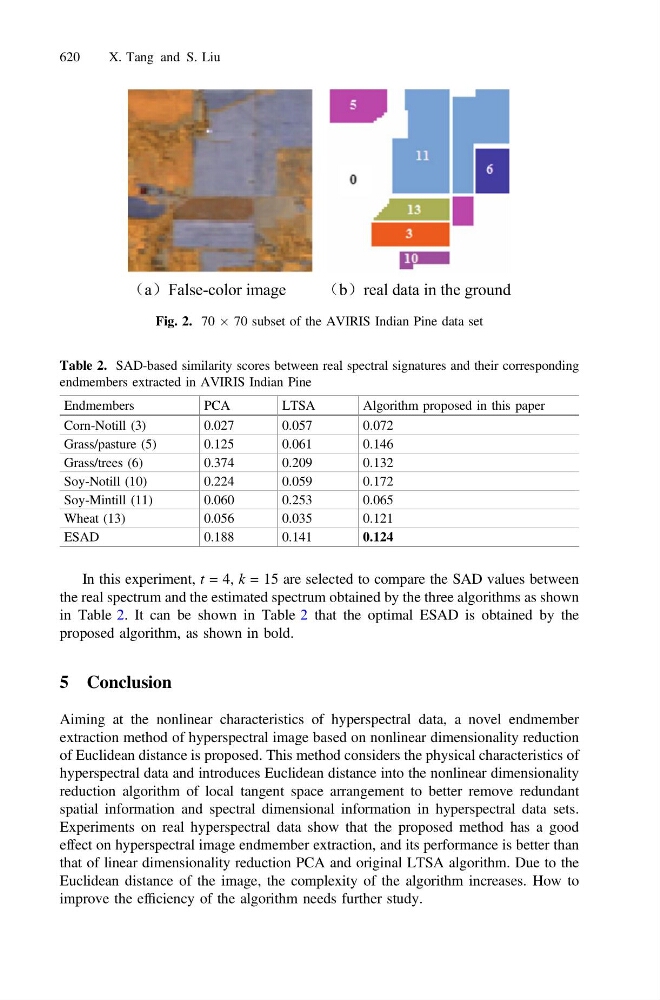
Fig. 2. 70 Â 70 subset of the AVIRIS Indian Pine data set
Table 2. SAD-based similarity scores between real spectral signatures and their corresponding
endmembers extracted in AVIRIS Indian Pine
Endmembers
PCA
LTSA
Algorithm proposed in this paper
Corn-Notill (3)
0.027
0.057
0.072
Grass/pasture (5)
0.125
0.061
0.146
Grass/trees (6)
0.374
0.209
0.132
Soy-Notill (10)
0.224
0.059
0.172
Soy-Mintill (11)
0.060
0.253
0.065
Wheat (13)
0.056
0.035
0.121
ESAD
0.188
0.141
0.124
620
X. Tang and S. Liu