

size is determined by the number of sampling segments and sampling points are
obtained. After time–frequency analysis, the discrimination of the two types of data
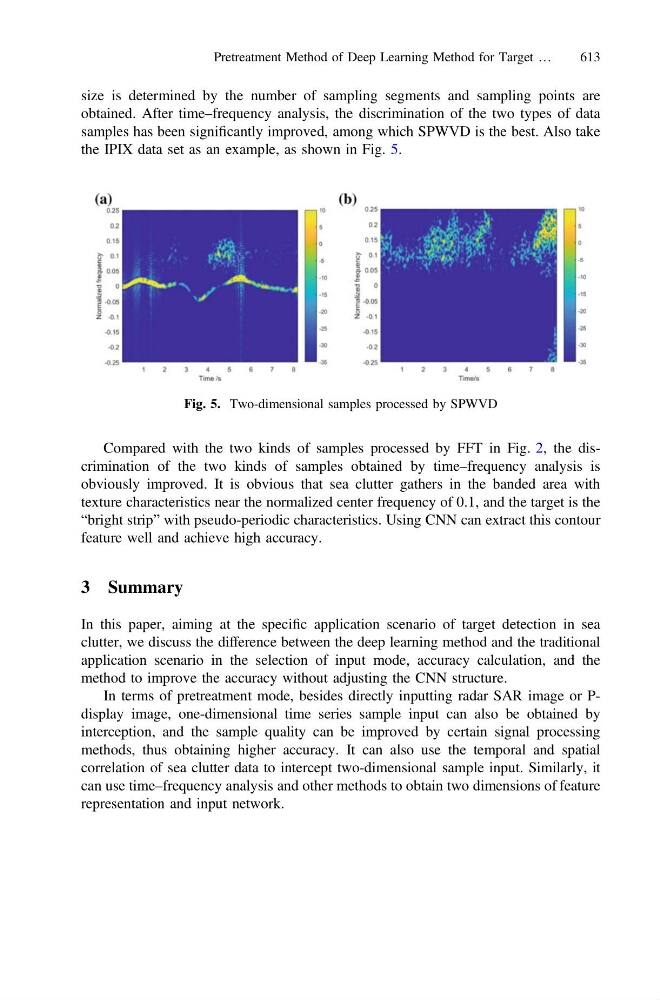
samples has been significantly improved, among which SPWVD is the best. Also take
the IPIX data set as an example, as shown in Fig. 5.
Compared with the two kinds of samples processed by FFT in Fig. 2, the discrimination of the two kinds of samples obtained by time–frequency analysis is
obviously improved. It is obvious that sea clutter gathers in the banded area with
texture characteristics near the normalized center frequency of 0.1, and the target is the
“bright strip” with pseudo-periodic characteristics. Using CNN can extract this contour
feature well and achieve high accuracy.
3 Summary
In this paper, aiming at the specific application scenario of target detection in sea
clutter, we discuss the difference between the deep learning method and the traditional
application scenario in the selection of input mode, accuracy calculation, and the
method to improve the accuracy without adjusting the CNN structure.
In terms of pretreatment mode, besides directly inputting radar SAR image or Pdisplay image, one-dimensional time series sample input can also be obtained by
interception, and the sample quality can be improved by certain signal processing
methods, thus obtaining higher accuracy. It can also use the temporal and spatial
correlation of sea clutter data to intercept two-dimensional sample input. Similarly, it
can use time–frequency analysis and other methods to obtain two dimensions of feature
representation and input network.
Fig. 5. Two-dimensional samples processed by SPWVD
Pretreatment Method of Deep Learning Method for Target …
613