

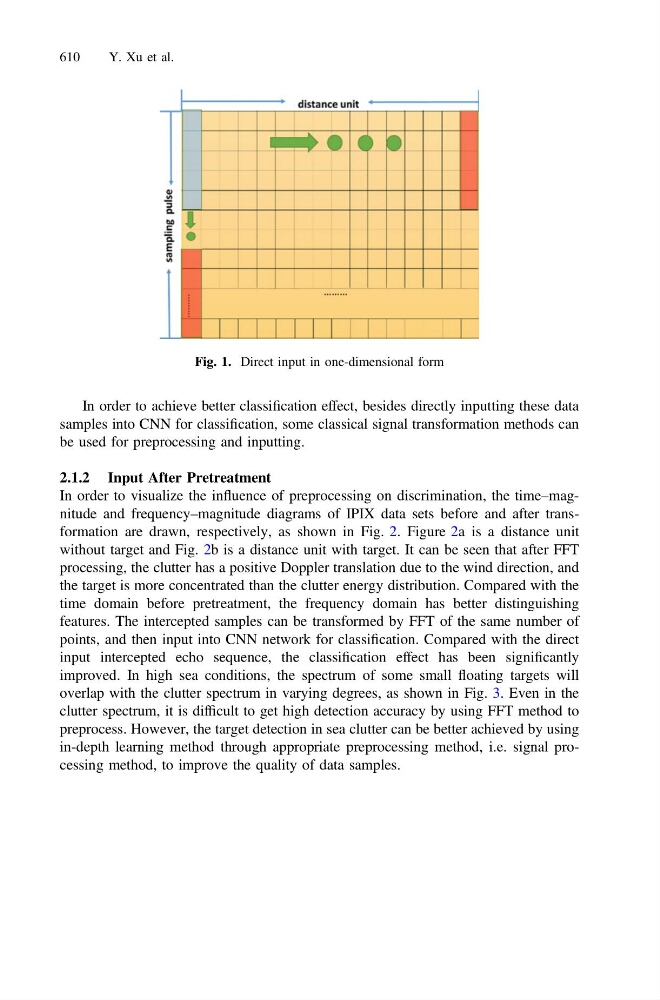
In order to achieve better classification effect, besides directly inputting these data
samples into CNN for classification, some classical signal transformation methods can
be used for preprocessing and inputting.
2.1.2 Input After Pretreatment
In order to visualize the influence of preprocessing on discrimination, the time–magnitude and frequency–magnitude diagrams of IPIX data sets before and after transformation are drawn, respectively, as shown in Fig. 2. Figure 2a is a distance unit
without target and Fig. 2b is a distance unit with target. It can be seen that after FFT
processing, the clutter has a positive Doppler translation due to the wind direction, and
the target is more concentrated than the clutter energy distribution. Compared with the
time domain before pretreatment, the frequency domain has better distinguishing
features. The intercepted samples can be transformed by FFT of the same number of
points, and then input into CNN network for classification. Compared with the direct
input intercepted echo sequence, the classification effect has been significantly
improved. In high sea conditions, the spectrum of some small floating targets will
overlap with the clutter spectrum in varying degrees, as shown in Fig. 3. Even in the
clutter spectrum, it is difficult to get high detection accuracy by using FFT method to
preprocess. However, the target detection in sea clutter can be better achieved by using
in-depth learning method through appropriate preprocessing method, i.e. signal processing method, to improve the quality of data samples.
Fig. 1. Direct input in one-dimensional form
610
Y. Xu et al.