

(3) Bus-based scheme: The bus-based parallelization scheme is the most seriously
affected by the transmission time. As Fig. 2b shows, bus-based scheme with four
execution units in a 10 MB/s environment is not even as fast as a single process,
and overall, it is slower than a pipeline-based solution. The reasons for this include:
First, the design of the bus-based solution is based on frequent message transmission for more uniform execution, so it is particularly affected by the transmission speed; second, for being more precise to control the operation time, the
execution unit needs to report to the control unit after the execution of the current
processing step, and the address of the execution unit of the next step is to be
obtained from the execution unit, so that the transmission time cannot be covered
by the execution time, thereby causing the effect of transmission time is further
amplified.
4 Conclusion
Based on the existing CAD system, this paper conducts a parallelization study on the
preprocessing part of the system to find out the time-consuming parallelization that can
most effectively reduce the preprocessing time.
We propose three parallelization schemes from the aspects of data and instructions,
and tested these three schemes on an existing CAD system at the end of the paper.
Firstly, we tested the static grouping-based scheme, and a good result was obtained.
The processing time was shortened by making full use of the computing power of the
processor. The pipeline-based scheme was then tested, and the process of repairing the
lung parenchyma took too much time, causing the entire pipeline to be blocked at this
stage, resulting in poor performance. Finally, a bus-based scheme is tested. The performance is similar to that of static data-based scheme. When the execution unit is
small, the processing is slightly more, but the execution efficiency can be maintained as
the execution unit increases. Compared with the three schemes, the pipeline-based
parallelization architecture cannot achieve the desired results due to the uneven timeconsuming distribution of the stages before the reduction of false positives stage in the
CAD system; the static grouping-based scheme performs best, but with the number of
execution units increasing, the execution time is affected by the unevenness of the
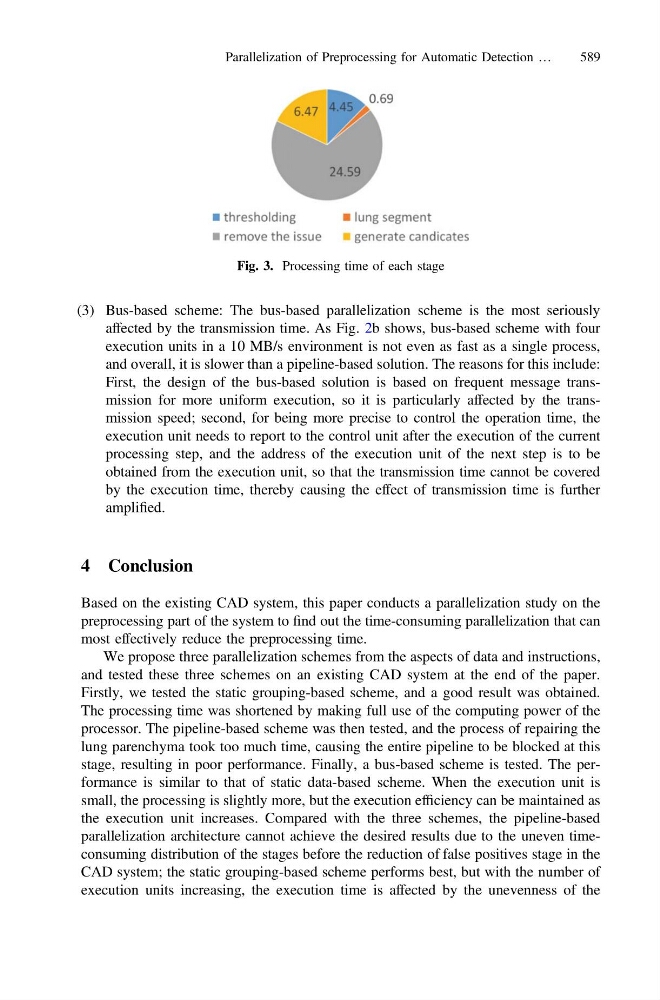
Fig. 3. Processing time of each stage
Parallelization of Preprocessing for Automatic Detection …
589