

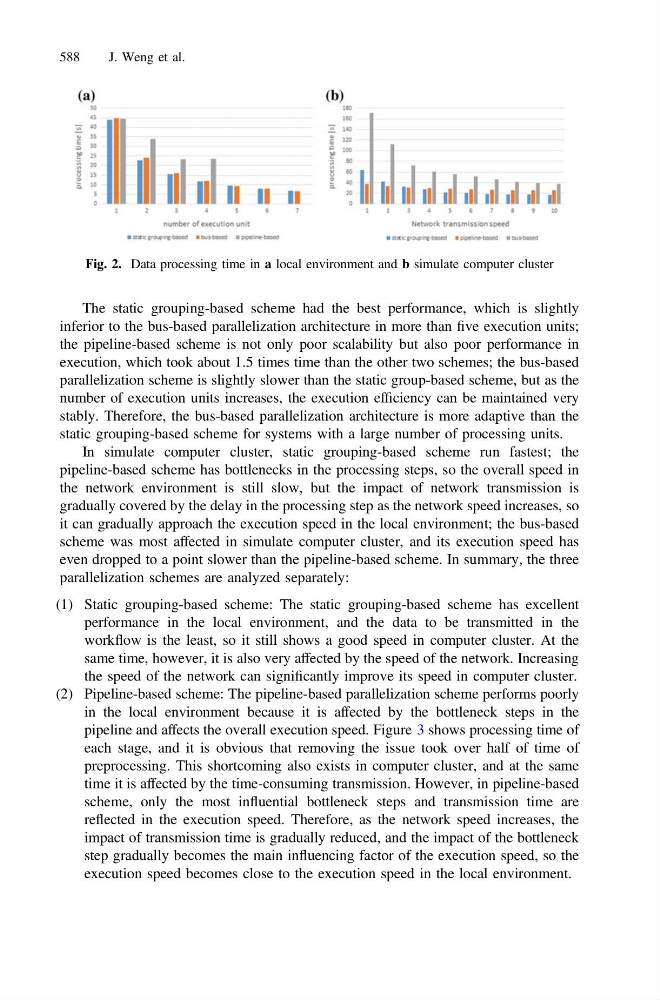
The static grouping-based scheme had the best performance, which is slightly
inferior to the bus-based parallelization architecture in more than five execution units;
the pipeline-based scheme is not only poor scalability but also poor performance in
execution, which took about 1.5 times time than the other two schemes; the bus-based
parallelization scheme is slightly slower than the static group-based scheme, but as the
number of execution units increases, the execution efficiency can be maintained very
stably. Therefore, the bus-based parallelization architecture is more adaptive than the
static grouping-based scheme for systems with a large number of processing units.
In simulate computer cluster, static grouping-based scheme run fastest; the
pipeline-based scheme has bottlenecks in the processing steps, so the overall speed in
the network environment is still slow, but the impact of network transmission is
gradually covered by the delay in the processing step as the network speed increases, so
it can gradually approach the execution speed in the local environment; the bus-based
scheme was most affected in simulate computer cluster, and its execution speed has
even dropped to a point slower than the pipeline-based scheme. In summary, the three
parallelization schemes are analyzed separately:
(1) Static grouping-based scheme: The static grouping-based scheme has excellent
performance in the local environment, and the data to be transmitted in the
workflow is the least, so it still shows a good speed in computer cluster. At the
same time, however, it is also very affected by the speed of the network. Increasing
the speed of the network can significantly improve its speed in computer cluster.
(2) Pipeline-based scheme: The pipeline-based parallelization scheme performs poorly
in the local environment because it is affected by the bottleneck steps in the
pipeline and affects the overall execution speed. Figure 3 shows processing time of
each stage, and it is obvious that removing the issue took over half of time of
preprocessing. This shortcoming also exists in computer cluster, and at the same
time it is affected by the time-consuming transmission. However, in pipeline-based
scheme, only the most influential bottleneck steps and transmission time are
reflected in the execution speed. Therefore, as the network speed increases, the
impact of transmission time is gradually reduced, and the impact of the bottleneck
step gradually becomes the main influencing factor of the execution speed, so the
execution speed becomes close to the execution speed in the local environment.
Fig. 2. Data processing time in a local environment and b simulate computer cluster
588
J. Weng et al.