

features between image data. RPnet [15] uses convolutional neural networks to generate high-quality regions for detection to detect objects more accurately and quickly.
However, in numerous challenging and complex scenes, the detection model tends to
have a sharp drop in accuracy. Moreover, the complicated of the model and the large
number of parameters lead to the long training time and the slow detection speed. We
designed a new detection model to use the convolutional neural network to complete
the license plate position detection. Based on the simpler model architecture, the
detection efficiency is improved under the premise of ensuring the detection accuracy.
This paper makes the following contributions:
– We proposed a new detection model named CMnet. The model is consisting of five
convolutional layers, and we can accurately detect the license plate at a faster speed.
– During the training, we connect the deconvolution network behind each convolutional layer to visualize the extracted image features. The structure of the network
model is adjusted and optimized in this way in order to achieve higher accuracy
with a compact model.
– Through experiments, we have proved that our model is superior to other methods
in terms of accuracy and speed.
2 A Compact Model for LP Detection
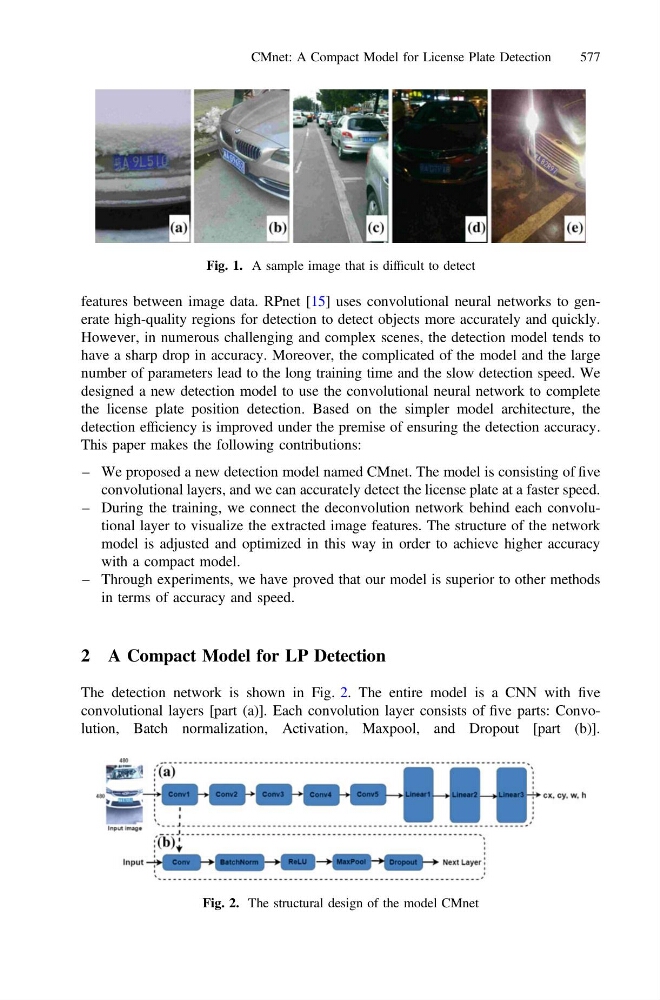
The detection network is shown in Fig. 2. The entire model is a CNN with five
convolutional layers [part (a)]. Each convolution layer consists of five parts: Convolution, Batch normalization, Activation, Maxpool, and Dropout [part (b)].
Fig. 1. A sample image that is difficult to detect
Fig. 2. The structural design of the model CMnet
CMnet: A Compact Model for License Plate Detection
577