

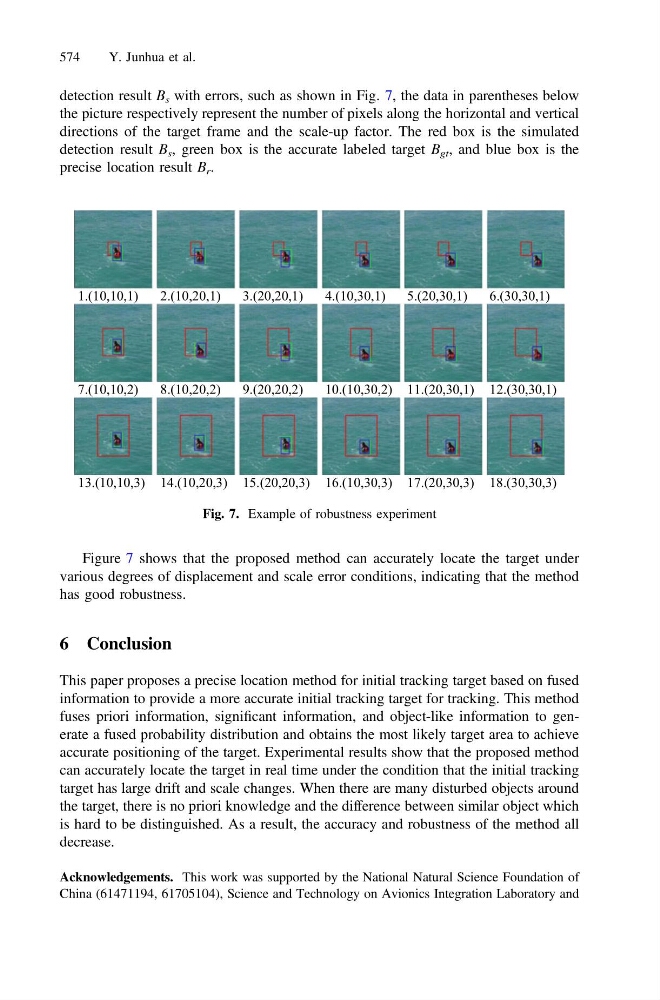
detection result B s with errors, such as shown in Fig. 7, the data in parentheses below
the picture respectively represent the number of pixels along the horizontal and vertical
directions of the target frame and the scale-up factor. The red box is the simulated
detection result B s , green box is the accurate labeled target B gt , and blue box is the
precise location result B r .
Figure 7 shows that the proposed method can accurately locate the target under
various degrees of displacement and scale error conditions, indicating that the method
has good robustness.
6 Conclusion
This paper proposes a precise location method for initial tracking target based on fused
information to provide a more accurate initial tracking target for tracking. This method
fuses priori information, significant information, and object-like information to generate a fused probability distribution and obtains the most likely target area to achieve
accurate positioning of the target. Experimental results show that the proposed method
can accurately locate the target in real time under the condition that the initial tracking
target has large drift and scale changes. When there are many disturbed objects around
the target, there is no priori knowledge and the difference between similar object which
is hard to be distinguished. As a result, the accuracy and robustness of the method all
decrease.
Acknowledgements. This work was supported by the National Natural Science Foundation of
China (61471194, 61705104), Science and Technology on Avionics Integration Laboratory and
1.(10,10,1)
2.(10,20,1)
3.(20,20,1)
4.(10,30,1)
5.(20,30,1)
6.(30,30,1)
7.(10,10,2)
8.(10,20,2)
9.(20,20,2)
10.(10,30,2) 11.(20,30,1) 12.(30,30,1)
13.(10,10,3) 14.(10,20,3) 15.(20,20,3) 16.(10,30,3) 17.(20,30,3) 18.(30,30,3)
Fig. 7. Example of robustness experiment
574
Y. Junhua et al.