

different regions, Ot L calls Ot G or Ot G-S to realize interoperability of the local
ontologies and then provides semantic data support for Agent communication in different regions.
In summary, the five-tuple and three-tuple representations of CO are obtained:
CO ¼ Ot OÀl ; Ot IÀl ; Ot OÀg ; Ot IÀg ; Ot GÀS
À
Á ) K
Onto
ð1Þ
CO ¼ Ot L ; Ot G ; Ot GÀS
ð
Þ ) K
Onto
ð2Þ
5 Calling Mechanism of CO
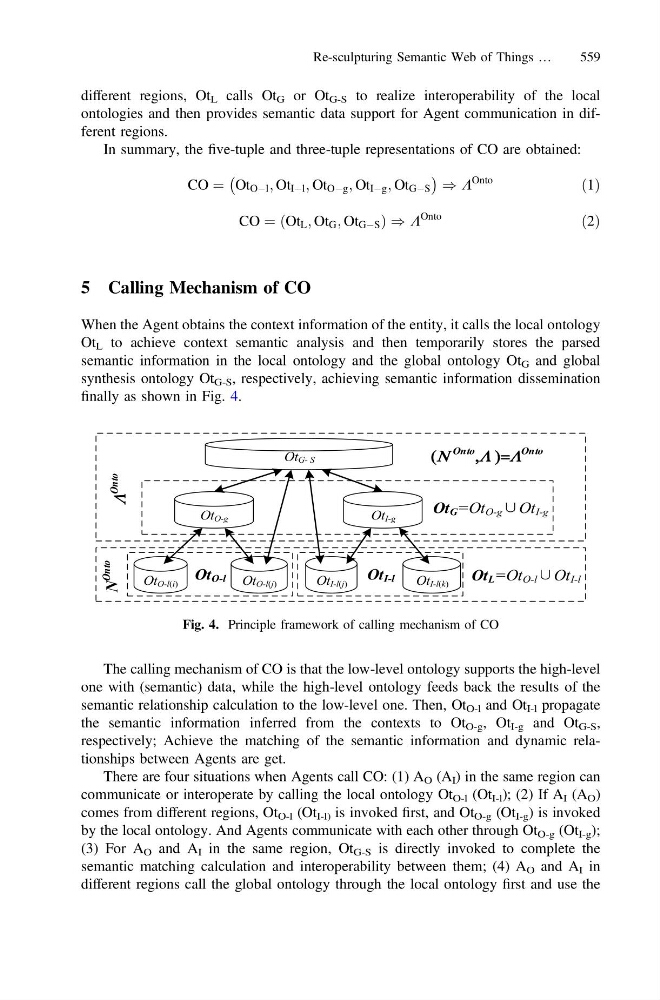
When the Agent obtains the context information of the entity, it calls the local ontology
Ot L to achieve context semantic analysis and then temporarily stores the parsed
semantic information in the local ontology and the global ontology Ot G and global
synthesis ontology Ot G-S , respectively, achieving semantic information dissemination
finally as shown in Fig. 4.
The calling mechanism of CO is that the low-level ontology supports the high-level
one with (semantic) data, while the high-level ontology feeds back the results of the
semantic relationship calculation to the low-level one. Then, Ot O-l and Ot I-l propagate
the semantic information inferred from the contexts to Ot O-g , Ot I-g and Ot G-S ,
respectively; Achieve the matching of the semantic information and dynamic relationships between Agents are get.
There are four situations when Agents call CO: (1) A O (A I ) in the same region can
communicate or interoperate by calling the local ontology Ot O-l (Ot I-l ); (2) If A I (A O )
comes from different regions, Ot O-l (Ot I-l) is invoked first, and Ot O-g (Ot I-g ) is invoked
by the local ontology. And Agents communicate with each other through Ot O-g (Ot I-g );
(3) For A O and A I in the same region, Ot G-S is directly invoked to complete the
semantic matching calculation and interoperability between them; (4) A O and A I in
different regions call the global ontology through the local ontology first and use the
Fig. 4. Principle framework of calling mechanism of CO
Re-sculpturing Semantic Web of Things …
559