

The main works of realizing dynamic relationships are (1) communication and dynamic
relationships reasoning between A I in the same location; (2) communication and
dynamic relationships reasoning between A I and A O in different locations; (3) reasoning between A I and A O in the same region and (4) communication and dynamic
relationships reasoning between A I and A O in different locations
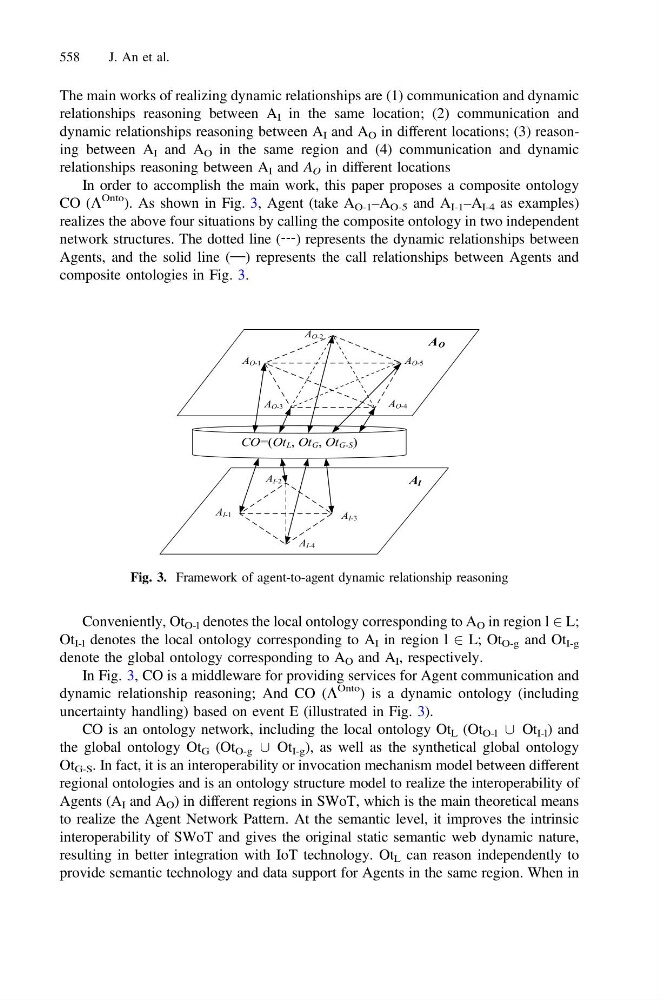
In order to accomplish the main work, this paper proposes a composite ontology
CO (K
Onto
). As shown in Fig. 3, Agent (take A O-1 –A O-5 and A I-1 –A I-4 as examples)
realizes the above four situations by calling the composite ontology in two independent
network structures. The dotted line (┄) represents the dynamic relationships between
Agents, and the solid line (─) represents the call relationships between Agents and
composite ontologies in Fig. 3.
Conveniently, Ot O-l denotes the local ontology corresponding to A O in region l 2 L;
Ot I-l denotes the local ontology corresponding to A I in region l 2 L; Ot O-g and Ot I-g
denote the global ontology corresponding to A O and A I , respectively.
In Fig. 3, CO is a middleware for providing services for Agent communication and
dynamic relationship reasoning; And CO (K
Onto
) is a dynamic ontology (including
uncertainty handling) based on event E (illustrated in Fig. 3).
CO is an ontology network, including the local ontology Ot L (Ot O-l [ Ot I-l ) and
the global ontology Ot G (Ot O-g [ Ot I-g ), as well as the synthetical global ontology
Ot G-S . In fact, it is an interoperability or invocation mechanism model between different
regional ontologies and is an ontology structure model to realize the interoperability of
Agents (A I and A O ) in different regions in SWoT, which is the main theoretical means
to realize the Agent Network Pattern. At the semantic level, it improves the intrinsic
interoperability of SWoT and gives the original static semantic web dynamic nature,
resulting in better integration with IoT technology. Ot L can reason independently to
provide semantic technology and data support for Agents in the same region. When in
AI-1
AI-2
AI-4
AI-3
CO=(Ot L , Ot G , Ot G-S )
AO-2
AO-1
AO-5
AO-3
AO-4
A O
A I
Fig. 3. Framework of agent-to-agent dynamic relationship reasoning
558
J. An et al.