

544
M. Ma et al.
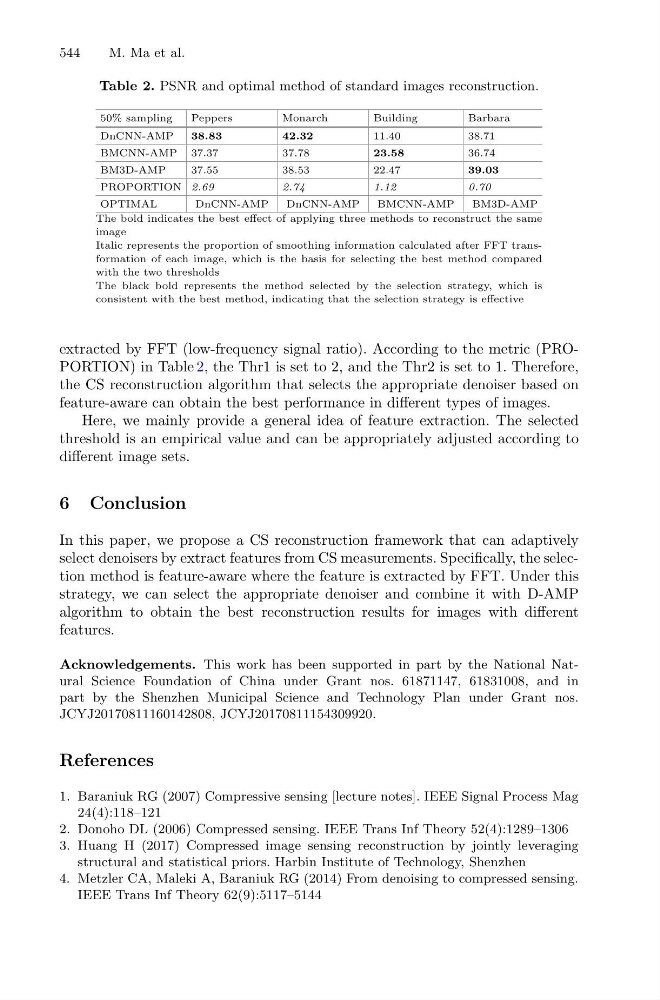
Table 2. PSNR and optimal method of standard images reconstruction.
50% sampling
Peppers
Monarch
Building
Barbara
DnCNN-AMP
38.83
42.32
11.40
38.71
BMCNN-AMP 37.37
37.78
23.58
36.74
BM3D-AMP
37.55
38.53
22.47
39.03
PROPORTION 2.69
2.74
1.12
0.70
OPTIMAL
DnCNN-AMP
DnCNN-AMP
BMCNN-AMP
BM3D-AMP
The bold indicates the best effect of applying three methods to reconstruct the same
image
Italic represents the proportion of smoothing information calculated after FFT transformation of each image, which is the basis for selecting the best method compared
with the two thresholds
The black bold represents the method selected by the selection strategy, which is
consistent with the best method, indicating that the selection strategy is effective
extracted by FFT (low-frequency signal ratio). According to the metric (PROPORTION) in Table 2, the Thr1 is set to 2, and the Thr2 is set to 1. Therefore,
the CS reconstruction algorithm that selects the appropriate denoiser based on
feature-aware can obtain the best performance in different types of images.
Here, we mainly provide a general idea of feature extraction. The selected
threshold is an empirical value and can be appropriately adjusted according to
different image sets.
6 Conclusion
In this paper, we propose a CS reconstruction framework that can adaptively
select denoisers by extract features from CS measurements. Specifically, the selection method is feature-aware where the feature is extracted by FFT. Under this
strategy, we can select the appropriate denoiser and combine it with D-AMP
algorithm to obtain the best reconstruction results for images with different
features.
Acknowledgements. This work has been supported in part by the National Natural Science Foundation of China under Grant nos. 61871147, 61831008, and in
part by the Shenzhen Municipal Science and Technology Plan under Grant nos.
JCYJ20170811160142808, JCYJ20170811154309920.
References
1. Baraniuk RG (2007) Compressive sensing [lecture notes]. IEEE Signal Process Mag
24(4):118–121
2. Donoho DL (2006) Compressed sensing. IEEE Trans Inf Theory 52(4):1289–1306
3. Huang H (2017) Compressed image sensing reconstruction by jointly leveraging
structural and statistical priors. Harbin Institute of Technology, Shenzhen
4. Metzler CA, Maleki A, Baraniuk RG (2014) From denoising to compressed sensing.
IEEE Trans Inf Theory 62(9):5117–5144