

Feature-Aware Adaptive Denoiser-Selection for Compressed . . .
541
BMCNN is an image denoising algorithm which shows advantages in both
regular and irregular features through combining the non-local self-similarity and
neural network. As is shown in Eq. (6), BMCNN simulates the 3D collaborative
filtering process of similar patches by residual network (φ(z 3D ; θ)) to obtain the
estimation of the reference patch (z r ).
ˆ
x = z r − φ(z 3D ; θ).
(6)
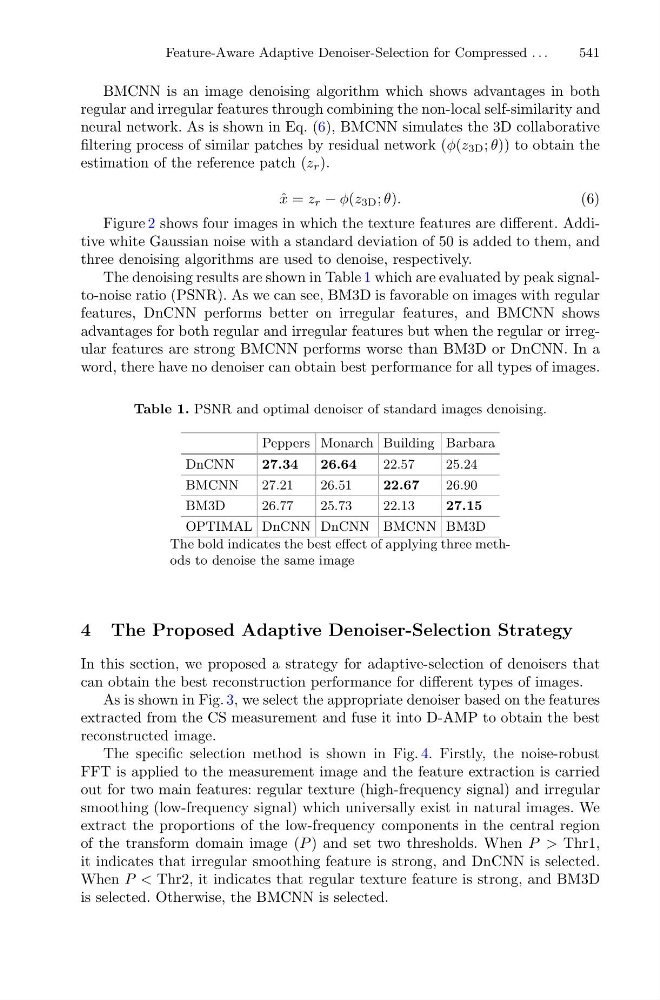
Figure 2 shows four images in which the texture features are different. Additive white Gaussian noise with a standard deviation of 50 is added to them, and
three denoising algorithms are used to denoise, respectively.
The denoising results are shown in Table 1 which are evaluated by peak signalto-noise ratio (PSNR). As we can see, BM3D is favorable on images with regular
features, DnCNN performs better on irregular features, and BMCNN shows
advantages for both regular and irregular features but when the regular or irregular features are strong BMCNN performs worse than BM3D or DnCNN. In a
word, there have no denoiser can obtain best performance for all types of images.
Table 1. PSNR and optimal denoiser of standard images denoising.
Peppers Monarch Building Barbara
DnCNN
27.34
26.64
22.57
25.24
BMCNN
27.21
26.51
22.67
26.90
BM3D
26.77
25.73
22.13
27.15
OPTIMAL DnCNN DnCNN BMCNN BM3D
The bold indicates the best effect of applying three methods to denoise the same image
4 The Proposed Adaptive Denoiser-Selection Strategy
In this section, we proposed a strategy for adaptive-selection of denoisers that
can obtain the best reconstruction performance for different types of images.
As is shown in Fig. 3, we select the appropriate denoiser based on the features
extracted from the CS measurement and fuse it into D-AMP to obtain the best
reconstructed image.
The specific selection method is shown in Fig. 4. Firstly, the noise-robust
FFT is applied to the measurement image and the feature extraction is carried
out for two main features: regular texture (high-frequency signal) and irregular
smoothing (low-frequency signal) which universally exist in natural images. We
extract the proportions of the low-frequency components in the central region
of the transform domain image (P ) and set two thresholds. When P > Thr1,
it indicates that irregular smoothing feature is strong, and DnCNN is selected.
When P < Thr2, it indicates that regular texture feature is strong, and BM3D
is selected. Otherwise, the BMCNN is selected.