

Feature-Aware Adaptive Denoiser-Selection for Compressed . . .
539
2 System Model of CS Image Reconstruction
In this section, we briefly introduce the system model of CS image reconstruction.
In the encoder, CS theory reduces the design difficulty of acquisition equipment and storage equipment, because the simple linear measurement is adopted
to combine the sampling and compression processes. In the decoder, CS theory
needs to solve the complex ill-posed inverse problem to reconstruct the original
signal which can be formulated as Eq. (1).
arg min
x
− Ax
2
2 ,
(1)
where x is the target image, A is the measurement matrix, y is the linear measurements of x, we use ˆ
x to denote the estimate of x and ˆ
y to denote the estimate
of y.
Therefore, the reconstruction problem has become the focus of the system
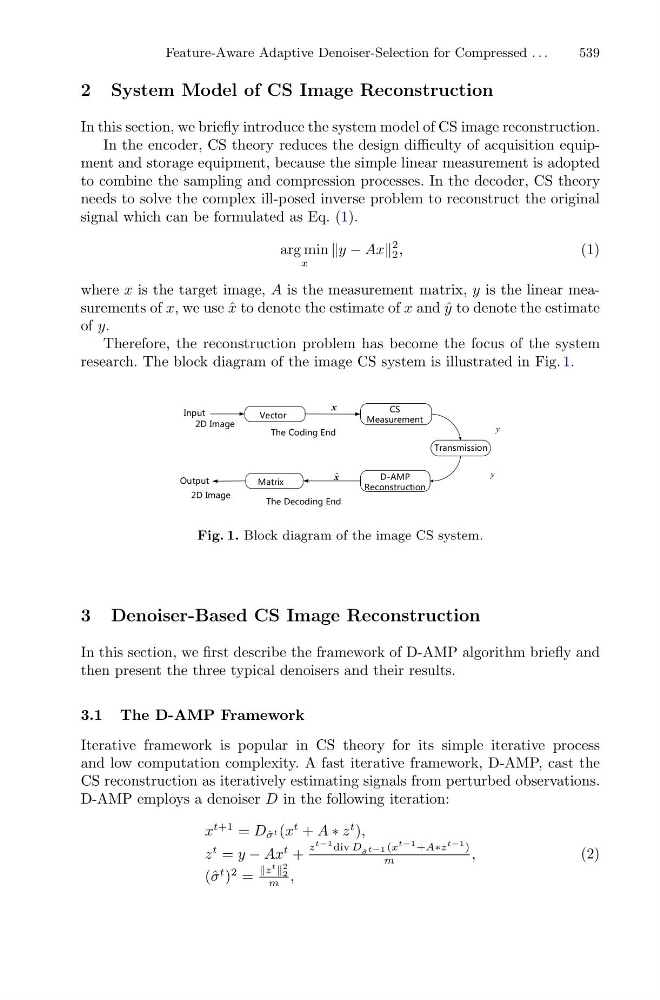
research. The block diagram of the image CS system is illustrated in Fig. 1.
Fig. 1. Block diagram of the image CS system.
3 Denoiser-Based CS Image Reconstruction
In this section, we first describe the framework of D-AMP algorithm briefly and
then present the three typical denoisers and their results.
3.1 The D-AMP Framework
Iterative framework is popular in CS theory for its simple iterative process
and low computation complexity. A fast iterative framework, D-AMP, cast the
CS reconstruction as iteratively estimating signals from perturbed observations.
D-AMP employs a denoiser D in the following iteration:
x
t+1 = D ˆ
σ t (x
t + A ∗ z
t ),
z
t = y − Ax
t +
z
t−1 div D ˆ
σ t−1 (x
t−1 +A∗z
t−1 )
m
,
(ˆ σ
t )
2 =
t
2
2
m ,
(2)